What the GL Pollution Exclusion Typically Removes
A commercial general liability policy is built around bodily injury and property damage caused by an occurrence, and the California Department of Insurance lists pollution among the major exclusions on a CGL policy. The exclusion carves out injury or damage arising from escaping pollutants, and the policy's own definition of pollutants is usually broad, reaching irritants and contaminants in solid, liquid, gaseous or thermal form, from smoke and fumes to chemicals and waste. Fuel, sediment and drilling fluid can fall inside it, depending on the wording and the facts.
The exclusion typically has a second part that matters as much as the first. It removes the cost of testing for, cleaning up, containing or removing pollutants when a government order, a statute or a claimant demands it, so even a release that injures no one can leave the contractor paying for the response. Policy definitions also differ from statutory ones: the federal Superfund definitions of a hazardous substance and of a pollutant or contaminant leave out petroleum unless it is specifically listed, while a GL pollutant definition commonly sweeps fuel in.
How a CPL form is read, from pollution conditions to covered operations, is explained on the main page for contractors pollution liability insurance.
The Carve-Backs and Why They Are Narrow
The standard exclusion is not total. Common forms keep a few exceptions, described here generally because wording differs by edition and carrier: injury inside a building from smoke or fumes produced by equipment used to heat that building, injury or damage from the heat, smoke or fumes of a hostile fire, and certain escapes of fuel or operating fluids from mobile equipment's own systems at a job site. Some forms also carve back limited indoor fumes from materials a contractor brings into a building for its work.
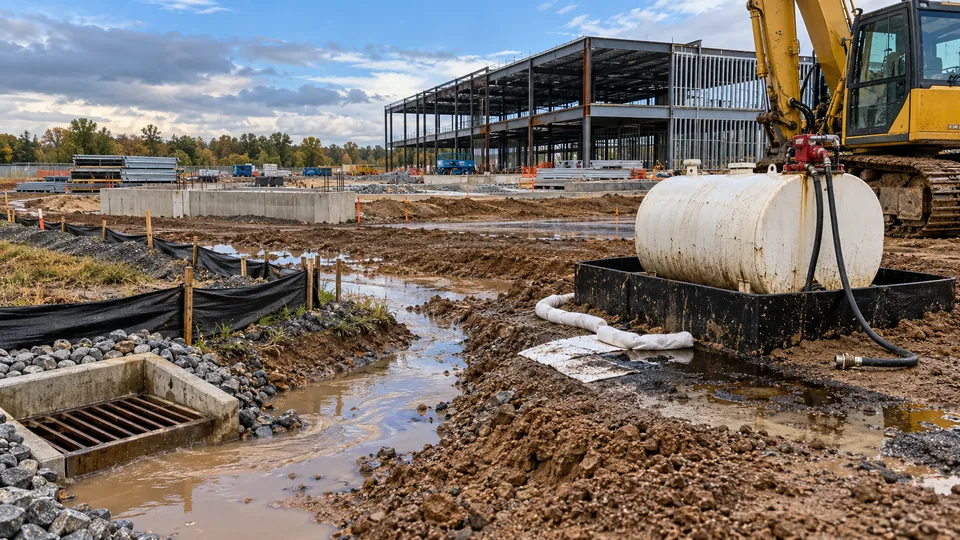
Each exception is tied to a narrow situation, such as where the release happened or whose equipment was involved. A fuel tank that leaks overnight, a slurry release or sediment leaving the site after a storm usually fits none of them. Many contractor programs go further and attach a total pollution endorsement, which removes most or all of the exceptions and may keep only the hostile fire language. Confirm which version is attached before assuming any carve-back applies.
For the underground version of that split, see how a struck line splits between GL and pollution claims.
Limited Pollution Endorsements on the GL
Some carriers sell an endorsement that gives a slice of pollution back to the GL. Common versions apply only to a release that begins and ends within a short window, is discovered within a set number of hours and is reported within a set number of days, or only to named situations. Many carry a sublimit and exclude gradual seepage. Where the sublimit sits inside the GL aggregate, each pollution payment also reduces the limit left for ordinary injury and property damage claims.
They can help with a small, sudden spill found and reported quickly, but they are a weak fit for grading, drilling, demolition and utility work, where releases are often discovered late, spread underground or involve material the contractor did not own. They also rarely satisfy a contract that names a pollution limit or asks for the owner to be insured on a pollution policy, so ask the owner in writing whether it will accept one before relying on it.
Whether a stand-alone policy is worth its cost next to an endorsement is weighed in how limits and endorsements move pollution pricing.
What a Contractors Pollution Policy Is Designed to Do
A contractors pollution liability policy starts where the GL exclusion ends. Its insuring agreement is usually written around pollution conditions arising from covered operations, and it may respond to third-party bodily injury and property damage, cleanup costs and defense. Many forms address cleanup a government orders, and some extend to voluntary or emergency cleanup. Endorsements can add transportation, non-owned disposal sites and mold, and many forms may respond when the contractor's work disturbs or spreads contamination that was already in the ground.
Regulators often start the clock. Nevada's spill rule, NAC 445A.347, requires the owner or operator of a facility, or its designated agent, to notify the state no later than the first working day after learning that a hazardous substance has turned up in at least 3 cubic yards of soil during excavation or in groundwater during subsurface work. Federal Superfund liability can reach parties that arranged for disposal or hauled material to a site they chose, and an indemnity cannot shift that liability away, which is one reason owners ask for the policy and not only the indemnity.
When grading opens soil nobody characterized, the developer's side is discussed under unknown contamination found during grading.
Comparing the Two Policies Row by Row
| Feature | Contractor's general liability | Contractors pollution liability |
|---|---|---|
| Trigger | Typically occurrence: injury or damage during the policy period, whenever the claim arrives | Occurrence or claims-made; a claims-made form turns on the retroactive date and reporting tail |
| Pollution exclusion | Standard exclusion with narrow carve-backs, or a total pollution endorsement removing most of them | Pollution is the purpose; exclusions target known conditions, specific materials, fines and unlisted operations |
| Cleanup costs | Typically excluded, including cleanup a regulator or claimant demands | Often included for government-ordered cleanup; voluntary or emergency cleanup depends on the form |
| Mold | Often removed by a separate fungi or bacteria exclusion | May sit in the pollution definition, carry a sublimit or be excluded unless written back |
| Completed operations | Finished work has its own aggregate, but pollution from it stays excluded | May extend to completed work for a stated period, or end with the policy and its reporting tail |
| Additional insureds | Blanket endorsements for ongoing and completed operations are common | Terms vary and may stop at ongoing operations or at claims caused by the named insured's work |
| Contract evidence | A certificate shows the limit, not the pollution endorsement attached | A certificate shows limits and dates, not the trigger, retroactive date or covered operations |
Read the table across each row, then check the actual forms. Gaps tend to sit where the GL column says something is removed and the CPL column says it depends on wording, such as cleanup an owner demands without a government order, or mold that appears after turnover on a claims-made form that has since lapsed.
More side-by-side guides, from renewal planning to bonding capacity, are collected under construction insurance and bond resources.
An Occurrence GL Beside a Claims-Made CPL
The two policies often run on different clocks. The California Department of Insurance describes an occurrence policy as one that answers claims from occurrences during the policy period whenever the claim is filed, and a claims-made policy as one that answers claims filed during the policy period, subject to a retroactive date. Contractor GL is usually occurrence-based, while CPL is sold both ways and often claims-made.
The mismatch shows up years later. A slow leak from a fuel line installed in one year may not be found until a later owner excavates. Under a claims-made CPL, that claim needs a policy in force when it is made, with a retroactive date earlier than the work. Letting the CPL lapse, moving to a carrier that resets the retroactive date or closing the business without an extended reporting period can leave the claim with no pollution policy, while the occurrence GL from the year of the work still carries its exclusion.
When a job justifies a dedicated term and reporting tail, see a pollution policy written for one project's term and tail.
Mold Between the Two Policies
Mold often arrives through a water event the GL may address. A roof drain or window leak may produce a property damage claim the GL handles, subject to its terms, while a separate fungi or bacteria exclusion removes the mold remediation and the occupants' related complaints. EPA's guidance calls moisture control the key to mold control and advises drying water-damaged areas and items within 24 to 48 hours, which is why the speed of the response after a leak often shapes the size of the claim.
A CPL form may include mold in its pollution conditions definition, add it by endorsement with a sublimit or separate retention, or exclude it. EPA also notes that some spores are found indoors in ordinary conditions and do not grow without moisture, so claims tend to turn on growth after a water problem. Contractors doing building envelopes, interiors and multifamily work should ask how the CPL treats mold in completed work, not only during construction.
Water intrusion and defect patterns on housing work are discussed under insurance for residential and multifamily projects.
Completed Operations Under Each Policy
Injury and damage from finished work typically fall in the GL's products-completed operations hazard, but the pollution exclusion still applies there. A leaking sewer lateral, a failed vapor barrier or a fuel system the contractor installed can each produce a pollution claim after turnover that the GL removes. That is the exposure a CPL's completed operations provisions are meant to address.
CPL forms handle it in different ways. Some include completed operations for as long as the policy stays in force and the retroactive date holds. Others state a fixed period after the work ends, and project pollution policies usually name a term and a reporting tail. Ask how long completed work stays inside the policy, whether the owner's additional insured status reaches it and whether that period matches what the contract requires.
The liability side of finished work, including state repose periods, is explained in how completed operations protection works after turnover.
Why a Certificate Showing Both Does Not Prove the Gap Is Closed
A certificate is a summary, and Texas law says so directly. Insurance Code chapter 1811 bars an insurer or agent from issuing a certificate that alters, amends or extends the policy it references, says a certificate conveys no contractual right to the holder and requires certificate forms approved by the Texas Department of Insurance. A certificate listing a GL limit and a CPL limit therefore says nothing about the total pollution endorsement, the CPL retroactive date, the covered operations schedule or a mold sublimit.
When a contract asks for both policies, ask for the documents that show how they meet rather than a second certificate. Each item below answers a question the certificate cannot, and together they show whether the CPL picks up where the GL stops for the specific work the contract describes.
- The GL pollution exclusion or total pollution endorsement attached to the policy
- The CPL declarations with trigger, retroactive date and any extended reporting terms
- The CPL covered operations description, checked against the contract scope
- Mold, transportation and disposal site wording and any sublimits
- Additional insured endorsements and other insurance clauses on both policies
The rest of that exhibit review is laid out in testing an owner's insurance exhibit against your policies.
Before You Ask for a Quote
What to Gather
- The GL pollution exclusion or total pollution endorsement and any limited pollution give-back
- Any fungi or bacteria exclusion attached to the GL
- CPL declarations with trigger, retroactive date, limits and extended reporting terms
- CPL covered operations description and endorsements for mold, transportation and disposal sites
- The contract's insurance exhibit and its indemnity clause on pollution
- Site reports, such as a Phase I or soils data, delivered with the bid documents
What to Ask the Insurer or Surety
- Which GL pollution exclusion is attached, and which carve-backs survive it?
- Does any limited pollution endorsement erode the GL aggregate?
- Is the CPL occurrence or claims-made, and what is the retroactive date?
- Does the CPL include government-ordered, voluntary and emergency cleanup?
- How does the CPL treat mold and completed operations, and for how long?
- Do the two policies' other insurance clauses agree on which responds first?
Quick Answer
A contractor's GL typically excludes pollution, keeping only narrow carve-backs, while a contractors pollution liability policy is written for releases from covered operations and often cleanup. When a contract asks for both, compare triggers, exclusions, mold, completed operations and insured parties.
Common Mistake
Accepting a certificate that lists a GL and a CPL as proof the pollution gap is closed, without reading the total pollution endorsement, the CPL retroactive date and the covered operations description.
Broker Perspective
A broker reads the GL pollution endorsement and the CPL form as a pair, then checks that the CPL's covered operations, trigger and additional insured terms meet the exact gap the GL leaves for that contract.
Coverage Impact
Whether a release is answered usually depends on the GL endorsement attached, the CPL trigger and retroactive date, mold and cleanup wording and whether the operation is listed; fines and penalties are commonly outside both policies.
Questions Buyers Ask
Is a limited pollution endorsement on our GL enough to meet a contract that asks for pollution coverage?
Usually not, if the contract names a pollution limit or wants the owner insured on a pollution policy. Limited endorsements commonly apply only to sudden releases found and reported within short windows, often carry a sublimit inside the GL aggregate and may exclude cleanup. Some owners accept them for low-exposure trades, so ask the owner in writing before relying on one.
Our GL is occurrence and our pollution policy is claims-made. What happens to jobs we finished years ago?
The GL in force when damage occurred may still respond to ordinary injury or property damage from those jobs, but its pollution exclusion applies. Pollution claims from the same work depend on a claims-made CPL in force when the claim is made, with a retroactive date before the work. Keep the retroactive date when changing carriers, and price an extended reporting period before a policy ends without a replacement.
Why can mold fall outside our GL when the water damage from the same leak is handled?
Many GL forms carry a separate fungi or bacteria exclusion that removes mold, its remediation and related injury claims, even when the water damage itself is treated as property damage. A contractors pollution form may include mold in its definition, add it by endorsement with a sublimit or exclude it. The leak and the mold can land on different policies.
Can an owner rely on our indemnity instead of our pollution insurance for a Superfund claim?
Not fully. Under 42 U.S.C. 9607(e), an indemnity or hold-harmless agreement cannot transfer CERCLA liability away from a liable party, although the parties can still agree to insure or indemnify each other. An indemnity is only as strong as the indemnitor's assets and insurance, so owners often ask for a pollution policy naming them as well.
Which insurance agency can help a contractor carry GL and pollution policies that fit together?
Many agencies can place both lines, so look for one that reads the GL pollution endorsement and the CPL form side by side, matches the CPL covered operations to the work and checks triggers, retroactive dates and additional insured terms against the contract. Gleason Insurance Brokers reviews GL and pollution programs for contractors in California, Texas, Arizona and Nevada through this site. Terms depend on each carrier's underwriting.
Official Sources
- Commercial Insurance Guide (Form 700, revised June 14, 2024): CGL exclusions and glossary, California Department of Insurance. Pollution is listed among the major exclusions under a CGL policy; glossary definitions of occurrence (occurrences during the policy period, regardless of when the claim is filed) and claims-made (claims filed during the policy period, subject to a retroactive date) policies. Verified 2026-10-29.
- 42 U.S.C. 9601 (CERCLA definitions), paragraphs (14) and (33), U.S. Government Publishing Office (govinfo). The definitions of hazardous substance (14) and of pollutant or contaminant (33) exclude petroleum, including crude oil or any fraction, unless specifically listed. Verified 2026-10-29.
- 42 U.S.C. 9607 (CERCLA liability), subsections (a) and (e), U.S. Government Publishing Office (govinfo). Liability of persons who arranged for disposal and transporters who selected the site (a)(3), (a)(4); no indemnification, hold harmless or similar agreement transfers liability, while agreements to insure, hold harmless or indemnify remain permitted (e)(1). Verified 2026-10-29.
- EPA, A Brief Guide to Mold, Moisture and Your Home, U.S. Environmental Protection Agency. The key to mold control is moisture control; dry water-damaged areas and items within 24 to 48 hours to prevent mold growth; some spores are present indoors and do not grow without moisture. Verified 2026-10-29.
- NAC 445A.347 (notification of a release within one working day), Nevada Legislature (Nevada Administrative Code, State Environmental Commission rule). A facility owner or operator, or its designated agent, notifies the Director no later than the first working day after learning of a hazardous substance released to land above 25 gallons or 200 pounds, discovered in at least 3 cubic yards of soil during excavation or found in groundwater during subsurface activity. Verified 2026-10-29.
- Tex. Ins. Code ch. 1811 (certificates of property and casualty insurance), Texas Legislature (Texas Constitution and Statutes). A certificate may not alter, amend or extend the policy's coverage or terms and conveys no contractual right to the holder (1811.051); certificate forms must be filed with and approved by the department (1811.052, 1811.101), and carry information-only language (1811.101). Verified 2026-10-29.
Reviewed by the Principal, Gleason Insurance Brokers, LLCUpdated
Find this useful? Add My Contractors Insurance Quote as a preferred source, and Google can show you more of our articles and guides. Follow on Google (opens in a new tab)