
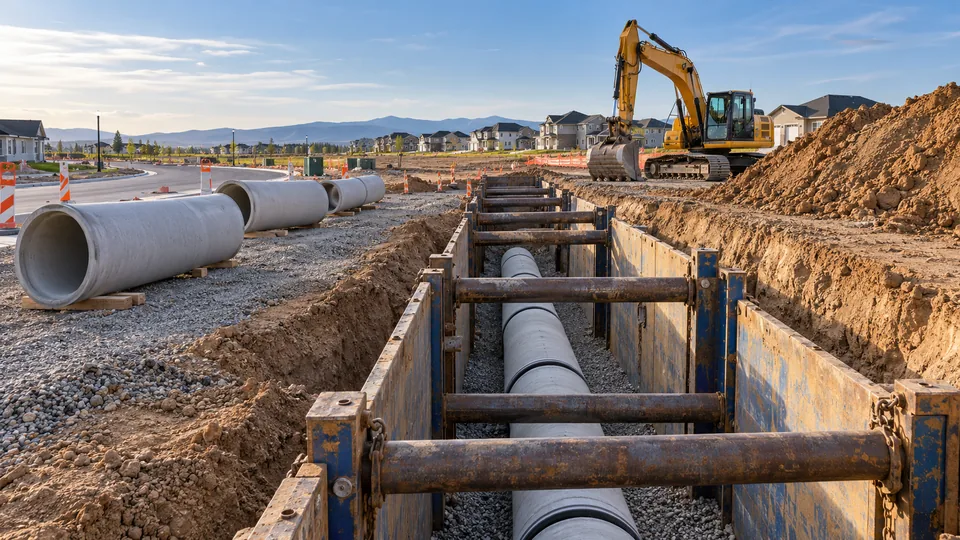
Underground Utility Contractors: Dry and Wet Utility Installation
Underground utility contractors carry a liability profile that looks nothing like a building trade. The work runs alongside live gas, electric, fiber, water and sewer lines owned by someone else, so a single bucket strike can produce a repair bill, a service outage claim from the operator's customers and an evacuation in the same afternoon. The insurer's first question is usually how the contractor locates, exposes and protects existing lines before power equipment touches the ground.
Many general liability forms used for contractors can carry an exclusion or limitation for explosion, collapse and underground property damage, often shortened to XCU. On a utility installer's policy, that wording deserves a line-by-line read. Ask whether the policy removes the exclusion for underground work, whether it applies only to certain operations and whether subcontracted boring or potholing is treated differently. Utility owners and public agencies commonly ask to be added as additional insureds, with primary and noncontributory wording and a waiver of subrogation, and those endorsements only help if the underlying form responds to underground damage in the first place.
Dry utility work (electric conduit, joint trench, telecom and gas service lines) and wet utility work (water, sewer and storm) are often bid by the same firm. Underwriters look at both, and they typically ask for the share of revenue on each, the depth range of the work and whether the contractor self-performs locating or relies only on operator marks.
Larger contracts sometimes justify a dedicated tower of limits, and the trade-offs are laid out in project-specific liability for a single utility contract.
Insurance and Bonds by Civil Trade at a Glance
| Trade | Exposures underwriters read first | Coverage and bonds commonly in the program |
|---|---|---|
| Gas and joint trench | Strikes on live gas, damage inside a shared trench and the operator qualification of the crew | General liability without a restrictive underground exclusion, pollution, equipment and permit and subcontract bonds |
| Fiber and telecom | Damage to other owners' buried and aerial facilities, and pole make-ready | General liability, auto and equipment for boring rigs and bucket trucks, pollution for drilling fluid and subcontract and permit bonds |
| High-voltage and underground electrical | Energized work, long completed operations tails and, in some states, wildfire exposure | General liability with completed operations, follow-form excess, equipment for digger derricks and cranes and performance and payment bonds |
| Directional drilling | Bore strikes, frac-outs and tools lost or stuck downhole | General liability without a restrictive XCU exclusion, pollution and equipment with downhole tool terms |
| Excavation and grading | Earth movement, slope and compaction claims and trench safety | General liability without an earth movement exclusion that removes the work, completed operations, equipment and pollution for exported soil |
| Water, sewer and storm drain | Live tie-ins, sewage backups, flooding of neighboring property and public owners | General liability, pollution for bypass, spill and sediment events, equipment and performance, payment and maintenance bonds |
| Paving and concrete | Work-zone crashes on open roads and pedestrian trip-and-fall claims | General and auto liability, excess sized to the agency exhibit, equipment and bid, performance, payment, maintenance and permit bonds |
Each civil trade gives underwriters a different first question, so the same set of coverages gets weighted differently from one program to the next. The table sets the trades side by side, and the sections below and each trade's own page explain why a given exclusion, limit or bond matters and what to ask before signing a contract.
Read it as a starting map. What a program needs depends on the contracts signed, the operations performed, the states worked in and each carrier's and surety's guidelines, and any coverage or bond remains subject to underwriting and to the terms of the form that is issued.
Fiber builders working for ISPs, BEAD subgrantees and pole owners can start with insurance and bonds for fiber and telecom contractors.
Horizontal Directional Drilling: Bore Path, Frac-Outs and Lost Tools
Horizontal directional drilling moves the risk from an open trench to a bore path the crew cannot see. The common losses are strikes on lines the pilot bore crosses, heave or settlement under roads and slabs, inadvertent returns of drilling fluid to the surface or into a waterway and a reamer or product pipe stuck downhole. Each of those lands on a different part of the insurance and contract program, which is why HDD firms rarely fit a general contractor's template.
An inadvertent return, sometimes called a frac-out, is the event that most often separates HDD underwriting from other underground work. Bentonite drilling fluid is generally considered low hazard, yet a release into a creek, wetland or storm system can trigger agency notice, cleanup and regulatory response under the permit for the crossing. Whether the cost of that response is insured may depend on the pollution exclusion in the GL form and on whether separate contractors pollution coverage is in place with wording that reaches the drilling operation.
Downhole tools and the drill rig itself sit on the equipment side of the program. Ask the equipment insurer whether tools lost or stuck in a bore are excluded, sublimited or available by endorsement, and whether the rig's value schedule reflects current replacement cost. Owners of crossings under highways, railroads and levees may also impose their own insurance exhibits, and those exhibits often ask for railroad protective or specific additional insured wording that needs review before the bid goes in.
How a pollution policy differs from the pollution exclusion in a GL form is explained in contractors pollution liability for drilling operations.
Excavation and Grading Contractors: Earthwork, Soils and Adjacent Property
Excavation and grading contractors move the ground every other trade builds on, so their claims tend to surface late. A compaction problem may not show up until a slab cracks or a retaining wall moves after occupancy, which places the loss in completed operations rather than in the year the dirt was moved. Underwriters typically ask about geotechnical oversight, compaction testing records and whether the firm imports or exports fill.
Mass grading also creates exposures that reach past the site boundary. Dust, mud tracked onto public streets, sediment in storm drains and slope failures onto a neighboring lot can each produce third-party claims. Stormwater rules add a regulatory layer: the EPA states that construction activity disturbing one acre or more, or a smaller site within a larger common plan of development, needs Clean Water Act permit coverage for stormwater discharges. Whether a sediment discharge claim is insured often depends on how the pollution exclusion and any pollution coverage are worded.
Grading contractors on residential subdivisions usually work under the developer's contract terms, which can include broad indemnity, additional insured requirements reaching into completed operations and a demand that the contractor's limits sit primary to the developer's own coverage. Those terms should be read against the actual endorsements before the grading subcontract is signed.
Grading is one piece of the horizontal scope, and the full allocation between developer and site contractor is set out in insurance and bonds for subdivision site improvements.
Water, Sewer and Storm Drain Contractors: Deep Trenches and Public Owners
Water, sewer and storm drain contractors work deeper and more often for public owners than most other civil trades. Gravity sewer and storm lines can run well below the depth where trench protection rules apply, and the owner is usually a city, county or special district that writes its own insurance exhibit and requires statutory bonds. That combination makes surety capacity and the trench safety record central to the program.
Pipe work also carries a distinctive completed operations exposure. A failed joint, a backflow event or an infiltration problem may surface after acceptance, and the claim can come from the agency, a property owner whose basement flooded or a downstream business. Ask whether the GL form treats water damage from the contractor's own completed pipe the same way it treats other completed work, and whether any designated work or residential exclusions affect service-line connections.
Bypass pumping, dewatering and connections to live mains add property damage and pollution scenarios that underwriters ask about directly. A sewage spill during a tie-in may be treated as a pollution event under many GL forms, so the contractor should confirm how the policy and any separate pollution coverage respond before the bypass plan is approved.
Agencies protect the suppliers and subcontractors on these jobs through payment bonds on public pipeline contracts.
Paving and Concrete Contractors: Streets, Flatwork and Long Tails
Paving and concrete contractors finish the visible surface of a civil project, which makes them the first party named when anything underneath fails. Pavement distress, trip-and-fall claims on new sidewalks, curb and gutter that holds water and ADA ramp disputes all tend to reach the paving or flatwork contractor even when the root cause was grading or utility backfill. Clear records of subgrade acceptance before paving help in those disputes.
Traffic control is the other major exposure. Lane closures on public streets expose the public to the work zone, and agencies typically require the paving contractor to name them, and sometimes their engineers, as additional insureds. Underwriters ask whether traffic control is self-performed or subcontracted and whether the subcontractor carries its own limits with matching endorsements.
Because paving and concrete defects can surface years after completion, completed operations limits and the duration of additional insured obligations under the contract matter as much as the current policy. Ask how the policy's completed operations aggregate is structured and whether additional insured endorsements extend to completed work.
The way claims emerge after a job closes is the subject of completed operations exposure after paving acceptance.
Public Works Contract Bonds and Agency Insurance Requirements
Most civil contractors meet the surety market through public work. Each launch state requires bonds by statute. California Civil Code §9550 requires a direct contractor awarded a public works contract over $25,000 to give a payment bond before work begins, with an exception for state entities that follow their own rules. Texas Government Code §2253.021 requires a performance bond on public work contracts over $100,000 and a payment bond over $25,000, or over $50,000 for municipalities, each in the amount of the contract. Arizona's A.R.S. §34-222 requires both a performance bond and a payment bond equal to the full contract amount on covered public works. Federal construction contracts over $150,000 require performance and payment bonds under the Miller Act provisions summarized in FAR 28.102-1.
Surety is not insurance. A performance or payment bond protects the agency and the claimants named in the statute, and the contractor and its owners sign an indemnity agreement promising to repay the surety for any loss. Sureties underwrite the contractor's financial statements, work-in-progress schedule, backlog and bank line, so a civil contractor planning a larger public bid should expect the surety to ask for current CPA-prepared financials and a WIP report that ties to them.
Agency insurance exhibits sit alongside the bonds and vary by owner. Common requests include additional insured status for the agency and its officers, primary and noncontributory wording, waiver of subrogation, specific limits and sometimes pollution or railroad protective coverage. Compare the exhibit to the current policies at the bid stage, because a mismatch found after award can delay the notice to proceed.
How sureties evaluate the contractor before issuing is explained in performance bonds for public civil contracts.
One-Call (811) Law and Utility-Strike Exposure in California, Texas, Arizona and Nevada
Every launch state has a one-call statute, and each one assigns duties that shape who pays after a strike. California Government Code §4216.2 requires the excavator to delineate the dig area before notifying the regional notification center and to give notice at least two working days and no more than 14 calendar days before excavating. A ticket is valid for 28 days and must be renewed if work continues. Section 4216.4 requires hand tools, or vacuum excavation where the operator agrees, to find the exact location of lines within the tolerance zone before power equipment is used, and it requires a 911 call when a strike releases gas or hazardous liquid or damages a high priority installation.
Texas Utilities Code chapter 251 requires an excavator to notify a notification center no earlier than the 14th day and no later than the 48th hour before excavation, excluding weekends and legal holidays, and §251.201 sets civil penalties for violations. Section 251.153 also requires the center to warn the excavator that water, slurry and sewage facilities in the area may not receive the notice, a practical gap for anyone trenching near older municipal lines. Arizona's A.R.S. §40-360.22 requires white-lining before a location request, gives operators two working days to respond and makes markings valid for 15 working days, with longer advance notice and a coordination meeting for large projects. Under A.R.S. §40-360.28, a party whose violation damages a facility can be liable for resulting damages, including economic loss. Nevada's NRS chapter 455 requires notice at least two working days and no more than 28 calendar days before excavating and white marking of the dig area, releases an excavator that substantially complied from repair costs and lets the Public Utilities Commission impose civil penalties for violations.
For insurance purposes, documentation is the defense. Underwriters and claims adjusters typically ask for the ticket number, positive response records, photos of marks and the potholing log. A contractor that cannot show compliance may find the operator's repair invoice, outage losses and statutory penalties all directed at it, and penalties and fines are commonly outside what liability insurance will pay.
Strike risk peaks during site work and falls off later, which is mapped in how utility-strike risk shifts across project phases.
OSHA's Excavation Standard and What Underwriters Read Into It
Federal OSHA's excavation standard, 29 CFR 1926 Subpart P, is the baseline every underground contractor works under, and the trench safety program built on it is one of the first documents a civil underwriter asks to see. Section 1926.651(b) requires the estimated location of underground installations to be determined before an excavation opens. Section 1926.652(a) requires a protective system against cave-ins unless the excavation is entirely in stable rock or is less than five feet deep with no indication of a potential cave-in found by a competent person.
The standard also requires a stairway, ladder, ramp or other safe means of egress in trenches four feet or deeper, placed so no worker travels more than 25 feet laterally to reach it, and daily inspections by a competent person before work and after rainstorms or other hazard-increasing events. California adds a public works layer: Labor Code §6705 bars award of a public works contract over $25,000 involving trenches five feet or deeper unless the contract requires the contractor to submit, in advance, a detailed shoring, bracing or sloping plan for acceptance.
A trench collapse is primarily a workers' compensation and employer's liability event, but it often spreads into general liability through third-party-over actions, damaged adjacent utilities and claims from nearby property owners. An underwriter who sees a named competent person, trench box and shoring inventory, inspection logs and a clean OSHA history is generally more willing to quote the general liability and excess layers on terms the contractor can use.
Crews working near energized lines add OSHA Subpart V duties, set out on the page for high-voltage and underground electrical contractor insurance.
Pollution Exposure in Underground Work: Drilling Fluid and Contaminated Soils
Underground contractors meet pollution in places a building contractor rarely does. Drilling-fluid inadvertent returns, contaminated soils uncovered in an old right-of-way, petroleum from a struck line, sewage during a bypass and sediment-laden runoff can each lead to cleanup demands and third-party claims. Many standard GL forms contain a broad pollution exclusion with narrow exceptions, so an event that feels like an ordinary jobsite accident may be treated as a pollution loss.
Contractors pollution liability is written separately and can be bought annually or for a specific project. Its value depends on the wording: whether it responds to pollution conditions caused by the contractor's operations, whether it includes transportation and disposal of spoils, whether known or pre-existing contamination is excluded and whether mold, fungus or microbial matter is limited. Developers and agencies increasingly name pollution limits in their contract exhibits, and the contractor should confirm the policy form matches the exhibit rather than relying on the limit alone.
When excavation is likely to encounter contaminated material, the contract should say who characterizes it, who pays for disposal and who carries the pollution risk. Those allocations belong in the bid, not in a change order dispute after the first truckload is rejected at the landfill.
Jobs with known soil or groundwater issues are often handled through project-specific pollution coverage for a single dig.
Equipment, Rented Machinery and Inland Marine
Civil contractors often carry more value in iron than in any other asset. Excavators, loaders, drill rigs, pavers, rollers, trench shoring and pumps are typically insured on a contractors equipment or inland marine form rather than a property policy, and the schedule should track what the company owns, leases and rents. Rental agreements commonly make the renter responsible for the machine from delivery to return, so ask whether rented and leased equipment is included automatically or must be added by endorsement.
Materials are a separate question. Pipe, fittings, precast structures and conduit staged on a jobsite or in transit may not be protected under the equipment form. On some projects the owner's builders risk policy may extend to installation materials, but horizontal work is often limited or excluded under builders risk forms, so the contractor should confirm in writing whose policy responds to stored and installed materials before the first delivery.
Theft, vandalism and fire at remote laydown yards are recurring loss sources. Underwriters typically ask about telematics, immobilizers, lighting and fencing at the yard, and those controls can affect both the deductible and the willingness of the market to write high-value units.
When owner-provided property insurance is meant to protect pipe and structures, the details are in builders risk for materials and installed work.
Project-Specific vs. Annual General Liability for Civil Work
Most civil contractors run on an annual GL and excess program that responds to all of their jobs. A project-specific policy, by contrast, dedicates limits to one contract and can isolate a large public or developer job from the rest of the book. The choice usually turns on contract size, the owner's insurance exhibit, the length of the completed operations tail and whether the annual aggregate could be eroded by one large loss.
Wrap-ups are the other path. When a public agency or developer runs an owner-controlled or contractor-controlled insurance program, the civil subcontractor is enrolled for on-site work and typically keeps its own annual program for off-site operations, auto and equipment. Ask what the wrap excludes, how long completed operations protection runs and whether the contractor's own policy will be asked to respond for work outside the wrap.
Either structure must still match the contract. Additional insured, primary and noncontributory and waiver of subrogation wording should be confirmed against the actual endorsements, and any differences between the owner's exhibit and the policies should be resolved before mobilization rather than at the first claim.
How enrollment works for subcontractors on large public jobs is explained under OCIP and CCIP wrap-up programs.
How a Civil Contractor Review Typically Works
For an underground, site work or paving contractor, a review usually starts with the work rather than the policy. The subcontract or bid package, the agency or developer insurance exhibit and any bond forms show what the job asks for, and the current program shows what is already in place. Most of the conversation tends to happen in the gaps between the two.
These steps describe how a review can typically run, not a fixed sequence. Each carrier and surety applies its own guidelines and programs, any quote depends on the specific project and the individual risk, and coverage and bonds are subject to underwriting and to the terms, conditions and exclusions of the policy or bond as issued.
- Documents: the subcontract or bid package, the insurance exhibit, any bond forms and the current policies with their endorsements
- Gap review: the requirements compared line by line with the current GL, pollution, auto, equipment and excess forms
- Submission: loss runs, an equipment schedule, safety and one-call procedures and, for bonds, financial statements and a work-in-progress schedule
- Underwriter questions: trench depth, crossings, drilling fluid handling or the share of public work, depending on the trade
- Options: quotes or indications compared side by side for limits, exclusions, deductibles and subjectivities before anything is bound
- On the job: certificates, endorsements and bonds issued to match the contract, with updates when the scope changes
If your program is coming up for renewal or you are weighing a broker change, see renewing or re-marketing a civil insurance program.
Captive Programs for Established Civil Contractors
Civil and underground contractors with large fleets and steady losses are among the firms that study captives for a retained auto or liability layer. Utility-strike severity, pollution exposure and agency certificate terms shape whether that layer is predictable enough, and comp typically stays with an insurer or an approved self-insurance program under each state's law.
The structures and state limits are covered in our overview of construction captive programs and feasibility.
Subcontracting to and from GCs and Developers
Civil contractors sit on both sides of the subcontract. On a commercial or residential project they are usually a subcontractor to a GC or a direct contractor to a developer for site work. On their own public jobs they are the prime and hire their own subcontractors for boring, traffic control, striping or hauling. Each direction carries different risk-transfer obligations.
Working down, the civil prime should collect certificates and the actual endorsements from each subcontractor, confirm additional insured status reaches completed operations where the contract requires it and check that the subcontractor's GL does not exclude the very work it was hired for. Working up, the civil subcontractor should read the GC's or developer's indemnity and insurance clauses against its own endorsements and push back on terms its policy will not support.
Gaps tend to appear in the same places: subcontractor exclusions on the prime's GL, residential or tract-housing exclusions on a subcontractor's form and pollution exclusions that leave drilling or hauling unprotected. Catching those during subcontract review costs far less than discovering them after a claim.
When hauling is subcontracted, the prime still has auto exposure; see how hired and non-owned auto coverage works for contractors.
A checklist for reviewing what flows down to subcontractors is in subcontractor risk transfer and completed operations.
Before You Ask for a Quote
What to Gather
- Revenue split by trade (utilities, HDD, excavation, pipe, paving) and by public vs. private work
- Current GL, excess, pollution and equipment policies with every endorsement, not only the declarations
- Equipment schedule with owned, leased and rented units and current replacement values
- Trench safety program, competent person designations and OSHA inspection history
- One-call ticket, potholing and strike records for recent jobs
- CPA-prepared financial statements, WIP schedule and backlog for the surety
What to Ask the Insurer or Surety
- Does the GL form exclude or limit explosion, collapse or underground property damage, and how is that removed?
- Does the pollution coverage respond to drilling fluid releases, sewage during bypass and transport of spoils?
- Are rented and leased machines and tools lost downhole included or excluded under the equipment form?
- How is the completed operations aggregate structured, and do additional insured endorsements reach completed work?
- What single-job and aggregate bond capacity will the surety support, and what does it need to increase it?
- Will the policies meet the owner's exhibit without exceptions, including primary and noncontributory and waiver of subrogation?
Quick Answer
Underground utility and civil contractors typically need GL without restrictive underground and collapse exclusions, contractors pollution wording for drilling fluid and soils, equipment coverage and statutory performance and payment bonds for public work.
Common Mistake
Assuming the GL responds to a utility strike without checking for an explosion, collapse and underground exclusion, then learning after the strike that the repair and outage claims may sit outside the policy.
Broker Perspective
A broker reviewing a civil contractor reads the underground and pollution wording first, matches the equipment schedule to the yard and checks surety capacity against the bid calendar.
Coverage Impact
One-call compliance, trench safety records and potholing logs often affect both the defense of a strike claim and the terms an underwriter is willing to offer at renewal.
Articles on This Topic
Requirements by State
Questions Buyers Ask
What insurance does an underground utility contractor need to bid a city pipeline job?
A city pipeline bid usually calls for general liability with additional insured status for the agency, auto, workers' compensation, excess limits and statutory performance and payment bonds. Many agencies also ask for pollution coverage. Before bidding, compare the agency's exhibit to your actual endorsements, confirm the GL has no restrictive underground exclusion and check that the surety will support the contract size.
Does general liability pay when we hit a gas line during excavation?
It may, depending on the form and endorsements. Some contractor GL policies exclude or limit explosion, collapse and underground property damage, and fines or penalties are commonly not insurable. Gas released in a strike can also raise pollution exclusion questions. Documentation of the one-call ticket, marks and hand exposure often decides how much of the loss shifts away from the excavator.
Is a drilling-fluid frac-out treated as a pollution claim?
Often, yes. Many GL forms treat a discharge of drilling fluid into soil or water as a pollution event subject to the pollution exclusion, even though bentonite is generally low hazard. Whether cleanup and regulatory response costs are insured typically depends on whether separate contractors pollution coverage is in place and whether its wording reaches drilling operations.
How much bonding capacity can a civil contractor get?
Surety capacity is set by underwriting, not by a formula on this page. Sureties review CPA-prepared financial statements, working capital, net worth, the WIP schedule, backlog, bank line and the owners' personal financial strength. Because the contractor and owners sign an indemnity agreement, the surety is evaluating its ability to be repaid. Steady, well-documented financials typically support capacity growth over time.
Do rented excavators and drill rigs need to be on our policy?
Usually the rental agreement makes the renter responsible for the machine while it is in its care, so the equipment or inland marine policy should include rented and leased equipment, either automatically or by endorsement. Check the per-item and aggregate limits for rented units, the rental reimbursement provision and whether the rental company requires being named as loss payee.
Official Sources
- NRS 455.110, 455.137, 455.150 and 455.170 (excavation near subsurface installations), Nevada Legislature. 2 working day to 28 calendar day notice, white marking, non-mechanical location, repair-cost release on substantial compliance, PUCN civil penalties and tripling Verified 2026-10-25.
- NRS 455.140, 455.150, 455.170 and 455.180 (damage duties, liability release, penalties), Nevada Legislature. Notice and hazard duties, repair-cost release on substantial compliance, PUCN penalty amounts and tripling, civil remedies preserved Verified 2026-10-25.
- Gov. Code §4216.2 (California excavator notice and delineation), California Legislative Information. Delineation before notice; two working days to 14 calendar days notice; ticket valid 28 days Verified 2026-10-23.
- Gov. Code §4216.4 (California tolerance zone and damage reporting), California Legislative Information. Hand tools or agreed vacuum excavation in the tolerance zone; 911 call for gas or high priority damage Verified 2026-10-23.
- Utilities Code ch. 251 (Texas underground facility damage prevention), Texas Legislature. §251.151 notice window (14th day to 48th hour); §251.153 water, slurry and sewage warning; §251.201 civil penalties Verified 2026-10-23.
- A.R.S. §40-360.22 (Arizona excavator duties), Arizona State Legislature. White-lining, two working day operator response, 15 working day mark validity, large project notice Verified 2026-10-23.
- A.R.S. §40-360.28 (Arizona violations and liability), Arizona State Legislature. Liability for damages proximately caused, including economic loss Verified 2026-10-23.
- 29 CFR 1926 Subpart P (OSHA excavations), eCFR, National Archives. §1926.651(b) locating installations, (c)(2) egress at four feet, (k) competent person inspections; §1926.652(a) protective systems Verified 2026-10-23.
- Labor Code §6705 (California public works trench shoring plans), California Legislative Information. Shoring plan clause for public works over $25,000 with trenches five feet or deeper Verified 2026-10-23.
- Civil Code §9550 (California public works payment bonds), California Legislative Information. Payment bond for public works contracts over $25,000 Verified 2026-10-23.
- Gov. Code §2253.021 (Texas public work bonds), Texas Legislature. Performance bond over $100,000; payment bond over $25,000 or $50,000 for municipalities Verified 2026-10-23.
- A.R.S. §34-222 (Arizona public works bonds), Arizona State Legislature. Performance and payment bonds each equal to the full contract amount Verified 2026-10-23.
- FAR 28.102-1 (Miller Act bond threshold), eCFR, National Archives. Federal construction contracts over $150,000 require performance and payment bonds Verified 2026-10-23.
- Stormwater discharges from construction activities, U.S. EPA. Permit coverage for disturbing one acre or more or part of a common plan of development Verified 2026-10-23.
Reviewed by the Principal, Gleason Insurance Brokers, LLCUpdated

