Why Flatwork in the Public Right-of-Way Is Its Own Risk
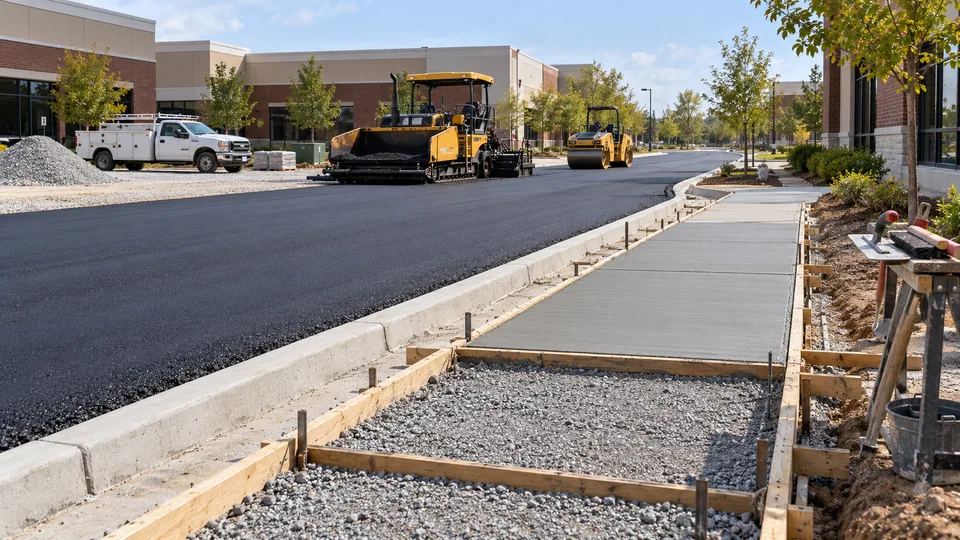
A sidewalk, curb and gutter crew works where the public walks. That single fact separates this trade from flatwork inside a private jobsite fence. Every lifted panel, open form line, saw-cut edge and fresh ramp is exposed to pedestrians, wheelchair users, cyclists and drivers turning into driveways, often for weeks at a time and often at night when the crew is gone. Underwriters read the trade that way, and they ask how the contractor barricades, plates and signs open work at the end of each shift.
The second difference is the owner. Most curb, gutter and sidewalk contracts come from a city, county, school district or state transportation department, or from a developer building off-site improvements that a city will accept and own. Either way, a public agency writes the permit conditions, the insurance exhibit and the bond requirements, and the agency's inspector decides when the work is accepted. The program has to satisfy that agency first and the contractor's own balance sheet second.
The third difference is time. A finished sidewalk carries foot traffic for decades, and the agency, the abutting owner and the injured pedestrian will all look for someone else to blame when a panel heaves or a ramp lip catches a wheel. That pushes most of the exposure into completed operations, which is where the policy wording deserves the closest read.
Sidewalk and curb work sits inside a wider civil program, and the shared exclusions and surety questions are set out in insurance and bonds for civil and underground contractors.
Encroachment Permits: The Permit, the Bond and the Certificate
Before a crew can break out a single panel in a public street, someone has to hold a permit from the agency that owns the right-of-way. Caltrans states that an encroachment permit must be obtained for activities that place encroachments in the state highway right-of-way, and its application package lists surety bonds and liability insurance among the attachments, with a deposit required in most cases. Cities and counties in all four states run their own right-of-way permit desks with their own forms, and the bond amount and insurance limits are set by each agency rather than by one statewide schedule.
The permit bond guarantees the agency that the permittee will restore the right-of-way and comply with permit conditions. It is not insurance. If the agency makes a claim because a curb was left unfinished or a sidewalk was replaced out of grade, the surety may pay the agency and then look to the contractor and its indemnitors for repayment. Repeat sidewalk contractors often carry an annual or blanket permit bond with a busy city, which makes the indemnity agreement behind it a standing obligation rather than a one-job promise.
The insurance certificate is the other half of the permit file. Agencies commonly ask to be named as additional insured, often with their officers and employees, along with primary and noncontributory wording. Ask whether the endorsement on your general liability policy extends to permit work and to completed operations, because a blanket endorsement that responds only to written contracts may not reach a permit that has no separate contract.
How agencies size and release permit security, and what the surety underwrites before issuing it, is covered in encroachment and right-of-way permit bonds.
Trip-and-Fall Claims and Who Owes the Duty to Maintain
Trip-and-fall claims are the most frequent liability loss in this trade, and California law shows why the contractor is rarely a bystander. Streets and Highways Code §5610 places the duty to keep a sidewalk safe on the owners of lots fronting an improved street, but it carves out conditions created by another person working under a permit from the city, and it says that person is under a like duty. A contractor that opens a sidewalk under a city permit can therefore stand in the abutting owner's shoes for the hazards its own work creates.
In practice, the claim usually names everyone: the city, the property owner, the developer and the contractor that last touched the panel. Defense depends on records. Daily photos of barricades and ramps, pedestrian detour plans, inspector sign-offs and the date the agency accepted each block can decide whether the loss stays with the contractor or moves to the party that controlled the walkway at the time of the fall.
On the insurance side, ask how the general liability form treats injuries on work that is finished but not yet accepted, and whether the products-completed operations aggregate is shared with every other job the company has built. A busy flatwork contractor can have hundreds of completed blocks in the field, and one aggregate stretched across all of them may be thinner than it looks on the certificate.
How long finished work can generate claims, and how the completed operations aggregate behaves, is explained in completed operations protection for finished sidewalks.
ADA Curb Ramps: The Inspection That Decides Acceptance
Federal rules make curb ramps a standing part of this work. Under 28 CFR 35.151(i), newly constructed or altered streets must contain curb ramps or other sloped areas where they meet a pedestrian walkway with curbs, and newly built or altered walkways must contain them where they meet streets. The Department of Justice and the Federal Highway Administration explained in their 2013 joint technical assistance that resurfacing is an alteration that triggers the curb ramp obligation, while treatments such as crack sealing, chip seals and slurry seals are generally treated as maintenance.
Design standards keep moving. The U.S. Access Board published its Public Right-of-Way Accessibility Guidelines as a final rule on August 8, 2023. The Board reports that GSA and DOT have adopted them for certain federal facilities and transit stops. Agencies write their own ramp details, slope tolerances and detectable warning requirements into the plans, so the contractor's job is to build exactly what the detail and inspector require. In Texas, TxDOT's construction manual notes that TDLR requires plan review and final accessibility inspection on TxDOT projects with at least $50,000 of pedestrian elements, performed through a registered accessibility specialist.
A ramp that misses slope or landing tolerance is usually torn out and repoured at the contractor's expense. Most general liability forms are not written to pay to fix the insured's own faulty work, so that cost typically lands on the job margin. Where a noncompliant ramp injures someone, the bodily injury claim is a separate question that depends on the form and endorsements.
Overlay and mill-and-fill contracts are where most ramp obligations start, which is why the paving side of the job is covered in street resurfacing work that triggers curb ramps.
Maintenance and Warranty Bonds After Acceptance
Public owners rarely stop at a performance bond. Many require the contractor, or the developer that hired it, to post maintenance or warranty security when the work is accepted, so the agency has recourse if panels crack, curbs separate or gutters hold water during the warranty period. The period and the bond amount come from the contract or the agency's code, and they vary widely, so read them at the bid stage rather than at closeout.
The warranty bond creates two separate exposures. The bond itself is credit: if the agency calls it, the surety may perform or pay and then seek repayment from the contractor under the indemnity agreement. Meanwhile, the bodily injury and property damage claims that arise from the same defect fall to the liability program, and only to the extent the policy wording responds. Treat those as two different conversations, one with the surety and one with the insurer.
Release timing matters to bonding capacity. A maintenance bond still open on a completed job can count against the contractor's aggregate surety line, so tracking acceptance letters and requesting release on schedule keeps that capacity available for the next bid.
What the agency can call during the warranty period, and how release works, is explained in maintenance and warranty bonds after acceptance.
Licenses and the Standard Specifications Agencies Write Into the Job
In California, the Contractors State License Board defines the C-8 concrete classification to include forming, pouring, placing and finishing pavement and flatwork, while the A general engineering license covers broader civil scopes. Underwriters and sureties compare the license held to the work bid, and a gap between the two can raise questions at claim time. Arizona requires every construction contractor on ADOT work, primes and subs alike, to be licensed with the Registrar of Contractors. Texas has no statewide general contractor license, so agency prequalification and contract terms do more of the screening.
The specification book often matters more than the license. Caltrans lists 2026 Standard Specifications and Standard Plans with an implementation date of October 19, 2026. In the Phoenix area, the Maricopa Association of Governments publishes the Uniform Standard Specifications and Details for Public Works Construction, which it describes as the basis for most standards used by its member agencies, with a 2026 revision. TxDOT's 2024 Standard Specifications govern state highway work in Texas.
Those documents set the forming, jointing and curing methods and the acceptance tests. They also set the warranty and correction obligations that a surety will be asked to stand behind. Pull the specification section and the agency's supplemental details before pricing, because an unfamiliar ramp detail or joint spacing requirement is a common source of rejected work.
The statutory bond thresholds that apply when the agency is the owner are summarized in public works bond requirements by contract size.
How a Flatwork Contractor Review Typically Works
Sidewalk, curb and gutter contractors usually work under a right-of-way permit as well as a contract, so a review often begins with the permit, its bond form and the certificate the agency expects. Developer off-site subcontracts add their own additional insured and completed-operations terms.
These steps show how a review may typically proceed. Each carrier and surety uses its own guidelines and programs, the answer depends on the project and the individual risk being quoted, and any coverage or bond is subject to underwriting and to the terms and conditions of the form as issued.
- Documents: encroachment permits with bond forms, developer subcontracts and current GL policies with every endorsement
- Gap review: additional insured forms for agencies and developers and completed-operations wording for trip-and-fall claims
- Submission: barricade and pedestrian detour procedures, daily photo logs and curb ramp inspection records
- Underwriter questions: claim history after acceptance and how the company documents end-of-shift conditions
- Bonds: permit and maintenance bonds sized to each agency's request
- Ongoing: certificates updated as permits renew
Curb, Gutter and Sidewalk As a Subcontractor on Subdivision Offsites
Much of the sidewalk, curb and gutter built in growth corridors is not a public contract at all. It is off-site and in-tract improvement work for a developer whose improvement agreement with the city is backed by subdivision improvement security. The developer is the principal on that bond, but its subcontract will usually pass the risk down: indemnity, additional insured status reaching completed operations, primary and noncontributory wording and a warranty that matches or exceeds the city's maintenance period.
Two policy details deserve attention on this work. Some contractor general liability forms exclude or limit residential or tract work, which can reach curb and sidewalk poured inside a residential subdivision even though no house is involved. And when a developer runs a wrap-up, the concrete subcontractor's on-site work may be enrolled while its off-site street frontage is not, so ask exactly where the wrap boundary sits on the plans.
Developers also tend to hold retention until the city accepts the improvements, which can be months after the concrete crew demobilizes. Keep the subcontract, the city acceptance date and the warranty start date in one file, because those three dates control both the payment and the claim timeline.
How developers and site contractors split risk across the horizontal scope is set out in insurance and bonds for subdivision site improvements.
Before You Ask for a Quote
What to Gather
- Current right-of-way and encroachment permits, with the bond form and amount each agency required
- General liability policy with every endorsement, including the additional insured forms used for agencies and developers
- Barricade, pedestrian detour and end-of-shift securing procedures, with sample daily photo logs
- Curb ramp inspection records and any rejected-work reports from the last three years
- Open maintenance and warranty bonds with acceptance dates and expected release dates
- CPA-prepared financial statements and work-in-progress schedule for the surety
What to Ask the Insurer or Surety
- Does the additional insured endorsement reach permit work with no separate contract and extend to completed operations?
- Is the products-completed operations aggregate shared across all jobs, and is a per-project aggregate available?
- Does the general liability form exclude or limit residential or tract work that could reach in-tract curb and sidewalk?
- Will the surety write a blanket permit bond for each city we work in, and how does it count against our aggregate line?
- Which open maintenance bonds can be released now, and what documents does each agency need to release them?
- Are traffic control and saw-cutting subcontractors carrying limits and endorsements that match our agency exhibits?
Quick Answer
Sidewalk, curb, gutter and ADA ramp contractors typically need general liability built for pedestrian trip-and-fall claims, agency additional insured wording that reaches completed operations and encroachment permit, performance, payment and maintenance bonds for public right-of-way work.
Common Mistake
Treating a rejected ADA ramp as an insurance claim. The cost to tear out and repour the contractor's own noncompliant work usually falls on the job margin, so bid the agency's ramp detail and tolerances carefully.
Broker Perspective
A broker reviewing a flatwork contractor reads the additional insured forms, the completed operations aggregate and the residential exclusions first, then lists every open permit and maintenance bond against the surety line.
Coverage Impact
Documented barricading, inspector sign-offs and acceptance dates often decide whether a trip-and-fall loss stays with the contractor or shifts to the agency or owner that controlled the walkway, and they can affect renewal terms.
Questions Buyers Ask
Can a sidewalk contractor be sued for a fall on a sidewalk it finished last year?
Yes. Claims on finished flatwork commonly arrive after acceptance, so they fall under completed operations. Whether the policy responds depends on the form, the completed operations aggregate and whether the agency's additional insured endorsement reaches completed work. Acceptance letters, inspector sign-offs and as-built photos are the records a defense attorney will ask for first.
Does a mill-and-overlay job mean someone has to rebuild the curb ramps?
Usually. The 2013 DOJ and FHWA joint technical assistance treats resurfacing, including overlays with or without milling, as an alteration that triggers curb ramps where walkways cross the resurfaced street. Crack sealing, chip seals and slurry seals are generally maintenance. The agency decides the ramp scope in its plans, and the concrete contractor builds to that detail.
Who pays when a city inspector rejects a curb ramp for slope?
Typically the contractor that built it. A rejected ramp is the contractor's own faulty work, and most general liability forms are not designed to pay to repair the insured's own work. The cost usually comes out of the job margin. If the agency calls a performance or maintenance bond instead, the surety may pay and then seek repayment from the contractor.
Do I need a separate permit bond for every city I pour curb and gutter in?
Often, yes. Right-of-way permits are issued by each agency, and each one sets its own security, which may be a single-permit bond, an annual blanket bond or a cash deposit. A surety can usually support several blanket bonds at once, but each one is backed by the same indemnity agreement and may count against your aggregate bonding line.
Is in-tract curb and sidewalk in a new subdivision treated as residential work by insurers?
It can be. Some contractor general liability forms exclude or limit work on residential or tract projects, and that wording may reach curb, gutter and sidewalk inside a subdivision even though no home is built by the concrete contractor. Read the exclusion against the subcontract before bidding developer work, and ask whether a project-specific option is available.
Official Sources
- Streets and Highways Code §5610 (California sidewalk maintenance duty), California Legislative Information. Abutting owners maintain sidewalks; persons working under a permit owe a like duty for conditions they create Verified 2026-10-24.
- 28 CFR 35.151(i) (curb ramps on new and altered streets and walkways), eCFR, National Archives. Newly constructed or altered streets and walkways must contain curb ramps or other sloped areas Verified 2026-10-24.
- DOJ/DOT Joint Technical Assistance on curb ramps when streets are resurfaced (July 8, 2013), U.S. Department of Justice and Federal Highway Administration. Resurfacing is an alteration triggering curb ramps; crack sealing, chip seals and slurry seals generally maintenance Verified 2026-10-24.
- Public Right-of-Way Accessibility Guidelines (PROWAG), U.S. Access Board. Final rule published August 8, 2023; covers sidewalks and curb ramps; adopted by GSA and by DOT for transit stops Verified 2026-10-24.
- Caltrans encroachment permits, California Department of Transportation. Permit required for encroachments in state highway right-of-way; application includes surety bonds and liability insurance; deposit usually required Verified 2026-10-24.
- CSLB C-8 Concrete Contractor classification, Contractors State License Board. C-8 scope includes pavement and flat concrete work Verified 2026-10-24.
- TxDOT Construction Contract Administration Manual: TDLR inspections, Texas Department of Transportation. TDLR plan review and final accessibility inspection on TxDOT projects with at least $50,000 of pedestrian elements Verified 2026-10-24.
- MAG Uniform Standard Specifications and Details for Public Works Construction, Maricopa Association of Governments. Specifications used by agencies and contractors in Maricopa County; 2026 revision Verified 2026-10-24.
- Caltrans Standard Plans and Standard Specifications, California Department of Transportation. 2026 Standards implemented October 19, 2026 Verified 2026-10-24.
- ADOT prime contractor general requirements, Arizona Department of Transportation. Primes and subs on ADOT work must be licensed with the Registrar of Contractors Verified 2026-10-24.
Reviewed by the Principal, Gleason Insurance Brokers, LLCUpdated