
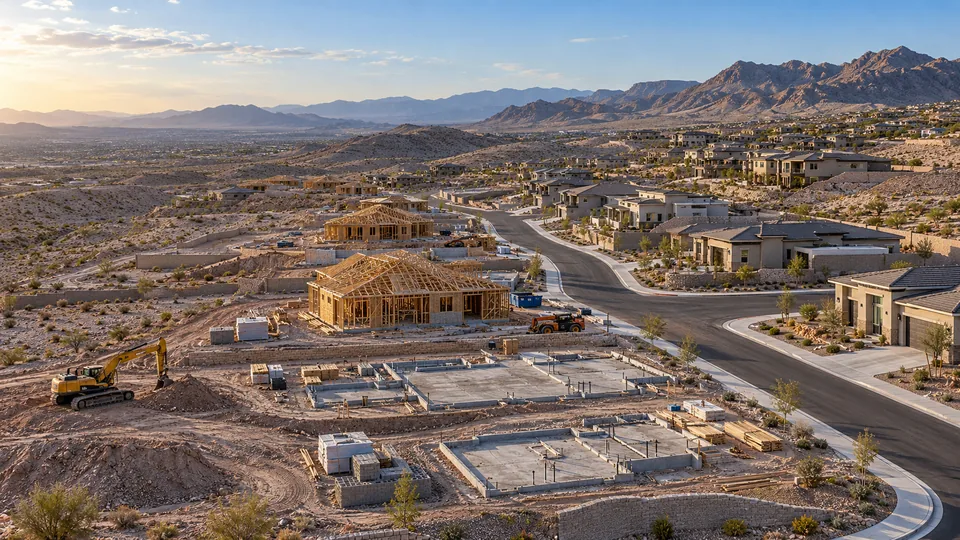
Clark County Dust Control Operating Permits
Clark County's Division of Air Quality issues the Dust Control Operating Permit that almost every valley project needs. The county's permitting page sets three triggers: soil-disturbing or construction activity of 0.25 acre or more, mechanized trenching of 100 feet or more and mechanical demolition of any structure of 1,000 square feet or larger. Temporary commercial activities of 0.25 acre or more need one too. Projects of 10 acres or larger also file a supplement to the dust mitigation plan, and the county runs dust monitor classes for site staff.
Those thresholds are low enough that a single utility tie-in, a short sewer extension or a pad demolition can require its own permit. A dry utility contractor trenching 120 feet across a parking lot meets the trenching trigger even if the overall project is small. That matters because the permit and its mitigation plan become daily operating obligations, and the contract should say whether the owner, the general contractor or a site subcontractor holds them.
The statewide rules that sit under every valley project are summarized under Nevada licensing, bond and one-call rules.
What a Dust Permit Means for Liability Coverage
A dust problem reaches insurance in two ways. A notice of violation from the county is a regulatory matter, and many liability forms exclude or limit fines and penalties, so contract allocation and site discipline usually do more than a policy can. A neighbor's claim for dust damage to vehicles, pools or rooftop equipment is a third-party claim, as is an injury claim tied to blowing dust, and those typically turn to general liability.
Some general liability forms carry pollution exclusions broad enough that an insurer may argue dust is a pollutant. Ask how each policy defines pollutants and whether contractors pollution liability on the grading or site contractor would respond where the general liability wording is unclear. On a 40-acre pad site with a 10-acre mitigation supplement in force, the answer is worth having in writing before mass grading starts.
How pollutant definitions treat dust, sediment and runoff is explained under pollution coverage for grading and site development.
The Water District's Commitment Rule Is a Surety Rule
The Las Vegas Valley Water District's service rules make a water commitment a precondition of new development. On the mapping path for new subdivisions, parcel maps and land divisions, the map must be approved under NRS chapter 278, the property must not discharge to a septic tank or evaporative pond and the developer must reach a minimum financial commitment of $5,000 per acre-foot of projected water use. That commitment can be built improvements, bonds, other acceptable surety or a mix, and any bonds must be certified to the District by the City of Las Vegas or Clark County.
The rules list what counts: streets, water lines, drainage facilities, sewers, site grading, foundations and vertical construction, among others. Land acquisition, legal and professional fees, permit and connection fees and dedications of right-of-way do not count. The rules also say that a commitment obtained through mapping stays with the land, that fees become nonrefundable once the map records and that the developer or its successors remain responsible for completing the water facilities.
For a developer, that turns the subdivision improvement bond into a water strategy as well as a map condition. The surety reviewing the program will want to see the engineer's estimate, the phasing plan and how much of the per-acre-foot figure will be met by bonded work rather than finished improvements.
How cities and counties size, reduce and release map security is covered under Nevada subdivision improvement bonds.
Conditional Commitments, Permit Expiration and Cooling Choices
Commercial and industrial projects usually take the District's development-review path. A conditional commitment issues only after the primary building permit and off-site plans are approved, off-site improvements are built or bonded as the city, county or District requires, development approval is issued and District agreements are signed. The rules state that the conditional commitment is tied to the primary building permit and ends automatically if that permit expires.
That link gives a schedule slip a water consequence. If a project stalls long enough for the building permit to lapse, the commitment goes with it, and the owner's builders risk and soft-cost terms should be read with that in mind. The rules also tie final commitments for buildings with evaporative cooling to permit and occupancy dates in 2023, 2024 and February 2026, so cooling design on data centers and large industrial buildings is part of the water review, not only the mechanical design.
Before a final commitment issues, the water facilities must be built and accepted by the District, landscaping installed and proof given that the commitment will not serve non-functional turf, a man-made lake or an ornamental water feature.
Delay, soft costs and equipment values on large buildings are covered under builders risk for data center and industrial projects.
Drainage Studies and the Regional Flood Control District
Clark County Public Works requires a drainage study when a site is in a FEMA Special Flood Hazard Area, is next to or affected by a master plan facility or takes flows from a wash or facility. Its Drainage Review Group reviews studies and grading plans and coordinates floodplain issues with the Clark County Regional Flood Control District. The District, in turn, reviews regionally significant private and public development proposals for conformance with its Hydrologic Criteria and Drainage Design Manual.
Valley storms are short and intense, and partly built channels, detention areas and graded pads are most exposed before permanent drainage works are finished. Whether a builders risk policy includes site work, earth movement and flood during that window depends on the form and the deductibles. Water pushed onto a neighbor's property is a liability question, and contractual risk transfer between the owner, the grading contractor and the storm drain contractor decides whose policy is asked first.
Earth movement, flood sublimits and site work values are explained under builders risk for site work and flood.
Airport Projects
The Clark County Department of Aviation runs a construction wrap program and its own badging rules.
Those requirements are set out in Harry Reid International Airport contractor requirements.
Why the City Line Changes the Answer
The District's commitment rules are written around approvals from the City of Las Vegas or Clark County. Henderson and North Las Vegas each run their own water and wastewater utilities and their own off-site permit and surety processes, so the same subdivision can face different bond forms, inspection rules and drainage conditions a few miles apart. The county dust permit, by contrast, follows the site across city lines.
For a buyer with projects in more than one valley jurisdiction, that argues for one insurance and surety review that maps each site to its permit authority, its utility and its drainage reviewer before contracts are signed.
Henderson's own bond form and blasting insurance rules are covered under Henderson off-site bond and blasting rules.
Before You Ask for a Quote
What to Gather
- Clark County Dust Control Operating Permit and mitigation plan, plus the 10-acre supplement where it applies
- District water plan approval, projected water use and the commitment path (mapping or development review)
- Engineer's estimate and the bonds the city or county will certify to the District
- Drainage study, grading plan and any master plan facility affecting the site
- Contract clauses naming the dust permit holder and allocating penalties
- Builders risk values for site work, channels and early vertical construction
What to Ask the Insurer or Surety
- Does each liability policy's pollutant definition reach dust claims, and is there an exception?
- Will the surety accept the improvement bond the county or city must certify to the District?
- What happens to the water commitment and the bond if the building permit lapses during a delay?
- Does builders risk include earth movement, flood and unfinished drainage works, and at what deductibles?
- Who pays a dust notice of violation under the contract?
- How long does completed-operations coverage run for phases sold before the last map records?
Quick Answer
Las Vegas-area projects need a Clark County dust permit at 0.25 acre, 100 feet of trenching or 1,000 square feet of demolition, and new maps served by the Las Vegas Valley Water District need $5,000 per acre-foot of projected use in improvements or certified bonds before a commitment issues.
Common Mistake
Treating the improvement bond as a map formality and missing that the same bond supports the water commitment, so a delayed or undersized bond can hold up both the map and water service.
Broker Perspective
A broker maps each valley site to its permit authority, water utility and drainage reviewer first, because the bond form, the surety's underwriting file and the liability terms all follow from that map.
Coverage Impact
Dust and runoff claims may fall under general liability or be argued as pollution depending on the form, fines are often excluded or limited, and storm damage to unfinished drainage works may or may not be included on builders risk.
Questions Buyers Ask
Does a short utility trench in Clark County need its own dust permit?
It can. The county's permitting page lists mechanized trenching of 100 feet or more as a separate trigger, apart from the 0.25-acre disturbance threshold. A dry utility or sewer contractor on a small site may need its own Dust Control Operating Permit, so the contract should say who applies for it and who follows the mitigation plan.
Can a subdivision bond count toward a Las Vegas Valley Water District commitment?
Yes, on the mapping path. The District's service rules let the $5,000 per acre-foot financial commitment be met with built improvements, bonds or other acceptable surety, as long as the City of Las Vegas or Clark County certifies the bonds to the District. Land costs, fees and right-of-way dedications do not count toward it.
What happens to a conditional water commitment if our building permit expires?
Under the District's rules, a conditional commitment obtained through development review is tied to the primary building permit and ends automatically if that permit expires. A stalled project can lose its commitment, which is one reason to read builders risk delay terms and the project schedule together.
When does a Las Vegas-area site need a drainage study?
Clark County Public Works requires one when the site is in a FEMA Special Flood Hazard Area, is next to or affected by a master plan flood facility or receives flows from a wash or facility. The county decides case by case based on size and location, and regionally significant projects also go to the Regional Flood Control District.
Official Sources
- Dust Control Permitting Portal, Forms and Requirements, Clark County Department of Environment and Sustainability, Division of Air Quality. Dust Control Operating Permit required for soil disturbing or construction activity of 0.25 acre or more, mechanized trenching of 100 feet or more, mechanical demolition of structures of 1,000 square feet or larger and temporary commercial activities of 0.25 acre or more; mitigation plan supplement for projects of 10 acres or larger; dust monitor classes. Verified 2026-10-25.
- Service Rules, Chapter 2: Water Commitment, Las Vegas Valley Water District. Water commitment required before new development; conditional commitment requires off-site improvements built or bonded and ends if the primary building permit expires; evaporative cooling date conditions; final commitment after facilities accepted and no non-functional turf; mapping path requires NRS chapter 278 map approval and $5,000 per acre-foot financial commitment in improvements, bonds or other surety certified by the City of Las Vegas or Clark County; qualifying and non-qualifying improvements; commitment runs with the land and developer remains responsible for water facilities. Verified 2026-10-25.
- Drainage Study, Clark County Department of Public Works. Drainage study required when a site is in a FEMA Special Flood Hazard Area, adjacent to or affected by a master plan facility or affected by flows from a wash or facility; Drainage Review Group reviews studies and grading plans and coordinates with the Regional Flood Control District. Verified 2026-10-25.
- Land Development, Clark County Regional Flood Control District. District ensures compliance with the Hydrologic Criteria and Drainage Design Manual and reviews regionally significant private and public development proposals. Verified 2026-10-25.
Reviewed by the Principal, Gleason Insurance Brokers, LLCUpdated

