
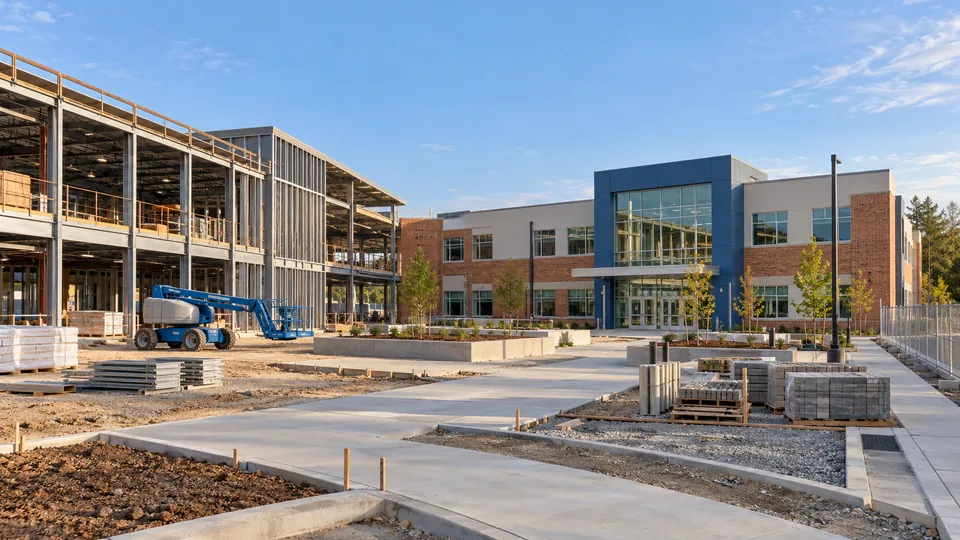
The School District Is Its Own Public Owner
Clark County School District and Clark County are separate public bodies, even though they share a name and a map. The County regulates subdivisions, grading and off-site improvements in unincorporated areas and holds the developer bonds tied to those permits. The School District buys its own construction, runs its own contractor prequalification and writes its own bid documents through its Facilities Services Unit and Construction Management department. A contractor that already performs County public works or posts County improvement bonds does not carry that standing over to District work.
Nevada statute treats the District like other local public owners. NRS 338.010 includes a school district in the definition of a public body for public works, and NRS chapter 339 names school districts among the contracting bodies that must take performance and payment bonds on contracts over $100,000. The statute sets a floor of 50 percent of the contract amount for each bond; as the bond section below explains, CCSD asks for more.
The statewide bond thresholds and claim rules that apply to the District and the County alike are explained in Nevada public works bond requirements under NRS 339.
Prequalification Comes Before the Pre-Bid
The District's Contractor Pre-qualifications page says applications are taken on a rolling basis and reviewed by a three-person panel, and that contractors must be deemed prequalified before any mandatory pre-bid conference. The page adds that prequalification status is good for up to two years. The linked application is marked Rev Jan 2025, so check that the form in hand is current before filing.
The written criteria, dated December 2024, ask for three comparable projects in each category a firm applies for, a written safety program, Nevada workers' compensation and proof of the insurance and bonding described below. The surety must appear on the U.S. Treasury's Circular 570 list, and the criteria cap a firm's prequalification at the surety's underwriting limit. A contractor turned down can appeal to the Board within 10 days.
NRS 338.1377 lists the kinds of criteria local governments may use to qualify bidders, including whether the applicant has the ability to obtain the necessary bonding for the work, along with insurance, safety programs, past performance and bankruptcy history. Bonding capacity therefore shapes which CCSD projects a firm can be prequalified to bid, and that capacity is set by the surety's own underwriting of the firm's financial statements, work on hand and indemnity. The prequalification decision belongs to the District; a broker can help assemble surety and insurance evidence but cannot prequalify a firm.
For how other school owners handle prequalification and delivery, see K-12 school construction requirements by state and district.
Insurance Minimums in the December 2024 Criteria
The prequalification criteria list the coverage a firm has to show to be approved. These are the minimums stated in that document; the insurance article of each project's conformed General Conditions controls the final requirement and can add coverage or raise limits.
The April 2024 bid template tells bidders to meet all insurance requirements in Article 11 of Document 00 72 00, the District's conformed AIA A201 General Conditions. That article is where additional insured wording, waiver of subrogation, primary and noncontributory terms and any owner-controlled or contractor-controlled insurance program would appear. We did not read Article 11, so this page does not state those terms. Read them in each solicitation and match the endorsements on the general liability, auto and umbrella policies to the exact wording before bid.
- Commercial general liability: $1,000,000, with $10,000 per-person medical payments
- Automobile liability: $1,000,000
- Umbrella or excess liability: not less than $5,000,000 on projects over $100,000; at the prequalification stage a letter from the insurer can be accepted
- Workers' compensation: Nevada coverage
- Insurer standard: A.M. Best rating of A- or better, Financial Size Category VIII or larger, licensed in Nevada
Building one program that meets several public owners' limits is covered in insurance and bonding programs for public works contractors.
Bid Security, 100 Percent Bonds and Subcontractor Bonds
The December 2024 criteria state that all projects over $50,000 require performance and payment bonds equal to 100 percent of the contract amount. That is a District rule layered on top of NRS 339.025, which requires bonds only on contracts over $100,000 and sets a 50 percent floor. A surety quoting CCSD work should be told the bonds run at the full contract amount.
The District's April 2024 pre-bid agenda for formal bids over $100,000 says bid security can be a bid bond or a certified check of no less than 5 percent, and that performance and payment bonds are due within four working days of the Notice of Award. That window is short, so the surety's approval and the bond forms need to be lined up before bid day rather than after award.
The same agenda requires subcontractors whose contracts exceed $250,000 to give the general contractor performance and payment bonds, each at 100 percent. That flows bonding down to the larger trades on a school job, and a mechanical, electrical or concrete subcontractor that has not bonded before may need to establish surety credit early. Some general contractors use subcontractor default insurance on private work; on CCSD projects the agenda's bond requirement still applies to subcontracts over that threshold.
How sureties underwrite and price bid security is explained in bid bonds for public contracts.
Retainage and Payment Under NRS Chapter 338
We did not read the retention clause in a CCSD contract, so this section sets out the statute that governs Nevada public bodies, including the District. Under NRS 338.515, a public body pays progress payments within 30 days after it receives the progress bill, paying 95 percent and withholding 5 percent as retainage until 50 percent of the work has been performed.
After the halfway point, if the public body finds satisfactory progress, it may pay the remaining progress payments without additional retainage and may release retainage already held. If it keeps withholding, it may hold no more than 2.5 percent of any progress payment and must first pay the contractor half of the retainage already withheld, unless it is also withholding for a deficiency under NRS 338.525, in which case the cap is 5 percent. The public body pays quarterly interest on amounts withheld. Under NRS 338.520, outstanding payments, including retainage, are due within 30 days after the owner occupies or begins using the work, or a notice of completion is recorded, in proportion to the part occupied.
The rules flow down. NRS 338.555 lets the prime withhold no more than 5 percent from a subcontractor's progress payment before the subcontract work is half done, and NRS 338.550 requires the prime to pay subcontractors and suppliers their share within 10 days after receiving payment. Subcontract forms carrying a 10 percent retention clause need to change for District work.
For the wider Nevada picture for prime contractors, see Nevada general contractor insurance and bonding.
Prevailing Wage, Online Bidding and the Bid Package
NRS 338.080 exempts public works with an estimated cost under $100,000 from the prevailing wage provisions, and the statute bars splitting a unit of the project from the total to get under that line. The District's bid template applies prevailing wage at $100,000 and up and calls for certified payroll through LCPtracker, so payroll reporting has to be set up for the prime and every subcontractor on site.
The same template says bids are submitted through e-Builder and held for 60 days, and it leaves liquidated damages blank to be set on each project. A 60-day hold means the surety and the bidder's insurers are committing to pricing and capacity for two months; the liquidated damages figure in the final documents affects how the surety views schedule risk on a tight summer school job.
Delivery method also varies. NRS 338.1711 allows a public body to contract with a design-build team, for a discrete project only above $5,000,000. Which method the District uses, and any different bond or insurance terms that come with it, is set in each solicitation.
For the city, county and utility owners that share the valley with the District, see Las Vegas construction and development requirements.
Clark County Permits Are a Separate Track
Some school sites sit in unincorporated Clark County, and work on or next to them can touch County dust control, grading and right-of-way rules. Those permits, and any bond or deposit the County requires for them, come from the County under its own code and are separate from the District's contract bonds. A contractor can owe a 100 percent performance and payment bond to the District and still need County permit security on the same site.
Keeping the two tracks apart in the bid budget avoids a common surprise: a District award that triggers County permits the estimate did not price, with their own security and insurance certificates.
The County's own off-site improvement bonds and dust permits are covered in Clark County development bond and permit rules.
The 2015 Capital Improvement Program
The District's 2015 CIP page estimates that the bond program will provide $4.1 billion over 10 years for the 2015 Capital Improvement Program, funded by bonding authority under Senate Bill 119 and Senate Bill 207 of the 2015 Legislature. The page is undated and reports enrollment as of April 1, 2016, so check the District's current capital plan for the projects now being bid.
A program of that size typically puts several new schools, replacements and modernizations in front of the same pool of prequalified contractors, which is one reason bonding capacity and the two-year prequalification cycle tend to drive which firms can compete.
Before You Ask for a Quote
What to Gather
- The current CCSD prequalification application and the December 2024 minimum requirements
- Three comparable projects for each prequalification category
- A written safety program
- Insurance certificates or an insurer letter showing $1,000,000 GL and auto and a $5,000,000 umbrella
- Surety letter showing Circular 570 listing and the underwriting limit available
- Article 11 of Document 00 72 00 from the solicitation
What to Ask the Insurer or Surety
- Is our prequalification approved and current through the pre-bid date?
- Can our surety issue 100 percent bonds within four working days of award?
- Which of our subcontracts will exceed $250,000 and need their own bonds?
- What additional insured and waiver wording does Article 11 of this solicitation require?
- Does this solicitation include an owner-controlled insurance program?
- What liquidated damages figure does the project set?
Quick Answer
CCSD requires prequalification before the mandatory pre-bid, $1,000,000 GL and auto, a $5,000,000 umbrella over $100,000, A- / VIII insurers, 5 percent bid security, 100 percent bonds over $50,000 and subcontractor bonds over $250,000.
Common Mistake
Assuming Nevada's 50 percent statutory bond floor applies. CCSD's December 2024 criteria call for performance and payment bonds at 100 percent of the contract on projects over $50,000.
Broker Perspective
The four-working-day bond deadline and the subcontractor bond rule mean surety support for both the prime and its larger trades typically needs to be confirmed before bid day.
Coverage Impact
The prequalification criteria set limits, not policy wording; additional insured terms and any wrap-up are in each solicitation's Article 11, and policies can vary by carrier guidelines and programs.
The Same Requirement in Other States
Questions Buyers Ask
When must a contractor be prequalified with Clark County School District?
The District's prequalification page says contractors must be deemed prequalified before any mandatory pre-bid conference, and that status is good for up to two years. Applications are taken on a rolling basis.
What umbrella limit does CCSD require?
The December 2024 prequalification criteria call for an umbrella or excess liability policy of not less than $5,000,000 on projects over $100,000. An insurer letter can be accepted at the prequalification stage.
How large are CCSD performance and payment bonds?
The December 2024 criteria require bonds equal to 100 percent of the contract amount on all projects over $50,000. The April 2024 bid template says the bonds are due within four working days of the Notice of Award.
Do CCSD subcontractors need their own bonds?
The April 2024 pre-bid agenda requires subcontractors whose contracts exceed $250,000 to provide the general contractor performance and payment bonds, each at 100 percent.
How much retainage can a Nevada school district hold?
Under NRS 338.515, the public body may withhold 5 percent until 50 percent of the work is performed. After that the public body may stop withholding or, in most cases, hold no more than 2.5 percent of later payments. Confirm the contract's terms.
Does CCSD use a wrap-up insurance program?
We found no CCSD source describing one. Any owner-controlled program and the additional insured wording are set in each solicitation's General Conditions, so check Article 11 of the bid documents.
Official Sources
- Contractor Prequalifications, Minimum Requirements and Criteria (December 2024), Clark County School District Facilities Services Unit. GL and auto limits; medical payments; $5,000,000 umbrella over $100,000; A- / FSC VIII insurers licensed in Nevada; Nevada workers' compensation; 100 percent bonds over $50,000; Circular 570 surety and underwriting-limit cap; comparable projects; safety program; appeal within 10 days Verified 2026-10-26.
- Contractor Pre-qualifications, Clark County School District. Rolling applications; three-person panel; prequalification before any mandatory pre-bid; status good for up to two years; application Rev Jan 2025 Verified 2026-10-26.
- Pre-Bid Agenda, Formal over $100K (04.16.24 template), Clark County School District Construction Management. 5 percent bid security; bonds due within four working days of award; subcontractor bonds over $250,000; Article 11 of Document 00 72 00; prevailing wage and LCPtracker; liquidated damages per project; 60-day bid hold; e-Builder Verified 2026-10-26.
- NRS Chapter 338, Public Works, Nevada Legislature. School district as public body (338.010); prevailing wage exemption under $100,000 (338.080); bidder qualification criteria (338.1377); design-build over $5,000,000 (338.1711); retainage, payment and interest (338.515, 338.520); subcontractor payment and retainage (338.550, 338.555) Verified 2026-10-26.
- NRS Chapter 339, Contractors' Bonds on Public Works, Nevada Legislature. School districts as contracting bodies; performance and payment bonds of at least 50 percent on contracts over $100,000 (339.015, 339.025) Verified 2026-10-26.
- 2015 Capital Improvement Program, Clark County School District. About $4.1 billion over 10 years from bonding authority under SB 119 and SB 207 (2015); undated page citing April 1, 2016, enrollment Verified 2026-10-26.
Reviewed by the Principal, Gleason Insurance Brokers, LLCUpdated

