
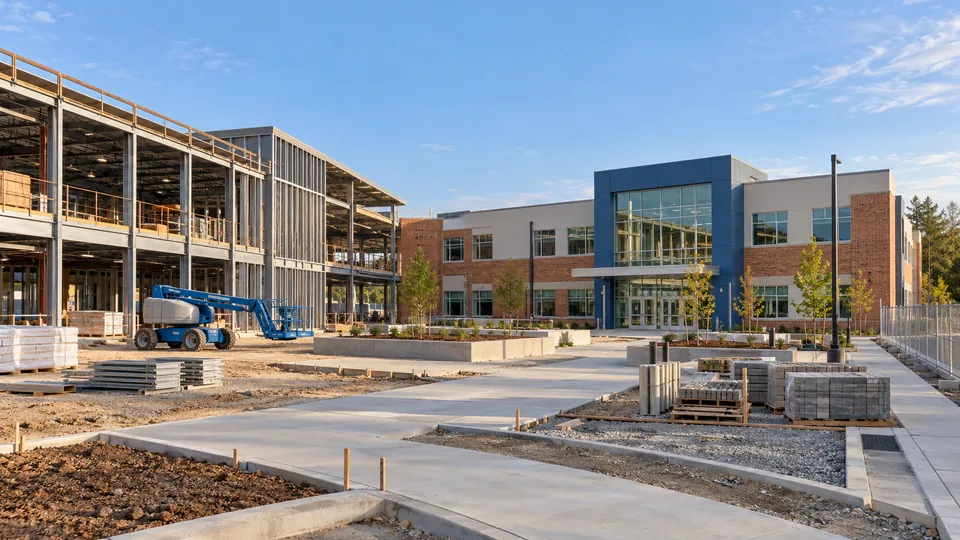
The Field Act and DSA's Role on K-12 Projects
The Field Act was enacted in 1933, and DSA describes it as establishing stringent structural safety standards for public schools. The Division of the State Architect, part of the Department of General Services, carries out plan review and construction oversight for public elementary and secondary schools (grades K-12) and community colleges. A charter school, private school or district-leased building can fall under different rules, so the first question on any school bid is whether the project is a DSA project at all.
On a DSA project the sequence is set before the contractor arrives. DSA approves the plans and specifications, and DSA's oversight page states that after the plans are approved, DSA is notified by the design professional of the start of construction. The contractor's job is to build what DSA approved, and changes to the approved documents typically go back through the design professional and DSA rather than being settled in the field between the contractor and the district.
Statewide coverage and bond topics for California builders are gathered under California construction insurance and bonds.
The DSA-Approved Project Inspector and What It Means for the Contractor
DSA's oversight page states that DSA reviews the qualifications of and approves the proposed project inspector who will inspect the construction. DSA's Interpretation of Regulations IR A-24, revised September 11, 2019, explains that the district must provide continuous inspection by a DSA-certified project inspector and that the cost is paid by the school board, citing California Administrative Code section 4-333(b). The inspector may not have any current employment relationship with an entity that is a contracting party.
For the contractor, the practical result is that the inspector works for the district and DSA, not for the builder. The inspector's presence does not replace the contractor's own quality control, and the inspector can issue deviation notices that the contractor must answer. Schedules typically build in inspection holds for each aspect of the work, and a crew that starts work the inspector was not told about can create a documentation gap that is hard to close later.
Program questions for contractors who build for public owners are discussed in insurance and bonds for public works contractors.
Contractor Duties Under DSA: Approved Plans, Quality Control and Notices
IR A-24 lists the contractor's construction phase duties alongside those of the district and the design professional. Form DSA 156, Commencement/Completion of Work Notification, carries the notice rule from Title 24, Part 1, section 4-343(b): the contractor must notify the project inspector of the commencement of construction of each aspect of the work at least 48 hours in advance. The duties IR A-24 assigns to the contractor include:
- Provide a written construction schedule.
- Build the work in accordance with the DSA-approved construction documents.
- Provide quality control of all work, including the work of all subcontractors.
- Respond to deviation notices from the project inspector.
- Notify the inspector at the start of each aspect of the work, using form DSA 156.
- Give the inspector and DSA access to the work.
- Submit a final verified report on form DSA 6-C, the Contractor Verified Report.
Modernization work inside existing school buildings raises its own property questions, discussed in builder's risk for renovations and existing structures.
Closeout, Verified Reports and the 90-Day Rule
DSA's project certification page describes final verified reports from contractors and others, each certifying under penalty of perjury that all construction was completed in accordance with DSA-approved documents. The same page states that if documents are not received within 90 days, the project will be closed without DSA certification.
Because the contractor's report is signed under penalty of perjury, the record behind it matters: DSA 156 notices, inspector deviation notices and how each was resolved, and the approved changes that altered the documents. A general contractor typically collects matching records from its subcontractors as the work proceeds rather than at the end, since the general contractor's quality control duty under IR A-24 extends to subcontracted work.
Prequalification Under PCC 20111.6
We could not read the current text of Public Contract Code section 20111.6 on the Legislature's site, so this section relies on two older official documents and says so. The text enacted in 2012 by AB 1565 (Chapter 808) applied to projects of $1,000,000 or more funded under the Greene Act or state school bond funds. Bidders submitted a standardized prequalification questionnaire and financial statement verified under oath, and the requirement reached the general contractor and subcontractors holding C-4, C-7, C-10, C-16, C-20, C-34, C-36, C-38, C-42, C-43 and C-46 licenses. It did not apply to a district with average daily attendance of less than 2,500, and it was set to become inoperative on January 1, 2019.
The California Senate Education Committee's June 13, 2018, analysis of AB 2031 states that the bill removes that January 1, 2019, sunset. It restates the requirement as applying to districts with average daily attendance over 2,500 on projects over $1 million that use state bond funds, using the Department of Industrial Relations model questionnaire, with prequalification held quarterly or annually and valid for one calendar year after initial prequalification. The same analysis describes school bid thresholds at that time of $15,000 for public projects and $50,000 for equipment and services. We could not confirm the bill's final enacted form, so a bidder should confirm the current statute and the district's own prequalification notice before relying on any of these figures. The State Allocation Board's School Facility Program grant agreement templates (Rev. 09/22) also have grantee districts certify compliance with section 20111.6.
One large district's prequalification rules, including its financial statement tiers, are laid out in San Diego Unified School District contractor requirements.
DIR Registration and Electronic Certified Payroll
The Department of Industrial Relations' SB 854 page states that no contractor or subcontractor may be listed on a bid proposal for a public works project unless registered with DIR, a rule in place since March 1, 2015. All contractors and subcontractors must furnish electronic certified payroll records directly to the Labor Commissioner. A general contractor typically confirms each listed subcontractor's registration before bid day, since the listing itself is the point at which registration counts.
The School Facility Program grant agreement templates add a state-funding link: DIR must provide prevailing wage monitoring services for School Facility Program projects awarded on or after January 1, 2012, under Labor Code section 1773.3. Prevailing wage, apprenticeship and payroll obligations flow down the subcontract chain, and payment bond and payroll exposure on a school job can vary by district contract and by the terms of the bonds issued.
Statutory bond rules for California public works are explained in California public works bond requirements.
State Funding: The School Facility Program and Proposition 2
The Office of Public School Construction's 2026 report to the Legislature describes the School Facility Program as a $54.5 billion program and states that Proposition 2, approved in November 2024, authorizes an additional $8.5 billion for School Facility Program projects. The California Department of Education states that Proposition 2 was approved by voters on November 5, 2024. It describes the measure as $10 billion in general obligation bonds; the $8.5 billion figure is the K-12 School Facility Program share reported by OPSC.
State funding matters to a contractor because, under the 2012 text of section 20111.6 and the grant agreement templates, a state-funded project brings prequalification and DIR monitoring with it. Local bond measures fund much of the work as well, and a district's own bond program can bring added terms such as a labor agreement, so the funding source is worth asking about at the pre-bid stage.
Requirements for other states and districts are compared in school construction insurance and bonds.
Bonds, Insurance, Retention and Warranty Come from the District
We did not verify a statewide bid security percentage, payment or performance bond percentage, retention cap or warranty term for school districts, so this page states none. Each district writes those terms into its own instructions to bidders, general conditions and supplementary conditions, along with insurance limits, additional insured wording, any owner-controlled insurance program and the form of bid security it accepts.
A bidder typically reads the district's bid documents for those terms first, then checks its surety capacity and policy forms against them. Surety bonds are credit rather than insurance, and whether a given policy responds to a loss depends on its wording, subject to underwriting and the terms of the bonds and policies issued.
Before You Ask for a Quote
What to Gather
- The district's prequalification notice, questionnaire and financial statement requirements
- DIR registration numbers for the firm and every subcontractor to be listed
- The DSA-approved plans and specifications and the project inspector's contact details
- The district's instructions to bidders, general conditions and supplementary conditions
- A schedule showing inspection holds and DSA 156 notice dates for each aspect of the work
- Current liability, auto, workers' compensation and excess policy forms with endorsements
What to Ask the Insurer or Surety
- Is this a DSA project, and is it funded in part through the School Facility Program?
- Does the district prequalify primes and MEP subcontractors, and when is the package due?
- What bid security, bond, retention and warranty terms does this solicitation set?
- What insurance limits and additional insured wording does the district require?
- Does a project labor or stabilization agreement apply to this bond program?
- Who assembles subcontractor records for the final DSA 6-C verified report?
Quick Answer
On a California public K-12 project, DSA approves the plans and the project inspector, the district pays for continuous inspection, and the contractor builds to the approved documents, gives 48 hours' notice on DSA 156 and files a DSA 6-C verified report; districts set bonds and insurance.
Common Mistake
Treating the district's project inspector as the contractor's quality control. IR A-24 makes quality control of all work, including subcontracted work, the contractor's own duty.
Broker Perspective
School bids often turn on paperwork that has nothing to do with price: prequalification packages, DIR registrations and verified reports, so a contractor's financial statements and records typically need to be ready before the bid is.
Coverage Impact
Modernization of existing, occupied school buildings can raise property and liability questions that new construction does not, and how a policy responds depends on its wording and the district's contract terms.
The Same Requirement in Other States
Questions Buyers Ask
Who pays for the DSA project inspector on a California school job?
DSA's IR A-24 states that continuous inspection by a DSA-certified project inspector is provided by the district and paid for by the school board. The inspector may not have a current employment relationship with a contracting party, so the contractor does not hire or pay the inspector.
What is form DSA 156 used for?
Form DSA 156 is the Commencement/Completion of Work Notification. It carries the Title 24, Part 1, section 4-343(b) rule that the contractor notify the project inspector at least 48 hours before starting each aspect of the work.
What happens if DSA closeout documents are late?
DSA's project certification page states that if documents are not received within 90 days, the project will be closed without DSA certification. Contractors typically gather their records during construction so the DSA 6-C verified report can be signed on time.
Is school prequalification still required under PCC 20111.6?
The 2012 enacted text had a January 1, 2019, sunset, and a 2018 Senate analysis of AB 2031 states that bill removes it. We could not confirm the current statute, though districts such as San Diego Unified still require prequalification over $1 million, so confirm with the district's notice.
How much does Proposition 2 provide for K-12 school construction?
OPSC's 2026 report states that Proposition 2, approved in November 2024, authorizes an additional $8.5 billion for School Facility Program projects. The California Department of Education describes the measure as $10 billion in general obligation bonds in total.
Official Sources
- DSA About Us, Department of General Services, Division of the State Architect. Field Act enacted 1933; structural safety standards; DSA plan review and construction oversight for K-12 and community colleges Verified 2026-10-26.
- Construction Oversight for Schools / Essential Services Construction Projects, Department of General Services, Division of the State Architect. DSA approves the project inspector; design professional notifies DSA of the start of construction after plan approval Verified 2026-10-26.
- IR A-24, Construction Phase Duties of the School District, Contractor, and Design Professional (rev 09/11/19), Department of General Services, Division of the State Architect. District provides and pays for continuous DSA-certified inspection (CAC sec. 4-333(b)); inspector independence; contractor duties including schedule, approved documents, quality control, deviation notices, notification, access and DSA 6-C report Verified 2026-10-26.
- Form DSA 156, Commencement/Completion of Work Notification, Department of General Services, Division of the State Architect. Title 24, Part 1, sec. 4-343(b) 48-hour notice before each aspect of the work Verified 2026-10-26.
- Project Certification for Schools / Essential Services Construction Projects, Department of General Services, Division of the State Architect. Final verified reports under penalty of perjury; closure without certification when documents are not received within 90 days Verified 2026-10-26.
- AB 1565 (2012), chaptered text, Chapter 808, California Legislature. Original PCC 20111.6 text: $1,000,000 threshold, state school bond funds, questionnaire and financial statement under oath, license classes, 2,500 ADA exclusion, January 1, 2019, sunset Verified 2026-10-26.
- Senate Education Committee analysis of AB 2031 (June 13, 2018), California State Senate, Committee on Education. Removal of the 2019 sunset; DIR model questionnaire; quarterly or annual prequalification valid one calendar year; $15,000 and $50,000 school bid thresholds Verified 2026-10-26.
- School Facility Program Grant Agreement Master Templates (Rev. 09/22), State Allocation Board, Office of Public School Construction. Grantee certification of PCC 20111.6 compliance; DIR prevailing wage monitoring for SFP projects awarded on or after January 1, 2012 (Labor Code 1773.3) Verified 2026-10-26.
- State General Obligation Bond Measures for the School Facility Program, 2026 Report to the Legislature, Department of General Services, Office of Public School Construction. $54.5 billion School Facility Program; Proposition 2 (November 2024) adds $8.5 billion for SFP projects Verified 2026-10-26.
- Supporting Priority School Districts (Proposition 2), California Department of Education. Proposition 2 approved November 5, 2024; $10 billion in general obligation bonds Verified 2026-10-26.
- SB 854 public works fact page, California Department of Industrial Relations. DIR registration required to be listed on a public works bid; electronic certified payroll to the Labor Commissioner Verified 2026-10-26.
Reviewed by the Principal, Gleason Insurance Brokers, LLCUpdated

