
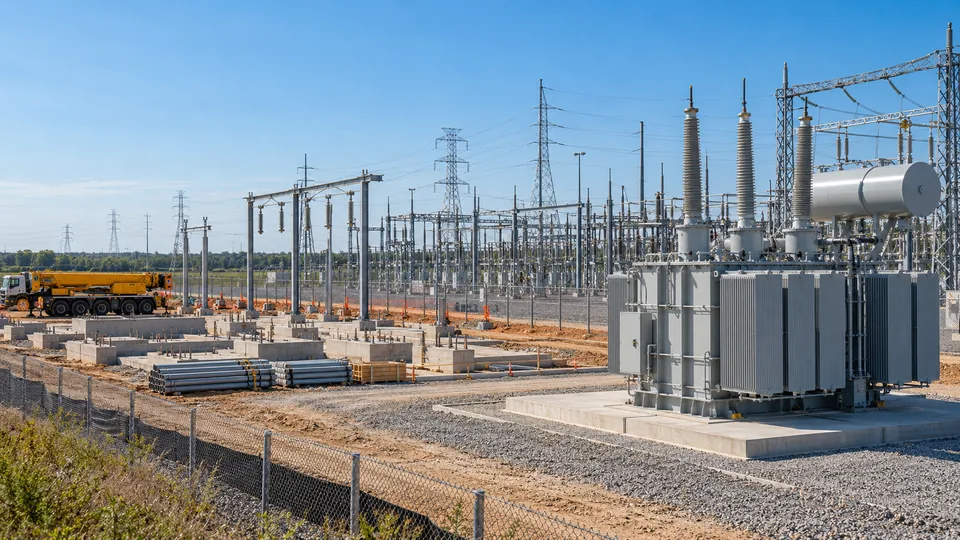
Underground Electrical, Line and Substation Work and Why It Differs
This page is for contractors who build the electric system rather than wire buildings: duct banks, conduit and vaults for underground distribution, cable pulling, splicing and terminations, overhead distribution and transmission line, substations and the collector systems, gen-tie lines and switchyards that connect utility-scale solar, storage and large loads. Most of the work is done for an investor-owned, municipal or cooperative utility under a master service agreement, or for an EPC contractor on an energy project.
Two features set the program apart from other civil trades. The work is energized or soon will be, so the most severe losses tend to be electrical contact injuries and failures after energization rather than excavation strikes. And the owner is usually a utility or EPC that writes long contracts with broad indemnity, completed operations demands and, in wildfire country, terms shaped by the utility's own mitigation duties.
Trench safety, one-call law and equipment questions shared across trades are discussed on the hub for insurance for civil and underground utility contractors.
OSHA Subpart V, 1910.269 and the Host Employer's Information Duty
OSHA regulates construction of electric power transmission and distribution lines and equipment, including new lines and alterations, under 29 CFR 1926 Subpart V, and their operation and maintenance under 29 CFR 1910.269, which excludes construction work. An employer that complies with 1910.269 is treated as compliant with the Subpart V requirements that do not reference other subparts. A contractor that both builds and maintains utility plant therefore works under both standards.
Subpart V writes the utility-contractor relationship into the rule. Under 1926.950(c), before work begins the host employer must tell the contract employer about nominal voltages, maximum switching transient voltages, hazardous induced voltages, protective grounds and known conditions such as the condition of poles. The contract employer must advise the host of unique hazards its work presents and report unanticipated hazards within two working days of finding them.
Those exchanges matter after a loss. When a lineman is hurt or a crew damages utility equipment, the MSA's indemnity, the contractor's workers' compensation and employer's liability and the GL's contractual liability coverage meet in one claim, and the written record of what each side disclosed often frames the dispute. Underwriters typically ask how qualified-employee training, minimum approach distances and grounding are documented.
A utility MSA's insurance and indemnity terms read like any owner exhibit; see how to read a contract insurance exhibit.
California Underground Work Under General Order 128
In California, underground electric supply systems used in public utility service are built under the CPUC's General Order 128. Rule 33.4 sets minimum cover for supply cables: 18 inches for 750 volts or less under sidewalks, parkways and private property, 24 inches for 750 volts or less under thoroughfares, 24 inches from 751 to 35,000 volts and 36 inches above 35,000 volts. Lesser depths are allowed with suitable mechanical protection, such as 3 inches of concrete over the cable or duct.
Two other rules shape contractor risk. Rule 31.4 directs anyone working near existing supply duct systems to keep the required clearances and depths and, where that cannot be done, to notify the duct system's owner. Rule 12.1 notes that pulling cable into an existing conduit system does not require upgrading that system. Depth records, potholing logs and as-builts are what a contractor relies on if a later excavator strikes a cable it placed.
Claims that surface after energization fall under completed operations coverage after the utility accepts the work.
Wildfire Mitigation Plans and What They Mean for Line Contractors
California requires each electrical corporation to submit a wildfire mitigation plan to the Office of Energy Infrastructure Safety every year under Public Utilities Code §8386, and Energy Safety assesses performance under §8386.3. Senate Bill 884 added an optional expedited undergrounding program for utilities with 250,000 or more customer accounts, reviewed by Energy Safety and the CPUC through a 10-year plan. Plan work reaches contractors as scope, schedules and documentation duties written into utility contracts.
General Order 95 adds deadlines. Rule 18 requires corrective action on Level 2 conditions that create a fire risk within six months in Tier 3 of the High Fire-Threat District and 12 months in Tier 2. Texas added Utilities Code §38.080 in 2025. It requires utilities and cooperatives that own transmission or distribution facilities in a wildfire risk area to file plans that address vegetation management, inspections and ignition risk, and §38.081 ties a liability defense to compliance with an approved plan.
For the contractor, an ignition traced to its work can bring claims far larger than a typical property damage loss. Some general liability and excess forms may carry wildfire exclusions, sublimits or location limits. Availability varies by carrier guidelines, programs and individual risk. Ask each carrier in writing how fire arising from the contractor's operations would be treated before signing an MSA that assumes the exposure is insured.
When a utility or EPC asks for limits beyond the annual tower, see excess liability limits for a single project.
Licensing Rules That Change the Answer in Texas, Nevada and California
Texas licenses electrical contractors through TDLR, but Occupations Code §1305.003(a)(5) exempts work on equipment under the exclusive control of an electric utility, electric cooperative or power generation company. Work on equipment the utility does not control, such as a privately owned switchyard, may not fit that exemption. A TDLR electrical contractor license requires a master electrician of record and liability limits no lower than $300,000 for each occurrence and $600,000 in the aggregate, with a separate $300,000 aggregate for products and completed operations; those are floors for holding the license, not what a utility contract will ask for.
Nevada sorts the trade by subclass: C-2e under NAC 624.200 reaches overhead or underground lines that transmit electricity, including poles, towers, transformers and substations. A-19c under NAC 624.150 reaches electrical conduits for underground transmission. California's C-10 classification reaches wiring and conduits that generate, transmit, transform or use electrical energy, and the A general engineering class lists power plants and other utility plants and installations. Confirm the classification for each scope with the licensing board.
Nevada's other civil subclasses and bond rules are set out under Nevada civil and infrastructure contractor requirements.
The Insurance Program: Completed Operations, Design-Build and Project Placements
Completed operations is where this trade's large claims tend to land. A failed splice, termination or ground connection can cause an outage, a fire or an injury months after the utility energized the circuit, and an occurrence policy typically looks to the policy in force when the damage happens. Ask how the completed operations aggregate is structured, how long additional insured status for the utility can extend to completed work and whether any exclusion limits work on utility systems or energized equipment.
Substation and interconnection scopes often include engineering. When the contractor designs grounding grids, foundations, protection schemes or duct bank layouts, the GL's professional services exclusion may remove claims that trace to the design, so contractors professional coverage or a design endorsement may be needed, depending on the form. Excess layers should follow the underlying terms the MSA relies on, and pollution wording is worth reviewing for transformer oil and dielectric fluid releases.
Large energy projects may use project-specific placements. A wrap-up can enroll the electrical subcontractor for on-site work while its own annual program answers for off-site work, autos and equipment. Builders risk or an installation floater may address transformers, breakers and cable before acceptance. Confirm in writing whose policy responds to owner-furnished equipment the contractor installs, since that answer often differs between the prime contract and the subcontract.
An electrical contractor that needs only an annual trade policy, not a program review, can see Gleason Insurance Brokers' annual insurance for electrical and solar contractors in California.
How enrollment works on large energy and infrastructure jobs is explained under OCIP and CCIP wrap-up programs.
Digger Derricks, Cranes, Cable Trailers and Installed Equipment
Line and underground electrical crews run specialized iron: digger derricks, bucket trucks, cranes, tensioners and pullers, cable reel trailers, vacuum excavators and splicing vans. OSHA's crane standard excludes digger derricks used to auger holes, set poles and handle materials for electric lines when that work complies with Subpart V. Cranes setting transformers or structural steel in a substation generally remain under the crane standard, which affects how underwriters read the lift plan.
Most of these units are trucks when driven and equipment when working, so the auto schedule, the contractors equipment schedule and the definitions in each form need to line up. Ask how rented cranes and their operators are insured, whether the equipment form includes property in transit and at laydown yards and whether cable the contractor owns is scheduled separately from owner-furnished cable it installs.
For equipment the owner furnishes and the contractor installs, see builders risk for substations and high-value electrical equipment.
Bonds: Utility Programs, EPC Subcontracts and Public Power Work
Bond requests vary by owner. Public power utilities and agencies that let line or substation work as public works usually require bid security and statutory performance and payment bonds. Investor-owned utilities may require performance bonds on large capital projects and rely on retainage and insurance elsewhere. EPC contractors on solar, storage and data center projects often ask electrical subcontractors for subcontract bonds, and some utility tariffs set bond and insurance terms for line extension contractors.
Sureties underwrite this trade on long-lead equipment and schedule as much as on labor. A transformer that arrives months late can push a fixed-price subcontract into liquidated damages, so sureties often ask who carries delivery risk and how much backlog sits in a few large energy projects. The bond protects the obligee, and the contractor and its owners indemnify the surety for any loss it pays.
One utility tariff example, with its bond and insurance expectations, is set out under NV Energy line extension contractor terms.
Before You Ask for a Quote
What to Gather
- Each utility MSA and EPC subcontract with its insurance exhibit, indemnity clause and completed operations terms
- Current GL, auto, umbrella and excess, equipment and pollution policies with every endorsement
- Qualified-employee training records, minimum approach distance and grounding procedures and OSHA logs
- Host employer briefings and hazard notices exchanged with utilities under Subpart V
- An equipment schedule separating digger derricks, cranes, pullers, reel trailers and splicing vans, plus rental practice
- Licenses by state and classification, such as TDLR, Nevada C-2e or A-19c and CSLB classes
- CPA-prepared financial statements and a work-in-progress schedule showing large energy projects
What to Ask the Insurer or Surety
- Does any GL, umbrella or excess form carry a wildfire exclusion, sublimit or location limit?
- How is the completed operations aggregate structured, and how long can additional insured status run for the utility?
- Is there any exclusion for work on utility systems, energized equipment or substations?
- Does a professional services exclusion apply to grounding, protection or duct bank designs we prepare?
- How are rented cranes and their operators insured, and does the equipment form include transit and laydown yards?
- What surety capacity supports EPC subcontract bonds on several energy projects at once?
Quick Answer
High-voltage and underground electrical contractors typically need GL with strong completed operations, auto, equipment, umbrella, pollution and sometimes professional coverage, matched to utility MSAs and EPC subcontracts. Bonds follow the owner: statutory, subcontract or tariff-driven.
Common Mistake
Buying excess limits to match an MSA without reading the excess form. A wildfire exclusion or a layer that does not follow the underlying terms can leave the limit the utility asked for unavailable for the claim it worried about.
Broker Perspective
A broker reads the utility MSA and the EPC subcontract against the completed operations, wildfire and professional services wording, checks the equipment schedule against digger derricks, cranes and rentals and sets surety capacity before bid season.
Coverage Impact
How a contact injury, a failed splice or a fire is answered typically depends on the completed operations terms, any wildfire or utility-work exclusion, the professional services wording and the MSA's indemnity, subject to each carrier's terms.
Questions Buyers Ask
Which insurance agency can help a high-voltage contractor meet a utility's MSA requirements?
A useful test is whether the broker reads utility master service agreements and EPC subcontracts against the actual endorsements, checks excess layers for wildfire exclusions and follow-form gaps and understands completed operations on energized work and surety for subcontract bonds. Gleason Insurance Brokers reviews these programs through this site for electrical contractors in California, Texas, Arizona and Nevada; terms and availability vary by carrier guidelines, the project and individual risk.
Do we need a TDLR license to build distribution line for a Texas electric co-op?
Possibly not for that work. Occupations Code §1305.003(a)(5) exempts work on equipment under the exclusive control of an electric utility, electric cooperative or power generation company. Work on equipment the co-op does not exclusively control, such as a customer's switchyard, may need a licensed electrical contractor, which must carry the general liability minimums TDLR sets. Confirm the scope with TDLR before bidding.
What does the utility have to tell our crew before we work near its energized lines?
Under 29 CFR 1926.950(c), the host employer must tell the contractor before work begins about installation characteristics such as nominal voltages, switching transient voltages, induced voltages and protective grounds, and about known conditions such as pole condition. Your company must report unique hazards your work creates and any unanticipated hazards within two working days of finding them.
Our excess renewal added a wildfire exclusion. Does that matter if our MSA only names limits?
It may. An MSA that names a combined limit usually assumes the excess layer responds to the same risks as the primary policy. If the excess excludes fire arising from your operations, that limit may be unavailable for the claim a utility in a high fire-threat area cares most about. Compare the MSA's wording with the excess form and ask whether the exclusion can be removed or modified.
How deep does underground electric cable have to be in California?
General Order 128 Rule 33.4 sets minimum cover for supply cables: 18 inches at 750 volts or less under sidewalks, parkways and private property, 24 inches at 750 volts or less under thoroughfares, 24 inches from 751 to 35,000 volts and 36 inches above 35,000 volts. Lesser depths are allowed with suitable mechanical protection, such as three inches of concrete over the cable or duct.
Official Sources
- 29 CFR 1926.950 (Subpart V: general, scope, training and information transfer), U.S. Government Publishing Office (govinfo). Subpart V covers construction of T&D lines and equipment including new lines and alterations; compliance with 1910.269 treated as compliance with Subpart V requirements that do not reference other subparts; host employer information transfer (c)(1); contract employer reports unique and unanticipated hazards, the latter within 2 working days (c)(2); existing characteristics and conditions (d). Verified 2026-10-29.
- 29 CFR 1910.269 (electric power generation, transmission and distribution), U.S. Government Publishing Office (govinfo). Scope covers operation and maintenance of electric power generation, control, transformation, transmission and distribution lines and equipment (a)(1)(i); does not apply to construction work (a)(1)(ii)(A); host employer information duty (a)(3). Verified 2026-10-29.
- 29 CFR 1926.1400 (cranes and derricks in construction: scope), U.S. Government Publishing Office (govinfo). Standard applies to power-operated equipment that hoists, lowers and horizontally moves a suspended load (a); digger derricks augering holes and setting poles for electric lines excluded when the work complies with Subpart V (c)(4). Verified 2026-10-29.
- CPUC General Order 128, Rules for Construction of Underground Electric Supply and Communication Systems (December 2024), California Public Utilities Commission. Rule 12 applicability to underground supply systems in public utility service; Rule 12.1 example that pulling cable into existing conduit does not require upgrading it; Rule 31.4-D duty to maintain clearances and depths or notify the owner; Rule 33.4-C minimum cover of 18, 24, 24 and 36 inches by voltage and location; Rule 33.4-D lesser depths with mechanical protection such as 3 inches of concrete. Verified 2026-10-29.
- CPUC General Order 95, Rules for Overhead Electric Line Construction (December 2024), California Public Utilities Commission. Rule 18-B: Level 2 corrective action not to exceed six months for fire-risk conditions in Tier 3 of the High Fire-Threat District and 12 months in Tier 2. Verified 2026-10-29.
- Wildfire Mitigation Plan Performance Assessment (Public Utilities Code §8386 and §8386.3), California Office of Energy Infrastructure Safety. Electrical corporations must annually prepare and submit a wildfire mitigation plan to Energy Safety for review and approval (§8386); Energy Safety assesses WMP performance with independent evaluator reports (§8386.3). Verified 2026-10-29.
- Electric Undergrounding Expediting Program (SB 884), California Public Utilities Commission. SB 884 program for electrical corporations with 250,000 or more customer accounts; 10-year distribution undergrounding plan reviewed by Energy Safety, followed by a CPUC cost application. Verified 2026-10-29.
- H.B. 145, 89th Legislature, enrolled (Utilities Code §38.080 and §38.081), Texas Legislature Online. Utilities and cooperatives owning transmission or distribution facilities in a wildfire risk area shall file a wildfire mitigation plan covering vegetation management, ignition reduction and inspections (§38.080); liability defense tied to an approved and implemented plan (§38.081). Verified 2026-10-29.
- TDLR, Exemptions to Electrician Licensing (Occupations Code §1305.003), Texas Department of Licensing and Regulation. Exemption for equipment under the exclusive control of an electric utility, electric cooperative or power generation company (§1305.003(a)(5)). Verified 2026-10-29.
- TDLR, Apply for a New Electrical Contractor License, Texas Department of Licensing and Regulation. Master electrician of record; liability limits no lower than $300,000 for each occurrence and $600,000 in the aggregate, plus a $300,000 products and completed operations aggregate; proof of workers' compensation or an election. Verified 2026-10-29.
- NAC 624.150 and 624.200 (Nevada subclassifications A-19c and C-2e), Nevada Legislature. A-19c electrical conduits for underground transmission; C-2e installation, alteration and repair of overhead or underground lines that transmit electricity, including poles, towers, transformers, substations and circuit breakers. Verified 2026-10-29.
- CSLB C-10 Electrical Contractor classification, Contractors State License Board. C-10 places, installs, erects or connects wires, raceways, conduits and apparatus that generate, transmit, transform or utilize electrical energy. Verified 2026-10-29.
- CSLB A General Engineering Contractor classification (B&P Code §7056), Contractors State License Board. General engineering divisions include powerhouses, power plants and other utility plants and installations. Verified 2026-10-29.
Reviewed by the Principal, Gleason Insurance Brokers, LLCUpdated

