
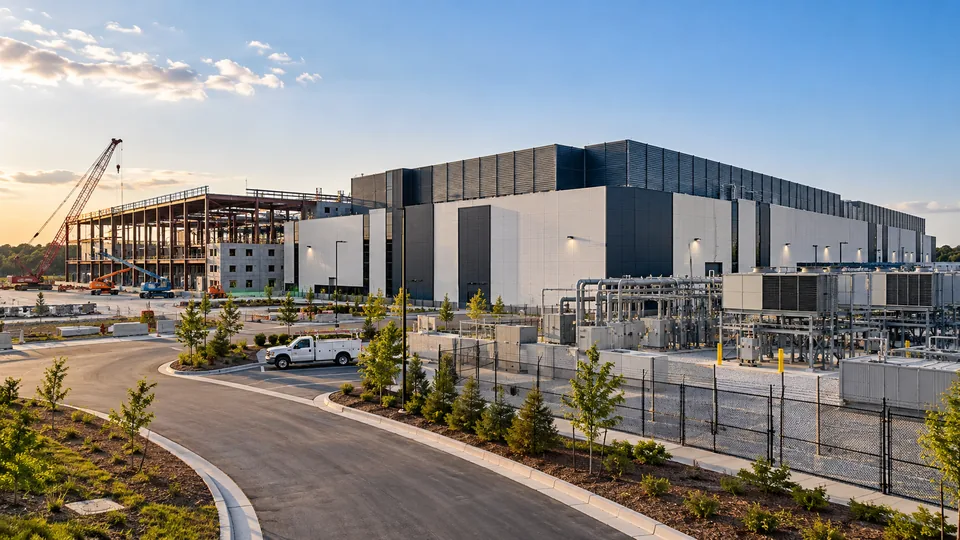
What Changes on a Data Center Project
Data centers concentrate value in power and cooling equipment, and the rules that apply to them follow the power. Before a large load can connect, the developer may owe a study fee and financial security to the utility or transmission provider. Incentive agreements tie tax relief to investment, jobs and, in some states, construction labor. Cities that have adopted data center ordinances add setbacks, generator emission tiers, test windows and noise limits that the finished building must meet.
For the general contractor and the trades, those owner-side obligations show up as schedule risk, completion conditions and contract terms. A permit pause or interconnection delay stretches the builders risk term and the bond period. A noise requirement measured after occupancy can bring the contractor back for mitigation work. The equipment and testing questions that underwriters ask are explained separately in our builders risk guidance.
Equipment values, testing and delay in startup are explained under data center builders risk for equipment and testing.
Texas: Large-Load Security, Sales Tax Conditions and 2026 Directives
Senate Bill 6, effective June 20, 2025, directs the Public Utility Commission of Texas to set interconnection standards for loads of 75 megawatts or more in the ERCOT region. Those standards include financial commitments for transmission, such as security on a dollar-per-megawatt basis set by the commission, a contribution in aid of construction or an advance payment, and a flat screening study fee of at least $100,000. Large loads must also disclose on-site backup generation, which can be called on in emergencies.
The state sales tax exemption for qualifying data centers carries investment and job conditions, and the Comptroller describes construction materials incorporated into real property as outside the exemption. In 2026 the Governor also issued directives on data centers, including a September 21 letter directing the environmental agency to halt data center permits pending an ERCOT review; those are executive directives whose duration and effect may change.
- Statewide rules: large-load interconnection, sales tax conditions and the 2026 directives
- Mesquite: a city data center ordinance adopted in July 2026
The Texas rules are set out in Texas data center requirements.
Mesquite: A City Data Center Ordinance in Dallas-Fort Worth
Mesquite adopted Ordinance No. 5259 on July 20, 2026. It requires a conditional use permit, sets 300-foot setbacks for buildings and 500-foot setbacks for generators, cooling and other equipment from sensitive uses, requires diesel generators to meet EPA Tier 4 Final standards with limited test windows, and calls for a noise study after occupancy with fixes if limits are exceeded. It also requires a decommissioning plan without requiring a bond for it.
The ordinance is set out in Mesquite data center ordinance.
Arizona: Certification, Utility Agreements and City Rules
Arizona certifies computer data centers through the Arizona Commerce Authority. A certified center must reach $25 million or $50 million of new investment, depending on county population, by the fifth anniversary of certification, or the certificate is revoked and the Department of Revenue may recapture tax relief. In December 2025 the Arizona Corporation Commission approved an energy supply agreement between Tucson Electric Power and a data center customer that puts line-extension and switchyard costs, minimum bills and termination fees on the customer; each project's agreement controls its own terms.
Chandler permits data centers only within a Planned Area Development and holds their noise to measured baseline levels, and Phoenix adopted a data center ordinance in July 2025. Salt River Project runs its own large-load queue process, so developers in its territory confirm terms with SRP.
- Arizona statewide: certification, recapture and utility agreements
- Chandler: Planned Area Development, baseline noise and generator testing rules
The Arizona rules, with Phoenix and Tucson notes, are set out in Arizona data center requirements.
Chandler: Noise Held to Baseline
Chandler's Ordinance No. 5033, effective January 5, 2023, requires a third-party baseline sound study, design that keeps sound from exceeding the observed ambient levels, noise studies at occupancy and annually for five years, and generator testing on weekdays with advance notice. A noise obligation that continues after occupancy is a contract and warranty question for the contractor who builds the mitigation.
The ordinance is set out in Chandler data center ordinance.
Nevada: Abatement Labor Conditions and Utility Security
Nevada's partial tax abatement for data centers, approved by the Governor's Office of Economic Development, requires a capital investment of at least $25 million in a county for its shorter tier, operation for a set period and, during construction, that at least 50 percent of the workers be Nevada residents unless waived. A data center that stops meeting the conditions repays the abatement with interest. NV Energy's line-extension rule accepts cash, a letter of credit from an issuer rated A or better or a parent guarantee as security, and requires line-extension contractors to carry insurance and furnish a performance bond where required.
The City of Reno has stated it is not accepting data center conditional use permit applications through August 31, 2027; check current status with the city.
The Nevada rules are set out in Nevada data center requirements.
Bonds, Security and Who Carries the Risk
Most of the security a data center posts to a utility is a deposit, letter of credit, guaranty or advance payment rather than a surety bond. Incentive recapture falls on the owner or operator. Those obligations still matter to the contractor: lenders and owners often push schedule, completion and indemnity terms down the contract chain, and a delay in interconnection or permitting can extend performance and payment bonds and builders risk policies. Where a utility requires a performance bond from a line-extension contractor, that bond is underwritten on the contractor's own financials and capacity, subject to the surety's review.
Insurance typically does not respond to a missed investment or job threshold or to tax recapture. Those risks are managed through the incentive agreement, the construction schedule and contract terms, with counsel and tax advisors.
How contractors are underwritten for bonds is explained under construction surety bonds.
Generators, Fuel and Work After Occupancy
Backup generators sized for a large share of the load, the fuel stored for them and the battery systems some campuses add bring pollution and fire questions into the construction program, alongside the equipment values and testing schedules that drive builders risk. Ordinances that limit generator testing to set hours can lengthen commissioning. Noise studies at or after occupancy can bring contractors back for mitigation after completion, which raises completed operations and subcontractor questions in the liability program.
Pollution exposure on construction sites is explained under contractors pollution liability.
Before You Ask for a Quote
What to Gather
- The interconnection or line-extension agreement and its security terms
- The incentive agreement or certification and its conditions
- The city ordinance, permit conditions or development agreement
- Generator, fuel and battery specifications and test plans
- The prime contract's bond, insurance, warranty and indemnity exhibits
- The construction schedule with permit and energization milestones
What to Ask the Insurer or Surety
- Which party posts utility security, and in what form?
- Do incentive conditions reach the contractor's workforce or records?
- Is any noise or emissions test measured after occupancy?
- How are delays from permits or power handled in the contract?
- Does builders risk run through testing and energization?
Quick Answer
Data center projects typically face large-load interconnection security, incentive conditions with recapture and, in some cities, ordinance requirements for setbacks, generators and noise; the terms vary by state, utility, city and project.
Common Mistake
Assuming utility security or incentive recapture can be insured. Those are financial obligations handled through agreements and contracts, not insurance.
Broker Perspective
We start with the documents that set the conditions, then line up bonds, builders risk and liability terms around the schedule and the contract.
Coverage Impact
Statutes, tariffs and ordinances set the conditions; the bonds and policies issued, their endorsements and the surety's underwriting decide what responds.
Questions Buyers Ask
What does Texas Senate Bill 6 require of data centers?
For loads of 75 megawatts or more in ERCOT, it calls for utility commission standards that include financial security, a screening study fee of at least $100,000 and disclosure of on-site backup generation.
Can a surety bond satisfy large-load interconnection security?
The Texas statute names security set per megawatt, contributions in aid of construction and advance payments; the accepted forms come from the commission's rules and each utility's terms.
Does Nevada's data center abatement affect contractors?
Yes. At least 50 percent of the construction workforce must be Nevada residents unless waived, so contractors are often asked to document workforce residency.
Do city data center ordinances require decommissioning bonds?
Not in the two ordinances we reviewed. Mesquite requires a decommissioning plan without security, and Chandler focuses on zoning, noise and generators.
Is California covered here?
Not yet. California's large-load rules were still interim at our last review, and we did not verify the text of the 2026 bills, so we have not built a California page.
Official Sources
- Senate Bill 6, enrolled (2025), Texas Legislature. Large-load interconnection standards, financial security, the study fee and backup generation in Texas. Verified 2026-10-26.
- Data center sales tax exemption, Texas Comptroller of Public Accounts. Qualifying data center conditions and the treatment of construction materials. Verified 2026-10-26.
- Letter to TCEQ on data center permits (Sept. 21, 2026), Office of the Texas Governor. Directive to halt data center permits pending an ERCOT review. Verified 2026-10-26.
- A.R.S. 41-1519, Arizona Legislature. Computer data center certification, investment thresholds, revocation and recapture. Verified 2026-10-26.
- ACC approves TEP energy supply agreement (Dec. 5, 2025), Arizona Corporation Commission. Line-extension, switchyard, minimum bill and termination fee terms for one data center agreement. Verified 2026-10-26.
- NRS Chapter 360, Nevada Legislature. Data center partial tax abatement conditions, including resident construction workforce, and repayment. Verified 2026-10-26.
Reviewed by the Principal, Gleason Insurance Brokers, LLCUpdated

