
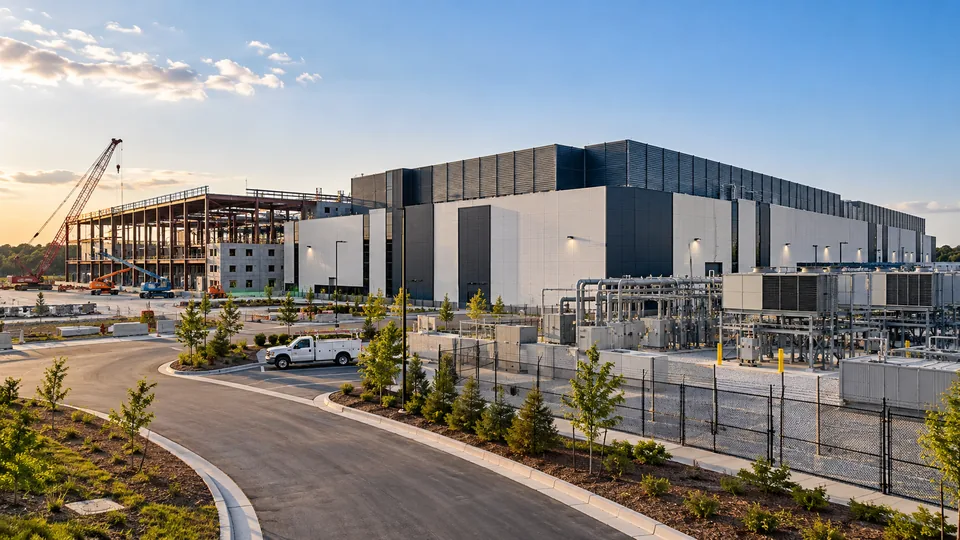
Data Centers Only Through PAD Zoning
Chandler's Ordinance No. 5033 amended the zoning code to address data centers. The city's January 11, 2023, news release says the ordinance was unanimously approved on December 5, 2022, and took effect on January 5, 2023. Its core rule is plain: data centers are not permitted to operate in the City of Chandler unless explicitly approved as part of a Planned Area Development zoning district.
There is a narrow exception for ancillary use, where the data center occupies no more than 10 percent of the building footprint. For a stand-alone or campus project, the PAD approval is the gate, and the conditions attached to it become project requirements alongside the ordinance itself. Developers typically need to budget the rezoning process, its neighborhood meetings and the technical studies before design is final.
Requirements in neighboring Valley cities are collected in Phoenix metro construction insurance and bonds.
A Baseline Sound Study Sets the Design Limit
Before the first neighborhood meeting, the applicant must have a baseline sound study performed by a third-party acoustic engineer. The facility's design must then keep its sound from exceeding the ambient noise levels observed in that baseline study, and the specifications of the mitigation measures must be provided to the City before building permit approval.
That makes the existing ambient level, not a fixed decibel number, the performance standard. Chillers, cooling towers, transformers and generators all count toward the result, so acoustic design, equipment selection and screening walls tend to be settled early. Changes to equipment during procurement or value engineering can reopen the acoustic analysis, which is worth tracking in the change process.
Equipment, testing and delay coverage for these builds is explained in builders risk for industrial and data center projects.
Noise Studies at Occupancy and for Five Years
The ordinance does not end the noise question at completion. A post-construction noise study is required at the certificate of occupancy, and studies continue annually during peak operation of the data center's mechanical equipment for five years. A shortfall found in a later year can lead to mitigation work long after the general contractor has demobilized.
For the construction program, that extends the period in which acoustic design and installation can be questioned. It bears on the design team's professional liability, on design-build contractors who take on acoustic design and on completed operations and warranty exposure for the mechanical and electrical trades. Contracts typically need to say who performs and pays for later mitigation, how subcontractors return to an operating site and which insurance responds to that later work.
Long completed operations periods on large projects are discussed in project-specific liability insurance.
Generator Test Windows and Notice
Generator testing must be posted at least 24 hours in advance. Outside power outages, generators may operate only between 9:00 am and 5:00 pm, Monday through Friday, excluding holidays. Commissioning plans that call for extended generator runs or integrated systems tests typically need to fit those windows, which can lengthen the commissioning period.
Generator fuel delivery, storage and testing also bring pollution exposure, both during construction and once the facility is running. The fuel system contractor and the owner typically decide early whose pollution coverage applies during commissioning, when the line between construction and operation can blur.
Fuel and release exposures for contractors are covered in contractors pollution liability insurance.
Notice, Neighborhood Meetings and an On-Site Liaison
The ordinance requires notice to residents within a half-mile radius and two neighborhood meetings. On the city's request, the operator provides an on-site liaison between the hours of 8:00 am and 10:00 pm. These are operating commitments more than construction terms, but they shape how complaints during commissioning and early operation are handled, and project teams typically agree in advance who answers them while the contractor is still on site.
The State Certification Layer
A Chandler project that seeks Arizona Commerce Authority certification under ARS 41-1519 also carries the state investment deadline. In a county with more than 800,000 people, the statute requires $50,000,000 of new investment on or before the fifth anniversary of certification, and a center that misses it faces revocation and possible recapture of tax relief by the Department of Revenue. A long PAD process or acoustic redesign can therefore press on that clock. Insurance does not cover a missed threshold or recapture; those remain the owner's financial risk.
Statewide certification, the equipment exemption and utility terms are explained in Arizona data center construction requirements.
What It Changes for Insurance, Bonds and Contracts
Ordinance No. 5033 sets no bond, insurance, security, water or decommissioning requirement, so those terms come from the PAD conditions, the utility and the project contracts. Its effect on the program is indirect: a certificate of occupancy study and five years of annual studies keep acoustic performance open, and limited generator windows can stretch commissioning. Owners commonly look at builders risk term and extensions, delay in startup, the general contractor's performance bond and how long completed operations limits stay in place. Whether a surety will support the bonds and on what indemnity, and the terms carriers offer, typically vary by carrier guidelines, programs, project and individual risk, subject to underwriting and the terms of the bonds and policies issued.
Surety underwriting and capacity for large contracts are explained in construction surety bonds.
Before You Ask for a Quote
What to Gather
- The PAD approval and its conditions
- The third-party baseline sound study and the mitigation specifications
- Equipment schedules for chillers, transformers and generators
- Commissioning plan with generator test dates and durations
- Contract terms for post-occupancy noise mitigation
- Generator fuel storage and delivery plan
What to Ask the Insurer or Surety
- Does the project fall under the 10 percent ancillary exception?
- Who pays for mitigation if a later annual study shows an exceedance?
- Can commissioning fit weekday 9:00 am to 5:00 pm generator windows?
- Which policy responds to subcontractor work on the operating site?
- Does the owner seek ARS 41-1519 certification, and when is the investment deadline?
- How long must completed operations limits stay in place?
Quick Answer
Chandler's Ordinance No. 5033, effective January 5, 2023, allows data centers only through Planned Area Development zoning, holds sound to baseline ambient levels with studies at occupancy and annually for five years and limits non-emergency generator operation to weekday business hours.
Common Mistake
Treating noise compliance as finished at the certificate of occupancy. Annual studies continue for five years, so mitigation work can arise long after completion.
Broker Perspective
It typically helps to settle who performs and pays for later acoustic mitigation, and which completed operations coverage applies, before subcontracts are signed.
Coverage Impact
The ordinance sets no insurance terms, but five years of noise studies extend professional, completed operations and warranty exposure, and generator testing adds pollution exposure during commissioning.
The Same Requirement in Other States
Questions Buyers Ask
Where can a data center be built in Chandler?
Only where it is explicitly approved as part of a Planned Area Development zoning district, except an ancillary data center using no more than 10 percent of a building footprint.
When did Chandler's data center ordinance take effect?
The city says Ordinance No. 5033 was unanimously approved on December 5, 2022, and took effect on January 5, 2023.
How long do noise studies continue after opening?
A study is due at the certificate of occupancy, then annually during peak operation of mechanical equipment for five years.
When can generators be tested in Chandler?
Outside outages, between 9:00 am and 5:00 pm, Monday through Friday, excluding holidays, with testing posted at least 24 hours in advance.
Does the ordinance require a bond or insurance?
No. It contains no bond, insurance, water or decommissioning terms; those come from PAD conditions, the utility and project contracts.
Official Sources
- Ordinance No. 5033, data centers (PLH22-0053), City of Chandler. PAD-only rule and 10 percent ancillary exception; third-party baseline sound study; design held to baseline ambient; mitigation specifications before building permit; studies at certificate of occupancy and annually for five years; generator hours and 24-hour notice; half-mile notice, two meetings, on-site liaison Verified 2026-10-26.
- Chandler's data center ordinance now in effect (January 11, 2023), City of Chandler. Unanimous approval on December 5, 2022; effective January 5, 2023 Verified 2026-10-26.
- ARS 41-1519, computer data centers; certification, Arizona Legislature. $50,000,000 investment threshold by the fifth anniversary in counties of more than 800,000 people; revocation and recapture Verified 2026-10-26.
Reviewed by the Principal, Gleason Insurance Brokers, LLCUpdated

