
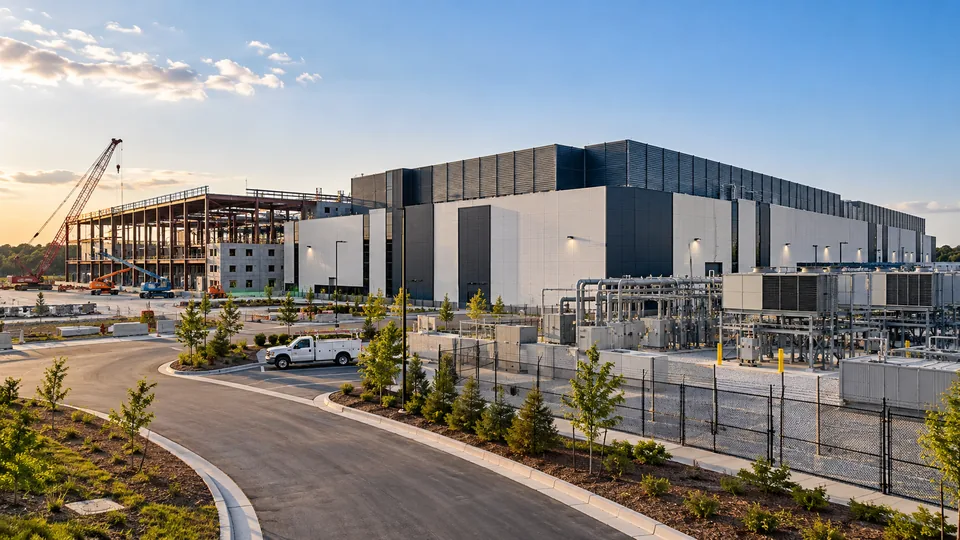
SB 6 Puts a Financial Commitment Before the Grid Connection
SB 6 of the 89th Legislature added Section 37.0561 to the Utilities Code, and the bill history shows it signed and effective immediately on June 20, 2025. The section says "The commission shall establish a demand threshold of 75 megawatts" and that the commission "by rule shall establish standards for interconnecting large load customers in the ERCOT power region." A hyperscale or colocation campus above that line typically meets these standards long before the general contractor mobilizes.
The standards must include "uniform financial commitment requirements for the development of transmission infrastructure." Under subsection (h), the commitment may be security "provided on a dollar per megawatt basis as set by the commission," a contribution in aid of construction, an advance payment for significant equipment or services or another commitment the commission approves. The statute leaves the per-megawatt amount and the accepted forms of security to the commission's rule, so read the current PUCT rule and the utility's agreement rather than assuming a figure.
Subsection (i) says security is refunded in whole or in part "after the security is applied to any outstanding amounts owed," when the load meets its ramp milestones, the request is withdrawn or the capacity is reallocated. The applicant must also show site control through an ownership interest, a lease or another legal interest the commission accepts. The statute does not say which party holds the security, so the interconnection agreement for each project controls that point.
For how Texas compares with other markets, see data center construction requirements by state and city.
Study Fees, Backup Generation and Curtailment
Subsection (f) sets "a flat study fee of at least $100,000" for the initial transmission screening study, and any unused amount is credited toward the customer's obligations at the same site. That fee is an early, sunk cost of site selection, and it sits with the owner or developer rather than in the construction budget.
SB 6 also reaches the generator yard. Large loads must disclose "information about the customer's on-site backup generating facilities," and the utility may require the customer to "either deploy the customer's on-site backup generating facilities or curtail load" during an emergency. Backup covered by that provision must be able to serve "at least 50 percent of on-site demand," and the bill says this does not override emissions limits. New Section 39.170(a) adds that large loads connected after December 31, 2025, can be curtailed during firm load shed, and Section 35.004(c-1) requires large loads to contribute to recovering the utility's interconnection costs under agreements made on or after the effective date.
For builders, a backup plant sized for half or more of site demand typically means more generators, larger fuel storage and longer commissioning, which feeds the testing and pollution questions underwriters ask.
Fuel storage and generator work raise the exposures discussed in contractors pollution liability insurance.
The Commission and ERCOT Set the Process Details
Because SB 6 delegates the amounts and forms to rules, the operating details sit with the PUCT and ERCOT. ERCOT's issue page for NPRR1325, "Batch Zero Process for Large Load Interconnections," shows it approved by the PUCT on June 18, 2026, and effective July 11, 2026, for all but four listed sections. That page describes the study process rather than security terms.
Rule numbers, security amounts and batch timing can change, so the developer's interconnection counsel and the transmission service provider are the parties to confirm current terms. A broker can help price what a delay in the interconnection date does to the builders risk term and soft costs, but cannot set the security amount or obtain the interconnection.
Where a campus pairs the load with on-site generation or storage, see Texas solar and battery storage requirements.
The Sales Tax Exemption Leaves Construction Materials Taxable
Texas Tax Code Section 151.359 provides a sales and use tax exemption for qualifying data centers, and the Comptroller's pages describe two tracks. The standard track (Form AP-233) needs "at least 100,000 square feet of space in a single building or portion of a single building," at least 20 qualifying jobs in the county and "a capital investment of at least $200 million" over five years, and the exemption "lasts for 10 or 15 years beginning on the date the Comptroller's office certifies the data center." The large project track (Form AP-236) needs "a project of at least 250,000 square feet," 40 qualifying jobs and "a capital investment of at least $500 million," and that exemption "lasts for 20 years." A qualifying job must pay "at least 120 percent of the county average weekly wage."
For the general contractor, the key line is what the exemption leaves out. The Comptroller says property incorporated into real estate or into an improvement of real estate is excluded, so building materials stay taxable, while electrical systems, cooling systems, emergency generators and hardware can qualify. Labor used to build or refurbish property used in the data center counts toward capital investment. Data centers with Chapter 313 value limitation agreements are excluded.
If the requirements are not met, the Comptroller will "terminate the certification and revoke the data center's sales tax exemption," and each person whose registration number is revoked is liable for the tax "including penalty and interest from the date of purchase." That recapture is a tax and contract obligation. Insurance does not cover a missed incentive threshold or tax recapture, so allocate it in the owner, tenant and construction contracts.
Owner-side program design, including contract allocation, is covered in insurance and bonds for developers.
The Governor's 2026 Directives Are Letters, Not Statutes
Three 2026 letters from the Governor affect data center schedules. They are executive directives, not statutes or adopted rules; their duration and effect may change, and the current status should be confirmed with the PUCT, ERCOT, the TWDB and the TCEQ.
On August 3, 2026, the Governor directed a PUCT and ERCOT audit, stating the audit must be completed "before any data center project moves forward" and that non-compliant projects "will be denied connection to the Texas grid." On September 14, 2026, he directed the Texas Water Development Board to act on data centers that fail to return its water survey, saying a late filer is ineligible for TCEQ permits, amendments or renewals under Chapter 11 of the Water Code. On September 21, 2026, a letter said, "I am directing the Texas Commission on Environmental Quality (TCEQ) to halt all permits sought by data centers," until ERCOT completes its review, with a compliance update requested by October 19, 2026. That letter also described setback and incentive changes the Governor will seek, which are legislative goals, not enacted law.
A pause on air permits for generators or on water permits can push back mobilization or energization. That is a schedule risk to price into contract dates, bond terms and the builders risk policy period.
For the wider set of Texas rules contractors and developers face, see Texas construction insurance and bond requirements.
What It Changes for Builders Risk, Bonds and Contracts
None of these state sources sets an insurance limit for the construction program. What they change is timing, scope and who carries financial obligations. An interconnection date that moves with a study batch, an audit or a permit pause typically means a builders risk policy period that may need an extension and delay in startup and soft cost limits sized to the real energization date. Performance and payment bond terms can also run longer than planned.
Larger backup generation adds fuel storage, load bank testing and commissioning exposure, which underwriters often price through testing and pollution terms. Utility security, study fees and tax recapture are financial obligations of the owner or developer rather than insurance, and SB 6 does not name a surety bond as a security form. Indemnity and liquidated damages clauses should say who bears an energization delay the contractor did not cause. Terms can vary by carrier guidelines and programs, subject to underwriting and the terms of the bonds and policies issued.
Equipment, testing and delay coverage for these builds is explained in builders risk for industrial and data center projects.
Surety Capacity and the Project Checklist
Large data center contracts can test a general contractor's single and aggregate surety capacity, so capacity and the subcontractor default plan are typically settled before bid. Whether a surety will write a bond, and on what indemnity, is subject to underwriting. Use the checklist to line up the power, incentive and permit dates that drive the bond and builders risk terms.
A step-by-step list of these items is in the data center construction risk checklist.
Before You Ask for a Quote
What to Gather
- Expected peak demand and the large-load interconnection request
- The utility's study fee, security and refund terms
- Backup generation sizing, fuel storage and air permit status
- Sales tax exemption track, job and investment commitments
- Construction schedule tied to the energization date
- Contract clauses on delay, indemnity and tax allocation
What to Ask the Insurer or Surety
- Is the site above the 75 megawatt large-load threshold?
- Which form of financial commitment does the current PUCT rule and utility agreement accept?
- What is the current status of the 2026 audit and permit directives for this project?
- Which purchases stay taxable because they are incorporated into the real estate?
- Who bears tax recapture if job or investment thresholds are missed?
- Does the builders risk policy period allow an extension if energization slips?
Quick Answer
Texas SB 6 (2025) sets a 75 megawatt large-load threshold in ERCOT, a flat screening study fee of at least $100,000 and financial commitments the commission sets by rule, while the Comptroller's data center sales tax exemption excludes construction materials and is recaptured with penalty and interest if thresholds are missed.
Common Mistake
Treating the Governor's 2026 letters as settled law, or assuming the data center exemption reaches building materials. The letters are directives with uncertain duration, and the Comptroller excludes property incorporated into real estate.
Broker Perspective
The energization date drives the program, so it typically helps to size the builders risk period, delay limits and bond terms to a realistic interconnection timeline rather than the original schedule.
Coverage Impact
Utility security and tax recapture are financial obligations, not insurance, while larger backup generation and permit pauses typically shape builders risk testing, pollution and delay terms.
The Same Requirement in Other States
Questions Buyers Ask
What does SB 6 require of large data center loads in Texas?
It directs the PUCT to set a 75 megawatt threshold and interconnection standards in ERCOT, including uniform financial commitments, a flat screening study fee of at least $100,000, site control and backup generation disclosure.
What forms of security does SB 6 allow?
Security on a dollar-per-megawatt basis set by the commission, a contribution in aid of construction, an advance payment for significant equipment or services or another commission-approved commitment. Check the current PUCT rule and utility agreement.
Are construction materials exempt under the Texas data center sales tax exemption?
The Comptroller says property incorporated into real estate or an improvement of real estate is excluded, so building materials typically stay taxable. Electrical systems, cooling systems and emergency generators can qualify.
What happens if a certified data center misses its job or investment thresholds?
The Comptroller can revoke the certification and exemption, and each person whose registration number is revoked owes the tax with penalty and interest from the date of purchase. Insurance does not cover that recapture.
Did Texas stop issuing permits to data centers in 2026?
A September 21, 2026, letter from the Governor directed the TCEQ to halt data center permits until ERCOT completes its review. It is an executive directive, and its current status should be checked with the TCEQ.
Official Sources
- SB 6, 89th Legislature, enrolled bill text, Texas Legislature Online. 75 megawatt threshold; large-load interconnection standards; per-megawatt security, CIAC, advance payment or other commitment; refund terms; flat study fee of at least $100,000; site control; backup generation and curtailment; firm load shed; interconnection cost recovery Verified 2026-10-26.
- SB 6, 89th Legislature, bill history, Texas Legislature Online. Signed and effective immediately on June 20, 2025 Verified 2026-10-26.
- Data Center Sales Tax Exemption, Texas Comptroller of Public Accounts. Standard and large project tracks, square footage, jobs, capital investment and exemption terms; exclusion of property incorporated into real estate; revocation and liability for tax, penalty and interest Verified 2026-10-26.
- Data Center Sales Tax Exemption FAQs, Texas Comptroller of Public Accounts. Qualifying job wage at 120 percent of county average weekly wage; construction labor counted toward capital investment; eligible items Verified 2026-10-26.
- Governor Abbott Directs Comprehensive Data Center Audit (August 3, 2026), Office of the Texas Governor. PUCT and ERCOT audit directive before data center projects move forward Verified 2026-10-26.
- Governor Abbott Directs TWDB to Penalize Data Center Reporting Failures (September 14, 2026), Office of the Texas Governor. Late survey filers ineligible for TCEQ permits, amendments or renewals under Water Code Chapter 11 Verified 2026-10-26.
- Letter to TCEQ on data center permits (September 21, 2026), Office of the Texas Governor. Directive to halt data center permits until ERCOT completes its review; compliance update by October 19, 2026; stated legislative goals Verified 2026-10-26.
- NPRR1325, Batch Zero Process for Large Load Interconnections, ERCOT. Approved by the PUCT on June 18, 2026; effective July 11, 2026, except listed sections Verified 2026-10-26.
Reviewed by the Principal, Gleason Insurance Brokers, LLCUpdated

