Where Fiber and Telecom Contractors Sit in the Contract Chain
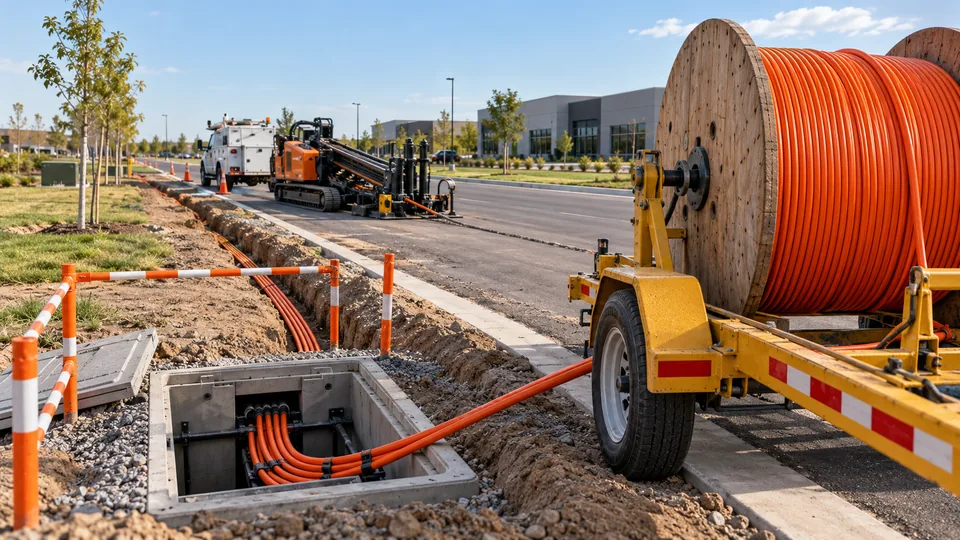
Fiber and telecom contractors build networks someone else will own: an internet provider extending fiber to homes, a cable or wireless company building backhaul, an electric utility adding communications or a city building municipal conduit. Underground work means open trench, micro-trenching, plowing and directional boring of conduit and handholes; aerial work means strand and cable on utility poles after make-ready. Many firms do both under multi-year unit-price master service agreements.
Each owner writes its own insurance terms, and they rarely match. An ISP agreement may call for primary and noncontributory additional insured status, a waiver of subrogation and limits that depend on an umbrella following form. A pole owner's attachment agreement may name the electric utility and set its own indemnity, and each road permit adds conditions. The endorsement schedule usually matters more than the limits on a certificate.
Gas services, operator qualification and shared-trench clearances are covered on the page for gas and joint trench dry utility contractors.
BEAD Builds: The Provider's Letter of Credit or Performance Bond
The federal Broadband Equity, Access and Deployment program funds networks through state broadband offices that award subgrants to providers. NTIA's notice of funding requires a subgrantee to deliver an irrevocable standby letter of credit worth at least 25 percent of the subaward before signing. NTIA's waiver allows instead a performance bond of at least 100 percent of the subaward from a Treasury Circular 570 surety, and either instrument may be reduced as buildout milestones are met.
NTIA's BEAD FAQs, version 22, published in June 2026, add that a state may make the bond a condition to be met within 60 days after the subgrant agreement is signed, with no funds paid until the bond or letter of credit is in place. The requirement applies to every subaward regardless of size, and the bond needs to cover only the federal funds, with the state as its primary beneficiary.
Those obligations belong to the provider, not the builder. The contractor meets them through the subcontract: a provider whose surety bonded the full subaward may ask for a subcontract performance and payment bond, schedule terms tied to the state's milestones and indemnity that mirrors the subgrant agreement. A subcontract bond protects the provider as obligee, and the contractor and its owners indemnify the surety that writes it.
How sureties underwrite that kind of obligation is explained under performance bonds for subcontracted network builds.
State Broadband Offices and the Conduit Access Point Rule
Each state's office sets the subgrant terms that providers flow down. In California, the Public Utilities Commission handles implementation, and NTIA approved its Final Proposal on July 17, 2026. Texas' Broadband Development Office selected 22 applicants to serve more than 240,000 locations and expected construction as soon as summer 2026. NTIA lists the Arizona Commerce Authority as Arizona's broadband contact, and Nevada's Office of Science, Innovation and Technology runs BEAD as Phase III of High Speed Nevada.
Federal law adds one construction requirement. For a BEAD project laying fiber or conduit underground or along a roadway, 47 U.S.C. §1702(h)(4)(D) requires interspersed conduit access points at regular and short intervals, a requirement NTIA's June 2025 restructuring notice kept while dropping added NOFO conduit terms and workforce requirements. Access points add handholes and vaults to each route, and with them more completed work that can draw claims after acceptance.
Trench safety, one-call law and other exposures shared across underground trades are discussed on the hub for insurance and bonds for civil and underground utility contractors.
Pole Attachments, Make-Ready and the Contractor's Insurance or Bond
Aerial fiber depends on the pole owner. Under 47 U.S.C. §224, utilities must give cable and telecommunications attachers nondiscriminatory access to poles, though an electric utility may deny it for capacity, safety, reliability or engineering reasons. The statute excludes cooperatives and government-owned systems from its definition of utility. The FCC also steps back where a state certifies that it regulates attachments, as California did in 1998 through CPUC Decision 98-10-058.
Where the FCC's rules apply, 47 CFR 1.1411 sets a staged timeline, amended effective May 7, 2026. For a standard order, the utility surveys within 45 days of a complete application and presents an estimate within 14 days after the survey, and make-ready is due 30 days after notice in the communications space or 90 days above it, with longer periods for larger orders. These are the regulation's terms, not a promise that any pole owner will meet them.
The rules reach insurance directly. Under 47 CFR 1.1412(c), a utility may require that a contractor doing surveys or make-ready be adequately insured or establish an adequate performance bond, including for work on facilities owned by existing attachers, and follow the utility's published safety guidelines or the National Electrical Safety Code. A crew moving someone else's cable faces that owner's claim, so care, custody or control wording deserves a close read.
Pole attachment agreements read much like an owner's insurance terms; see how to read a contract insurance exhibit.
California Rules for Aerial Lines and Broadband in State Right-of-Way
Overhead communication lines in California are built under the CPUC's General Order 95. Rule 18 makes each company, communications companies included, responsible for correcting potential violations its facilities cause and for keeping records of that work for at least 10 years. In Tiers 2 and 3 of the High Fire-Threat District, Rule 80.1 requires detailed inspections of communication lines on or near joint-use poles carrying supply circuits at least every 10 years in Tier 2 and every five years in Tier 3.
Caltrans uses one permit code, BB, for every telecommunications and wired broadband encroachment, fiber included. Installations are not permitted in the median, and the permittee pays for any later relocation. Under the Dig Smart policy, an installation longer than 10 miles in state highway right-of-way requires a published joint-build notice with at least 30 days for responses, and underground broadband construction at that location is then limited to once every five years unless Caltrans approves an exception.
Caltrans and city permit security is set out under California encroachment permit bonds.
Boring, Micro-Trenching and Damage to Existing Facilities
Underground fiber crews place conduit at shallow depth among gas services, water laterals, signal circuits and other providers' fiber. A bore or micro-trench saw that crosses an unmarked or mismarked line can bring a repair invoice from the operator, outage claims from its customers and, on a gas line, an evacuation. Each state's one-call statute shapes who pays, and the ticket, positive response and potholing records are the contractor's first defense.
Ask whether the GL removes any explosion, collapse and underground exclusion for boring, plowing and micro-trenching, whether subcontracted crews are treated like self-performed work and whether a cross bore found years later would reach the completed operations coverage then in force. Drilling fluid that surfaces in a street or creek may be treated as a pollution event under many GL forms, so contractors pollution coverage that names directional drilling is often part of the program.
State-by-state strike rules are set out in who pays after a utility strike under the one-call statutes.
Which OSHA Standard and License Apply to Communications Work
OSHA's telecommunications standard at 29 CFR 1910.268 reaches work at telecommunications field installations, overhead or underground, but states that it does not apply to construction work, which falls under Part 1926. New fiber construction therefore runs under the construction standards, including the excavation rules in Subpart P. At the pole the line blurs: OSHA's crane standard excludes digger derricks setting telecommunication poles only when that use complies with all of 1910.268.
Licensing follows the scope. Nevada's C-2d subclass under NAC 624.200 reaches systems that use fiber optics or do not exceed 91 volts, and California's C-7 classification reaches energy-limited communication and low voltage systems up to 91 volts. Conduit, boring and pole work may fall under other classifications, so confirm the classification for each scope with the licensing board before bidding.
Boring Rigs, Bucket Trucks and Cable Trailers: Auto or Equipment
Fiber crews run equipment that straddles two policies. A bucket truck is typically an auto when it is driven, while its aerial device may also be scheduled on a contractors equipment form for damage while it works, depending on the forms. Boring rigs, vacuum excavators, cable plows, micro-trench saws and splicing trailers are usually equipment risks, and fusion splicers and locators are small, valuable and easy to steal.
Ask how the auto policy's definitions of auto and mobile equipment treat each unit, whether the equipment form limits property in use underground or on a pole and whether rented rigs are included automatically. When a truck-mounted boom is damaged on the job, the auto carrier may call it equipment, and the equipment carrier may call it part of the auto, so settle that question on paper before the first loss.
A contractor that needs only an annual trade policy, not a program review, can see Gleason Insurance Brokers' annual insurance for fiber optic and low voltage contractors in California.
Lost-in-hole tooling and rig values are discussed under rig and downhole tool coverage for directional drilling contractors.
Bonds for Fiber Work: Subcontracts, Public Networks and Permits
Bond requests come from three directions. Providers building with BEAD or other grant money may ask for subcontract performance and payment bonds. Cities and districts that build their own conduit or fiber usually let the work as public works, with bid security and statutory bonds. Road owners ask for permit security, and in Nevada, NDOT may require a telecommunications provider to post a $100,000 surety bond, or more for a facility of significant length.
All three draw on the same surety credit. Sureties read CPA-prepared financial statements, the work-in-progress schedule and backlog, and multi-year unit-price programs can hold capacity longer than their dollar value suggests. A bond protects the obligee, not the contractor: if the surety pays a claim, the contractor and its owners repay it under the indemnity agreement they signed.
Statutory thresholds for publicly owned networks are compared in public works bond requirements by state.
Before You Ask for a Quote
What to Gather
- Each ISP or utility master service agreement with its insurance exhibit and indemnity clause
- Pole attachment agreements for each pole owner on the route, including cooperative and municipal owners
- The BEAD subgrant terms the provider is flowing down, if the build is BEAD-funded
- Current GL, auto, umbrella, equipment and pollution policies with every endorsement
- A unit schedule separating bucket trucks, boring rigs, plows, saws and splicing trailers
- Locate, potholing and damage records, plus OSHA logs and loss runs
- CPA-prepared financial statements and a work-in-progress schedule for the surety
What to Ask the Insurer or Surety
- Does the GL remove any underground exclusion for boring, plowing and micro-trenching, including subcontracted crews?
- How do the auto and equipment policies treat a truck-mounted aerial device damaged while working?
- Does the policy limit property damage to another attacher's cable we move during make-ready?
- Does the pollution policy name directional drilling and vacuum excavation as covered operations?
- Can the pole owner, the ISP and the road agency each be added as additional insureds by blanket endorsement?
- What surety capacity supports a multi-year unit-price program alongside permit bonds?
Quick Answer
Fiber and telecom contractors typically need GL without a restrictive underground exclusion, auto, equipment, umbrella and pollution coverage, with endorsements for ISPs, pole owners and road agencies. On BEAD builds the provider posts a letter of credit or performance bond, and subcontract bonds may follow.
Common Mistake
Treating a BEAD subcontract like any other ISP job. The provider's letter of credit or bond and its milestone schedule can reach the subcontract as bond, schedule and indemnity terms the contractor did not price.
Broker Perspective
A broker lines up the ISP agreement, each pole owner's attachment agreement and each permit against the actual endorsements, then checks how bucket trucks, rigs and third-party cable moved during make-ready are treated before crews mobilize.
Coverage Impact
How a strike, a damaged attachment or a drilling fluid release is answered typically depends on underground and pollution wording, care, custody or control limits and the auto and equipment definitions, subject to each carrier's terms.
Questions Buyers Ask
Which insurance brokers can help a fiber contractor qualify for ISP and BEAD subcontracts?
Look for a broker that reads ISP master agreements, pole attachment agreements and BEAD flow-down terms against the actual endorsements and that can place underground, pollution and equipment coverage alongside subcontract bonds. Gleason Insurance Brokers reviews these programs through this site for contractors in California, Texas, Arizona and Nevada; what any market offers varies by carrier guidelines, the project and the firm's own risk.
Do we have to post the BEAD letter of credit if we are only the construction contractor?
Not under the BEAD rules themselves. NTIA's letter of credit or performance bond requirement falls on the subgrantee, the provider that signs the subgrant agreement with the state. The provider may still ask its construction contractor for a subcontract performance and payment bond or other security, so read the subcontract's bond, milestone and indemnity terms before pricing the work.
The electric co-op says FCC make-ready deadlines don't apply to its poles. Is that right?
Often, yes. The federal pole attachment statute excludes cooperatives, railroads and government-owned systems from its definition of utility, so a co-op's attachment agreement and any applicable state law usually set access terms, timelines and insurance requirements. Ask the co-op for its contractor qualification and insurance terms before scheduling make-ready crews.
Can our crews do the make-ready for an ISP when the pole owner misses its deadline?
On poles under the FCC's rules, the new attacher, usually the ISP, may perform make-ready itself once the utility's deadline passes, and it may hire a contractor on the utility's approved list or one that meets the qualifications in 47 CFR 1.1412. The utility may require that contractor to be adequately insured or post an adequate performance bond and to follow its published safety guidelines. Check the current rule's notice steps and the attachment agreement before crews mobilize.
Does Caltrans limit how often we can dig for fiber along a state highway?
It can. Where Caltrans applied its Dig Smart policy, underground broadband construction at that location is limited to once every five years unless an exception is approved. Longer installations in state highway right-of-way also require a published joint-build notice with at least 30 days for responses, so missing a build window can cost a route.
Official Sources
- BEAD Letter of Credit Waiver (letter of credit, performance bond alternative and milestone reductions), National Telecommunications and Information Administration (BroadbandUSA). Irrevocable standby letter of credit of at least 25 percent of the subaward; performance bond alternative of at least 100 percent of the subaward from a Treasury Circular 570 surety; reductions as buildout milestones are met. Verified 2026-10-29.
- BEAD Frequently Asked Questions and Answers, Version 22 (June 2026), National Telecommunications and Information Administration (BroadbandUSA). January 2026 waiver update allowing the performance bond within 60 days of the subgrant agreement (FAQ 8.5); no funds paid before the instrument is secured; required for all subawards regardless of cost (8.6); state as primary beneficiary and bond for federal funds only (4.10, 4.11); 25 percent letter of credit or 100 percent bond may be maintained through milestones. Verified 2026-10-29.
- BEAD Restructuring Policy Notice (June 6, 2025), National Telecommunications and Information Administration. Statutory conduit access points kept while added NOFO conduit terms were removed; NOFO labor and workforce requirements eliminated in favor of a certification of compliance with federal labor and employment laws. Verified 2026-10-29.
- 47 U.S.C. §1702 (Broadband Equity, Access, and Deployment Program), U.S. Government Publishing Office (govinfo). Section 1702(h)(4)(D): projects laying fiber or conduit underground or along a roadway include interspersed conduit access points at regular and short intervals; (g)(2) subgrantee capacity and recovery for nonperformance. Verified 2026-10-29.
- California BEAD Final Proposal, California Public Utilities Commission. CPUC handles state implementation and grant administration of BEAD in California; NTIA approved California's Final Proposal on July 17, 2026. Verified 2026-10-29.
- Broadband Equity, Access, and Deployment (BEAD) Program, Texas Broadband Development Office, Texas Comptroller of Public Accounts. Texas Broadband Development Office selected 22 applicants to serve over 240,000 broadband serviceable locations and expects construction to begin as soon as summer 2026. Verified 2026-10-29.
- Arizona state broadband contact and BEAD award total, National Telecommunications and Information Administration (BroadbandUSA). Arizona Commerce Authority serves as Arizona's point of contact for broadband; BEAD award total of $993,112,231.37. Verified 2026-10-29.
- High Speed Nevada Initiative, BEAD, Nevada Governor's Office of Science, Innovation and Technology. OSIT runs the High Speed Nevada Initiative and its Phase III BEAD subgrantee selection. Verified 2026-10-29.
- 47 U.S.C. §224 (pole attachments), U.S. Government Publishing Office (govinfo). Definition of utility excludes railroads, cooperatives and government-owned entities (a)(1); no FCC jurisdiction where a state regulates and certifies (c); nondiscriminatory access with electric utility denial for capacity, safety, reliability and engineering reasons (f). Verified 2026-10-29.
- CPUC Decision 98-10-058 (rights-of-way and pole attachment rules), California Public Utilities Commission. CPUC certification to the FCC that California regulates rates, terms and conditions of access to poles, ducts, conduits and rights-of-way under 47 U.S.C. §224(c). Verified 2026-10-29.
- Accelerating Wireline Broadband Deployment, Fifth Report and Order (FCC 25-38), 90 FR 41726, U.S. Government Publishing Office (Federal Register). Amended 47 CFR 1.1411: 45-day survey and 14-day estimate for standard orders, make-ready due 30 days after notice in the communications space and 90 days above it, longer periods for mid-sized and large orders and self-help for make-ready after a missed deadline. Verified 2026-10-29.
- FCC Public Notice DA 26-446 (effective date for pole attachment rules), Federal Communications Commission. Amendments to 47 CFR 1.1403(b), 1.1411(c)-(k) and 1.1412(a)-(b), (e) effective May 7, 2026. Verified 2026-10-29.
- 47 CFR 1.1412 (contractors for survey and make-ready), U.S. Government Publishing Office (govinfo), CFR edition of October 1, 2025. Paragraph (c): contractor agrees to follow the utility's published safety guidelines or the NESC and is adequately insured or will establish an adequate performance bond, including for work on existing attachers' facilities (paragraph (c) was not amended by FCC 25-38). Verified 2026-10-29.
- CPUC General Order 95, Rules for Overhead Electric Line Construction (December 2024), California Public Utilities Commission. Rule 18: each company, including communications companies, takes corrective action on potential violations its facilities cause and keeps records for at least 10 years; Rule 80.1: detailed inspection intervals of 10 and five years for communication lines on or near joint-use poles in Tiers 2 and 3 of the High Fire-Threat District. Verified 2026-10-29.
- Caltrans Encroachment Permits Manual, Chapter 600 (Utility Permits), Section 603.2A (current as of 04/2026), California Department of Transportation. Permit Code BB for all telecommunications and wired broadband permits; wired broadband includes copper and fiber optic cabling; no median installations; relocation at permittee cost; Dig Smart joint-build notice over 10 miles with a 30-day response period and a five-year limit on underground broadband construction. Verified 2026-10-29.
- 29 CFR 1910.268 (telecommunications), U.S. Government Publishing Office (govinfo). Scope covers telecommunications field installations overhead or underground; the standard does not apply to construction work, which is subject to Part 1926 (a)(2)-(a)(3). Verified 2026-10-29.
- 29 CFR 1926.1400 (cranes and derricks in construction: scope), U.S. Government Publishing Office (govinfo). Paragraph (c)(4): digger derricks used to auger holes and set poles for electric or telecommunication lines are excluded when telecommunication construction use complies with all of 1910.268. Verified 2026-10-29.
- NAC 624.200 (Nevada classification C-2 electrical contracting; subclassification C-2d), Nevada Legislature. C-2d covers installation, alteration and repair of systems that use fiber optics or do not exceed 91 volts, including telephone and cable television systems. Verified 2026-10-29.
- CSLB C-7 Low Voltage Systems Contractor classification, Contractors State License Board. C-7 covers communication and low voltage systems that are energy limited and do not exceed 91 volts, including telephone and cable television systems. Verified 2026-10-29.
- NAC 408.4404 (NDOT surety bond for telecommunications facilities), Nevada Legislature. NDOT may require a provider of telecommunications to post a $100,000 surety bond for an occupancy permit, and more than $100,000 but less than $2,000,000 for a facility of significant length. Verified 2026-10-29.
Reviewed by the Principal, Gleason Insurance Brokers, LLCUpdated