
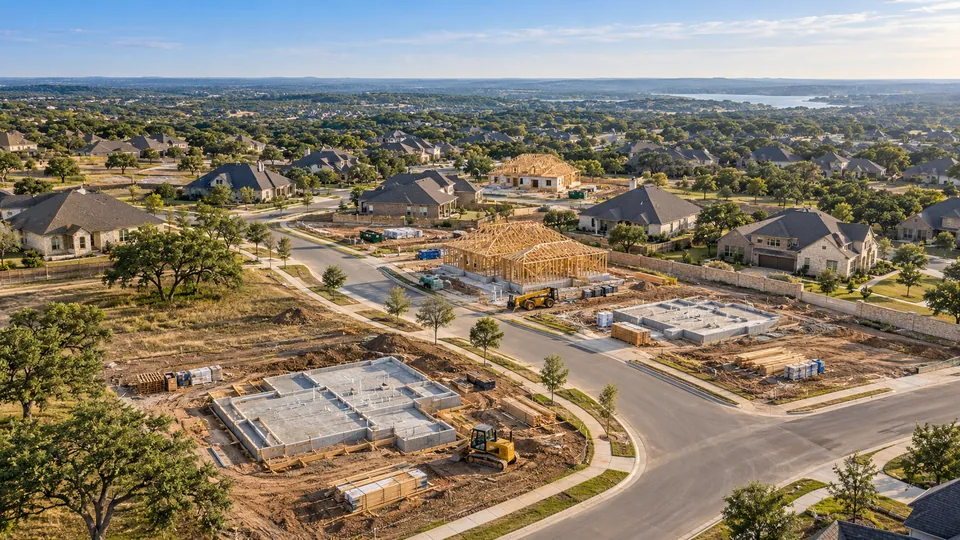
Atlas 14 and Austin's 500-Year Regulatory Floodplain
Austin's Watershed Protection Department says the NOAA Atlas 14 study showed Central Texas is getting heavier rainfall. In November 2019 the city updated its floodplain regulations, and the most significant change was to base development regulations on the current FEMA 500-year floodplain instead of the 100-year floodplain. The city has begun updating floodplains citywide, and until that work is complete, the regulatory floodplain stays tied to the FEMA 500-year line.
The city also changed how high a building must be elevated above the regulatory flood elevation. The result for a developer is that land once outside floodplain review may now be inside it, with elevation, drainage and permitting steps that affect cost and schedule.
Insurance follows the map. A builders risk carrier may ask whether a site is in a mapped floodplain, and the answer in Austin depends on which line governs. Ask how the carrier defines a flood zone and whether its terms track the FEMA 100-year line, the 500-year line or its own flood model.
Sublimits, deductibles and values for floodplain sites are explained under builders risk flood terms.
Austin Fiscal Surety: What It Guarantees and How It Is Posted
Austin's Development Services Department describes fiscal surety as security that certain improvements will be made during the development of site plans and subdivisions. The items listed include water and wastewater infrastructure, streets, sidewalks and right-of-way, drainage systems, detention and water quality ponds, erosion controls, restoration, landscaping and tree transplants, parkland and developer agreements.
The posting rules are specific. The deposit is paid at the end of review before the permit issues. The amount is approved from an engineer's estimate. Accepted methods are bond, escrow and letter of credit. Only original bonds with wet signatures from companies on the U.S. Treasury's list of certified sureties are accepted, in the city's format. Release comes after a city inspector approves the work, and the city says that selling the property does not release the requirement.
A fiscal surety bond is surety, not insurance. It protects the city, and the developer or its principals typically sign an indemnity agreement with the surety. Bond capacity for fiscal postings competes with any other bonds the sponsor needs, so a phased project should plan the postings across phases rather than one permit at a time.
How sureties underwrite developer security is explained in bonds for subdivision and site improvements.
Edwards Aquifer Plan Approval in the Austin Region
TCEQ regulates construction over parts of the Edwards Aquifer under 30 TAC chapter 213. Its program page says a builder must first have an Edwards Aquifer protection plan reviewed and approved by TCEQ, and that technical review of an administratively complete application takes 90 days. Williamson, Travis and Hays counties are assigned to TCEQ's Austin Regional Office for this program.
The schedule effect is direct: on a covered site, regulated construction should not begin until the plan is approved. Builders risk start dates, contractor mobilization and lender draw schedules should account for that review.
The insurance effect sits in pollution. The aquifer is karst, and TCEQ notes that caves, fractures and sinkholes can carry runoff and spills straight into it. A fuel or drilling-fluid release on a recharge-zone site can become a costly cleanup, and general liability forms often carry a pollution exclusion. Contractors pollution liability is the line that typically answers that question.
Spill and discharge exposures are explained under contractors pollution liability for aquifer sites.
Right-of-Way Excavation Permits: Insurance Terms
Excavation in Austin's right-of-way needs insurance, a bond and a right-of-way contractor license, according to the Right of Way Management division's reference sheet, which also says permits are issued per job and not until every document is on file. The bond and license mechanics are covered on the Texas right-of-way bond page; the insurance terms are where contractors more often run into trouble.
The reference sheet calls for commercial general liability of at least $500,000 per occurrence for bodily injury, property damage and personal and advertising injury, with products and completed operations of at least $500,000, explosion, collapse and underground (XCU) coverage and independent contractors coverage. The policy must carry the City of Austin as additional insured on CG 2010 or an equivalent, a waiver of subrogation on CG 2404 and 30 days' notice of cancellation on CG 0205, with insurers licensed in Texas and rated B+ VII or better by A.M. Best.
Three terms reach past the permit. The city's coverage is to be primary, with the other insurance clause not applying to the city. A claims-made policy needs a retroactive date matching the agreement. And the contractor must keep coverage in force for the agreement and for two years after it ends. A general liability policy that excludes XCU, or a renewal that drops completed operations, can leave a contractor out of compliance on open permits, so the endorsement schedule deserves a check at each renewal. The sheet says requirements vary by type of work and permit, so confirm the packet for each job.
Underground and boring exposures behind the XCU requirement are explained in insurance for directional drilling contractors.
What Austin's License and Permit Bond Form Promises
The city's License and Permit Surety Bond form, revised September 29, 2017, is short but broad. It names the city and all persons who may suffer injury from the principal's work as obligees. The principal promises to indemnify the city and others for damage arising from its use of the right-of-way, to repair defects caused by faulty materials or workmanship and warrant that work for one year after completion, to replace disturbed public property, to build safeguards the city orders and to pay fees, fines and judgments that result from the work.
Cancellation is slow and costly. The surety must give written notice, the cancellation takes effect 30 working days after the city receives it, and the surety stays liable for work begun before that date. Until coverage is restored, the principal is suspended and no permit issues under the city's excavation rules. The bond requirements sheet adds that the bond is annual, must be an original issuance on the city's form with a matching power of attorney and that a continuation certificate must carry the original bond number. Because renewals are not sent to the city automatically, a lapse can stop permits on every job the firm has in Austin.
The license bond model and statewide permit rules are compared in Texas right-of-way permit bonds.
Travis County Construction Security Outside City Limits
Land outside Austin's limits but inside Travis County falls under the county's Chapter 482 development regulations, posted with amendments through October 28, 2025. Section 482.401 requires construction security payable to the County Judge equal to 100 percent of the construction cost, based on an itemized estimate sealed by a Texas licensed engineer, within 120 calendar days after final plat approval when street and drainage improvements are proposed. If it is not filed in time, the plat approval is void. A construction plan for a nonresidential project or a subdivision is not approved until security for erosion controls, permanent stabilization and public infrastructure is filed, unless an agreement with another jurisdiction assigns the security elsewhere.
The county adds a separate amount of $3,000 per acre of land disturbance for on-site and off-site cleanup of erosion damage and discharged sediment, figured by phase. Accepted forms are a bond, a letter of credit or a cash security agreement, each with an escalation clause that may raise the amount over time. The security must have a principal period of three years or more, bonds with no expiration date are acceptable, and a letter of credit must renew automatically unless the bank gives 60 days' notice. A Construction Performance Period of at least one year follows the county's acceptance of public improvements.
For a sponsor, that means the bond request can grow after it is written, and the surety typically wants to see the cost index exposure, the phasing plan and the erosion control program before it commits. The per-acre cleanup amount is a reminder that sediment discharge is a real claim path, which is a pollution and liability question as much as a surety one.
The county rules north of Travis County are set out in Williamson County plat security and warranty bonds.
Putting the Austin Program Together
A typical Austin-area subdivision or commercial site may touch all three rules at once: a floodplain review under the 500-year standard, a fiscal surety posting for erosion controls and public improvements and, on aquifer land, TCEQ plan approval. Each has its own timing, and each affects a different part of the program: builders risk, surety and pollution.
The cleanest approach is to map the permit sequence first, then fit the policies and bonds around it. Builders risk should start when the risk does. Fiscal surety bonds should be lined up before the end of permit review so they do not hold up issuance. Pollution coverage should be in place before the first excavator arrives on a recharge-zone tract.
The owner's full program is laid out in insurance and bonds for land developers.
Bidding the City's Own Construction Contracts
Contractors bidding the city's own capital projects meet a separate set of requirements from development permits: bid security, payment and performance bonds, insurance minimums and endorsements, retainage, warranty and small business program rules, set in the city's contract documents and each solicitation.
Those terms are set out in City of Austin construction contract bonds and insurance.
Airport Expansion
The Austin-Bergstrom expansion runs under the ROCIP AUS owner program, which changes what contractors carry and price.
Those requirements are set out in Austin-Bergstrom airport expansion requirements.
Austin Within the Texas Picture
Statewide Texas rules on public-work bonds, liens and stormwater permits apply in Austin as they do across the state. The Austin difference comes from the city's floodplain standard and fiscal surety process, combined with the aquifer rules that apply across much of Central Texas.
Sponsors who build in both Austin and San Antonio should not assume the same plan fits both. The aquifer rules overlap, but the local ordinances, the posting process and the floodplain standards differ, and each city's review should be read on its own.
Licensing, bond and lien rules are summarized under Texas project insurance and bond rules.
Before You Ask for a Quote
What to Gather
- FEMA 100-year and 500-year floodplain boundaries for the site
- City floodplain review comments and required finished floor elevations
- Engineer's fiscal surety estimate and the city's approved posting amount
- TCEQ Edwards Aquifer protection plan status and approval letter
- Site contractor's liability, pollution and umbrella certificates
- Phasing plan showing which permits and postings apply to each phase
- Right-of-way contractor license bond, insurance certificate and endorsements CG 2010, CG 2404 and CG 0205
- Travis County sealed cost estimate, disturbed acreage by phase and the form of construction security
What to Ask the Insurer or Surety
- Does the builders risk carrier treat the 500-year floodplain as a flood zone for its terms?
- Will the surety write a fiscal surety bond in the city's required format, and what indemnity applies?
- How will bond capacity be used across several phases of fiscal postings?
- Can the builders risk start date follow TCEQ plan approval without a gap?
- Does the contractor's pollution coverage respond to spills that reach karst features?
- What happens to a fiscal surety bond if the developer sells part of the land?
- Does the contractor's liability policy include XCU and keep completed operations in force for two years after the permit agreement?
Quick Answer
Austin regulates development against the FEMA 500-year floodplain, requires fiscal surety before permits issue and, on aquifer land, needs TCEQ plan approval first. Those steps drive builders risk timing, surety needs and pollution exposure.
Common Mistake
Treating fiscal surety as a last-minute task and finding the bond does not match the city's format or comes from a surety not on the Treasury list, which can hold up the permit.
Broker Perspective
A broker maps the Austin permit sequence first: floodplain review, aquifer plan approval and the fiscal posting. The policies and bonds are then timed so none of them becomes the item holding up construction.
Coverage Impact
Flood terms on builders risk may depend on how the carrier defines flood zones. A fiscal surety bond protects the city, and the principal typically owes the surety indemnity. Aquifer spills may fall under a general liability pollution exclusion unless pollution coverage is in place.
Questions Buyers Ask
Why is my Austin site in the floodplain when the old FEMA map says it is not?
Since November 2019, the city has based development regulations on the current FEMA 500-year floodplain instead of the 100-year floodplain, after the Atlas 14 rainfall study. Until citywide floodplain updates are done, land inside the 500-year line is treated as regulatory floodplain. Ask the city's floodplain staff how the rule applies to your parcel.
Can I post Austin fiscal surety with a bond instead of cash?
Yes. The city accepts bond, escrow and letter of credit. A bond must be an original with a wet signature, in the city's format, from a company on the U.S. Treasury's list of certified sureties. The surety will usually ask for financials and an indemnity agreement before it writes the bond.
If we sell the lots, does our Austin fiscal surety obligation go away?
Not by itself. The city says selling the property does not release the fiscal deposit requirement. Release depends on a city inspector approving the improvements. A developer selling lots or pads should plan before closing how the obligation transfers or stays. It should also tell the surety.
How long does TCEQ take to approve an Edwards Aquifer plan for an Austin-area project?
TCEQ says technical review of an administratively complete application takes 90 days, and the application must first be found administratively complete. Regulated construction on a covered site should not start before approval. Build that review into the project schedule and the builders risk start date.
What insurance does Austin expect for a right-of-way excavation permit?
The city's reference sheet lists general liability of at least $500,000 per occurrence with completed operations, XCU and independent contractors coverage, the city as additional insured on CG 2010, a CG 2404 waiver and CG 0205 notice. Coverage is to stay in force for two years after the agreement ends. Requirements vary by permit, so confirm the packet for each job.
How much security does Travis County require for a subdivision outside Austin?
Chapter 482 calls for security equal to 100 percent of the engineer's sealed cost estimate within 120 days of final plat approval, plus $3,000 per disturbed acre for erosion cleanup. A bond, letter of credit or cash agreement can be used, with an escalation clause. Confirm current terms with the county before posting.
Official Sources
- Floodplain Management (Atlas 14 regulation changes), City of Austin Watershed Protection Department. November 2019 floodplain regulation update after NOAA Atlas 14; development regulations based on the current FEMA 500-year floodplain until citywide updates are complete; changes to required elevation above the regulatory flood elevation. Verified 2026-10-23.
- Fiscal Surety, City of Austin Development Services Department. Items guaranteed by fiscal surety; posting at the end of review before permit issuance; bond, escrow and letter of credit methods; original wet-signed bonds from Treasury-listed sureties; release by city inspector; sale of property does not release the requirement. Verified 2026-10-23.
- Edwards Aquifer Protection Program, Texas Commission on Environmental Quality. Plan must be reviewed and approved by TCEQ before regulated construction; 90-day technical review under 30 TAC 213.4(e); Williamson, Travis and Hays counties assigned to the Austin Regional Office; karst features carry runoff and spills into the aquifer. Verified 2026-10-23.
- Right-of-Way Contractors (license, bond and insurance), City of Austin Transportation and Public Works Department. Excavation permits need insurance, a $10,000 bond and a ROW contractor license; most insurers and bonding agents limit coverage to one year; license valid until the bond or insurance on file expires; links to the insurance and bond requirement sheets. Verified 2026-10-27.
- Requirements for ROW Insurance, City of Austin Right of Way Management Division. Permits issued per job only after documents are on file; CGL $500,000 per occurrence for coverages A and B; products-completed operations $500,000; XCU and independent contractors coverage; CG 2010, CG 2404 and CG 0205; Texas-licensed insurers rated B+ VII; other insurance clause not applying to the city; claims-made retro date; coverage for the agreement and two years after; excavation permits under City Code 14-11-102 through 14-11-103. Verified 2026-10-27.
- Requirements for ROW Bond and License and Permit Surety Bond form (revised 09/29/17), City of Austin Right of Way Management Division. Annual $10,000 bond on the city form, original issuance, matching power of attorney, continuation certificate with the same bond number; obligees include persons injured by the work; indemnity, one-year warranty, replacement of public property, payment of fees, fines and judgments; cancellation effective 30 working days after the city receives notice; permits suspended until coverage is restored. Verified 2026-10-27.
- Chapter 482, Travis County Development Regulations (amendments through 10/28/2025), Travis County Commissioners Court. Section 482.401: 100% construction security on a sealed engineer's estimate within 120 calendar days of final plat approval or approval is void; security before construction plan approval unless an agreement assigns it to another jurisdiction; $3,000 per acre for erosion cleanup; bond, letter of credit or cash security agreement with escalation clause; principal period of three years or more; letter of credit auto-renewal with 60 days' notice; Construction Performance Period of at least one year after acceptance. Verified 2026-10-27.
Reviewed by the Principal, Gleason Insurance Brokers, LLCUpdated

