Unincorporated Land, City Rules and a 2009 Document
This page covers subdivisions in unincorporated Denton County. Cities in the county set their own bond and insurance requirements, and inside a city's extraterritorial jurisdiction Section V.11 of the County rules says the more stringent regulations of the two governing bodies apply. Texas counties regulate subdivisions under Local Government Code chapter 232, so a County plat is a separate track from a city plat even on adjoining land.
The document the County links as its current Subdivision Rules and Regulations carries the footer "Rules and Regulations July 2009" on every page, and the County page shows no later amendment date. We could not confirm whether a newer revision exists. Treat the figures below as the posted rules and confirm the current requirement with Denton County Development Services before a surety prices the bonds.
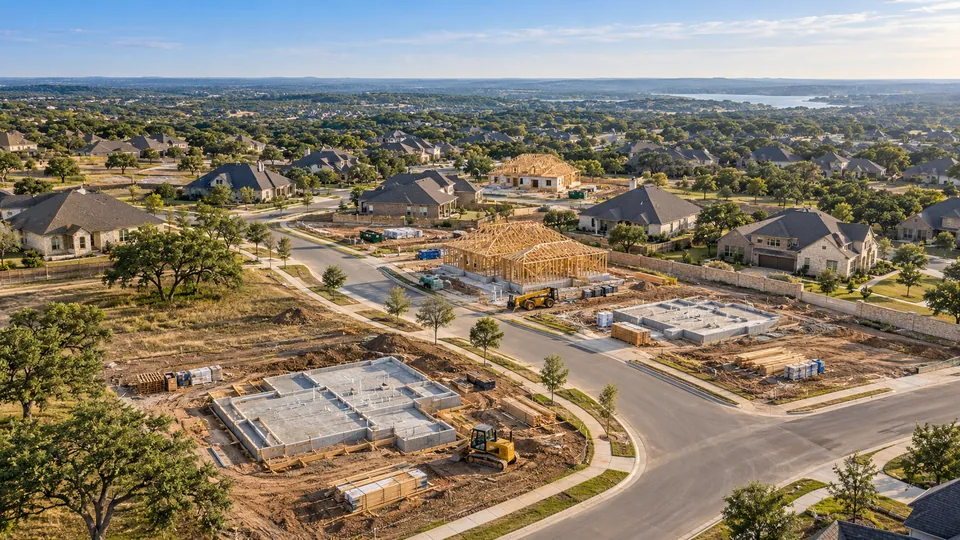
The pace of platting is the reason to check. The County's FY2027 recommended budget presentation, dated August 18, 2026, puts the population at 1,108,089 on a January 1, 2026, estimate under the heading Managing Rapid Growth, and outlying tracts are where County rules apply.
How the County compares with the region's cities is covered under Dallas-Fort Worth construction bonds and insurance.
The 100% Construction Bond Filed with the Preliminary Plat
Section X.V.1 sets the construction bond at 100% of the estimated cost of construction including drainage structures. It is filed with the preliminary plat, written by a surety authorized in Texas and payable to the County Judge. Construction must be complete within two years after preliminary plat approval, so the bond term and the construction schedule are tied to the same date.
Section X.V.4 allows an irrevocable letter of credit in lieu of bonds, with approval by the District Attorney and Commissioners Court. That approval path adds a step a bond does not, and a letter of credit draws on the developer's bank line rather than surety capacity. Which instrument fits typically depends on the developer's lender, its balance sheet and how many other projects are open.
Because the bond is filed at the preliminary plat stage rather than at final plat, it often lands before the construction contract is signed. The surety will usually want the engineer's estimate that sets the amount and some view of who will build the work.
How Texas counties and cities use plat security is explained under Texas subdivision improvement security.
Bonding Instead of Finishing: The 20% Contingency
Section VI.19 lets a developer post a bond instead of finishing construction before the final plat. Here the estimated construction cost must include a contingency factor of 20%, and the bond is not released until the County accepts the improvements for maintenance. The same document states the construction bond amount in Section X.V.1 as 100% of the estimate without that contingency. Both statements are in the County's posted rules; ask the County which figure it will apply to your plat before the surety sizes the bond.
Two related instruments use the same 20% idea. A development permit for unplatted land under Section VI.20 requires a performance bond, letter of credit or escrow agreement to cover the cost of the engineering and surveying process plus a 20% contingency. An erosion bond applies where 75% grass coverage is not reached, written in the rules as 120% of $200 per disturbed acre.
- Construction bond (Sec. X.V.1): 100% of estimated cost including drainage structures.
- Bond in lieu of completion (Sec. VI.19): estimated cost plus a 20% contingency, held until County acceptance.
- Development permit on unplatted land (Sec. VI.20): engineering and surveying cost plus 20%.
- Erosion bond: 120% of $200 per disturbed acre where grass coverage falls short.
The 10% Maintenance Bond and Final Acceptance Timing
Section X.V.2 substitutes a maintenance bond for the construction bond when the construction bond is released. It equals 10% of the estimated cost of construction including drainage structures and requires the improvements to be kept in a good state of repair for two years from the official release of construction security.
Final acceptance comes no earlier than two years after preliminary acceptance, or after the sale and completed construction of 60% of the platted lots. On a slow-selling subdivision, that second trigger can tie the acceptance date to lot sales and home construction rather than to the paving schedule alone.
A facilities agreement under Section X.VI is required for off-site extensions, multiple phases or a construction schedule longer than one year, and it must include a hold-harmless indemnity. That indemnity is a contract obligation the developer's general liability policy may or may not respond to, depending on its contractual liability terms, which can vary by carrier guidelines and programs.
How sureties look at warranty-period exposure is covered under maintenance and warranty bonds.
Right-of-Way Permits and the 12-Month Warranty
Denton County's Right-of-Way User Best Practices, updated November 3, 2025, require a Right-of-Way Use permit any time work takes place over, under or along a County-maintained roadway. Once the inspector is satisfied, the permit is marked completed and a 12-month warranty period begins. Road Policy 8.11 in the subdivision rules has the applicant indemnify the County for 12 months after the installation is accepted, and Section 8.8 requires road crossings to be bored and encased in schedule 40 steel.
Neither the right-of-way guidance nor the County's Utility Installation Requirements states an insurance limit or a permit bond amount. Confirm with Development Services what certificate, limits or additional insured wording the County expects before crews mobilize. The 12-month warranty also means the contractor's completed-operations coverage and the indemnity sit behind the work for a year after the permit closes.
Permit bonding on Texas county and city roads is explained under Texas right-of-way permit bonds and insurance.
Putting the County Program Together
A Denton County subdivision typically needs a surety relationship that can carry a 100% construction bond early, a 10% maintenance bond after release and smaller permit and erosion instruments along the way, plus contractors whose liability coverage matches the County's indemnity and warranty periods. The insurance terms the County imposes on developers were not found in the documents we read, so the certificate requirements are a question to settle with the County at the start.
Developers working on both sides of the county line can compare this with Collin County, whose October 2026 rules use a 100% maintenance bond. Each county's figures should be confirmed with that county.
Coverage for the contractors who build County roads and utilities is covered under Texas civil and infrastructure contractor insurance.
Before You Ask for a Quote
What to Gather
- The engineer's estimate of construction cost including drainage structures
- Written confirmation from the County of which rules version applies to the plat
- Preliminary plat approval date, which starts the two-year construction window
- Phasing plan and any off-site extensions that trigger a facilities agreement
- Right-of-Way Use permit applications and bore-and-casing details for road crossings
- Erosion control plan and the disturbed acreage for the erosion bond
What to Ask the Insurer or Surety
- Will the County apply 100% or the estimate plus 20% for this plat's bond?
- Is the County's July 2009 rules document still the version in force?
- Will the surety write the 100% construction bond at preliminary plat, before a builder is chosen?
- Does the developer's general liability respond to the facilities agreement hold-harmless?
- What certificate or limits will Development Services ask for with a right-of-way permit?
- Does the utility contractor's completed-operations coverage run through the 12-month warranty?
Quick Answer
Denton County's posted rules, dated July 2009, require a construction bond of 100% of estimated cost with the preliminary plat, a 20% contingency where a bond replaces finished work and a 10% maintenance bond for two years.
Common Mistake
Pricing a Denton County bond from the 2009 document alone. The County still links it as current, but its date and the 100% versus 20% contingency wording are reasons to confirm the amount in writing.
Broker Perspective
A broker sizes surety capacity for a 100% bond filed at preliminary plat, plans the step down to a 10% maintenance bond and checks contractor coverage against the 12-month right-of-way warranty.
Coverage Impact
The hold-harmless in a facilities agreement and the 12-month right-of-way indemnity are contract obligations, so contractual liability and completed-operations terms typically matter as much as the bond.
Other Dallas-Fort Worth Cities
Questions Buyers Ask
Are Denton County's posted subdivision rules from 2009 still in force?
The County links the July 2009 Subdivision Rules and Regulations as its current document and shows no later amendment date. We could not confirm whether a newer revision exists, so ask Denton County Development Services to confirm the current version before you price bonds.
Is the Denton County construction bond 100% or 120% of the estimate?
Section X.V.1 states 100% of the estimated cost of construction including drainage structures. Section VI.19, which covers bonding instead of finishing work before the final plat, adds a 20% contingency. Both are in the same posted document, so ask the County which figure applies to your plat.
How long does the Denton County maintenance bond last?
Section X.V.2 sets it at 10% of the estimated cost of construction, requiring the improvements to stay in good repair for two years from the official release of construction security. Final acceptance comes no earlier than two years after preliminary acceptance or after 60% of the platted lots are sold and built.
What does a Denton County right-of-way permit require after the work is done?
The County's right-of-way guidance says the 12-month warranty period begins when the inspector marks the permit completed, and the subdivision rules have the applicant indemnify the County for 12 months after installation is accepted. No insurance limit or permit bond amount was stated, so confirm those with Development Services.
Do Denton County rules apply on land inside a city's ETJ?
Section V.11 of the County rules says the more stringent regulations of the two governing bodies apply. Inside city limits, the city's own requirements govern. Ask the city and the County which rules apply to a specific tract.
Official Sources
- Denton County Subdivision Rules and Regulations (page footers dated July 2009), Denton County Planning and Development Services. Sec. X.V.1 construction bond at 100% of estimated construction cost including drainage structures, filed with the preliminary plat, Texas-authorized surety, payable to the County Judge, construction complete within two years of preliminary plat approval; Sec. VI.19 bond in lieu of completion with a 20% contingency, not released until County acceptance; Sec. X.V.2 maintenance bond at 10% for two years from release of construction security; Sec. X.V.4 letter of credit; Sec. VI.20 development permit security; erosion bond; final acceptance timing; Sec. X.VI facilities agreement with hold-harmless; Sec. V.11 more stringent ETJ rules; Road Policy 8.8 and 8.11. Verified 2026-10-25.
- Subdivision Rules and Regulations (County page linking the current document), Denton County. The County links the July 2009 Subdivision Rules and Regulations PDF as its current document and lists no later amendment date. Verified 2026-10-25.
- Denton County Right-of-Way User Best Practices (updated November 3, 2025), Denton County Development Services. A Right-of-Way Use permit is required for work over, under or along a County-maintained roadway; the 12-month warranty period begins when the inspector marks the permit completed. No insurance or bond requirement stated. Verified 2026-10-25.
- Denton County Utility Installation Requirements, Denton County Development Services. Repeats the 12-month damage responsibility and indemnity for utility work in County right-of-way; no insurance limits stated. Verified 2026-10-25.
- Denton County FY2027 Recommended Budget Presentation (August 18, 2026), Denton County. Denton County population of 1,108,089 based on a January 1, 2026, estimate, under the heading Managing Rapid Growth. Verified 2026-10-25.
Reviewed by the Principal, Gleason Insurance Brokers, LLCUpdated