
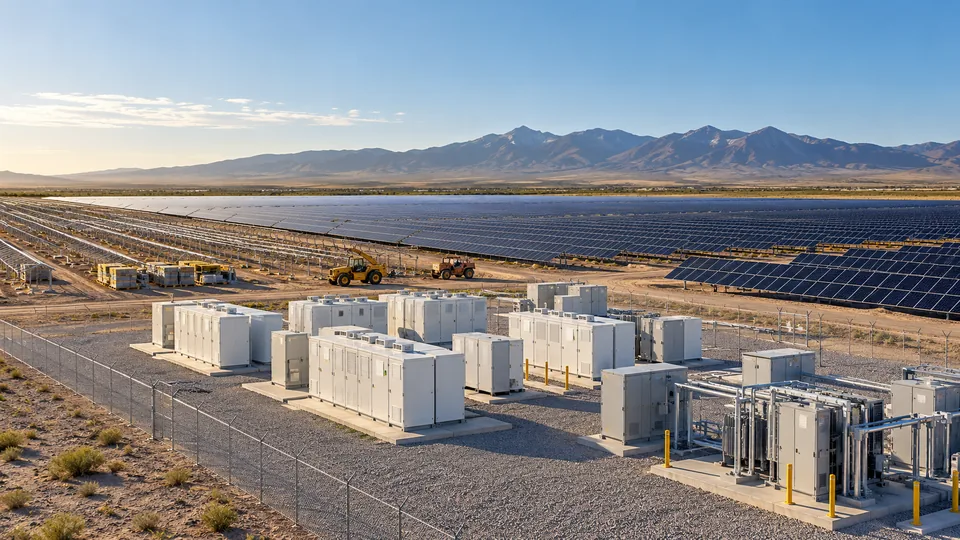
Which Projects Need a PUCN Permit
Nevada's Utility Environmental Protection Act, whose permit sections include NRS 704.860 through 704.890, is the state permit a large solar and storage project typically has to plan around. NRS 704.865 says "A person, other than a local government, shall not commence to construct a utility facility in the State" without a permit from the Public Utilities Commission of Nevada. Once permitted, the facility must be "constructed, operated and maintained in conformity with the permit and any terms, conditions" the PUCN attaches.
The size line comes from the definition. Under NRS 704.860 a utility facility includes electric generating plants, but it excludes a renewable plant with "a nameplate capacity of not more than 70 megawatts." A solar project above that size is therefore within the act, while a smaller one generally falls outside it, and the state permit questions on this page apply mainly to the larger projects.
Project counsel should confirm how a specific project, its gen-tie and any phased build are treated, since the count of megawatts and the scope of the application can affect whether the act applies.
For the wider set of state rules contractors and developers face, see Nevada construction insurance and bond requirements.
A Decommissioning Plan and a Funding Plan in the Application
NRS 704.870 lists what a UEPA application must contain. Subsection (1)(d) calls for "a surplus asset retirement plan as described in subsection 2 of NRS 704.734," covering decommissioning and removal after the facility stops operating, together with "a description of the manner in which the plan will be funded." Decommissioning is therefore part of the permit file from the start, not a matter left to the end of the project's life.
The PUCN then has to make a finding. Before it grants a permit, NRS 704.890(1)(f) requires it to find that the plan "Is able to be reasonably completed under the funding plan contained in the application." A sponsor that proposes a thin or vague funding plan can expect questions on that point. Under NRS 704.890(2), the PUCN "shall condition its permit upon the applicant obtaining" the other permits and approvals the project needs, so local and federal approvals remain separate steps.
For how Nevada compares with Texas, California and federal land projects, see solar and battery storage project requirements by state.
AB 493 Added Solar Plan Contents in 2025
AB 493 of the 2025 session amended NRS 704.734, and the enrolled bill makes that section "effective on October 1, 2025." The current codified NRS 704.734 carries the new 70 megawatt language. Its subsection (2)(e) now applies to "each utility-scale solar project with a nameplate capacity of 70 megawatts or more." For those projects the retirement plan must include the landowner's contact information, the sequence and schedule of decommissioning and how the land will be "returned to a substantially similar state."
The plan must also include "An estimate of the costs of decommissioning" and say how it "will be funded in accordance with NRS 704.870." The definition of a utility-scale solar project, ground-mounted photovoltaic generation of 70 megawatts or more connected directly to transmission, "includes, without limitation, solar arrays, accessory buildings, battery storage facilities, transmission facilities." Co-located battery storage therefore belongs in the estimate and the funding plan, not in a separate document.
Other parts of AB 493 start later. Sections on disposal plans for leased residential distributed generation, a 90 percent panel-recovery rate and reports from recyclers of utility-scale solar components take effect January 1, 2028; recyclers file an annual report by March 1. Owners planning end-of-life work should track those dates.
Sponsor-level program design across land, construction and operation is covered in insurance and bonds for developers.
The Statute Leaves the Form of Security to the Permit
None of NRS 704.734, 704.870 or 704.890 names a bond, letter of credit, escrow or parent guaranty, sets a percentage of the estimate or says how often the amount is recalculated. The statute asks for a cost estimate and a funding plan the PUCN finds adequate. Who holds any security, when it is posted and whether it is updated over time therefore depend on the application and the conditions in each permit, so read the permit itself rather than assuming a standard form.
For the surety market, that open design cuts both ways. A sponsor can propose a bond, a letter of credit or another structure in its funding plan, but a surety asked for a decommissioning bond will typically want to know the term, the trigger for a claim, whether the amount can rise with new estimates and how the bond can be released. Long-tail bonds of that kind usually draw on corporate indemnity and sometimes collateral, and whether a surety will write one is subject to underwriting. A decommissioning bond is a surety obligation, not insurance.
Surety underwriting, capacity and bond types are explained in construction surety bonds.
Projects on Federal Land
Many Nevada utility-scale projects sit on public land managed by the federal government, which brings its own approvals and financial assurance rules alongside the state permit. Those federal terms are a separate layer from the PUCN funding plan, and NRS 704.890(2) already ties the state permit to the other approvals the project needs. How the two sets of requirements fit together on a given project is a question for project counsel and the agencies involved.
Federal land requirements are covered in solar and battery storage on BLM public lands.
What It Means for Builders Risk, Liability and Bonds
The UEPA sections cited here set no insurance limit, additional insured requirement or pollution coverage term. Those come from permit conditions, landowner and federal land agreements, interconnection agreements and the EPC and supply contracts. Read each one for limits and named parties before binding the construction program.
Most utility-scale programs in Nevada still need builders risk with delay in startup for long-lead transformers, modules and battery enclosures, general and excess liability for construction and operation and pollution coverage for site work and battery releases. Battery fire safety is set by the fire code authority with jurisdiction over the site, and underwriters typically ask for test data and the design basis before quoting. The EPC contractor's performance and payment bonds and any decommissioning bond draw on surety capacity, so sponsors and contractors benefit from planning them together. Terms can vary by carrier guidelines and programs, subject to underwriting and the terms of the bonds and policies issued.
Builders risk underwriting for large electrical and equipment-heavy builds is discussed in builders risk for industrial and data center projects.
Before You Ask for a Quote
What to Gather
- Nameplate capacity and project scope, including co-located battery storage
- The surplus asset retirement plan with its cost estimate and schedule
- The proposed funding plan and the form of security behind it
- Landowner and federal land agreements with their insurance and security terms
- Battery test data and the fire code design basis for underwriters
- Sponsor financial statements for surety underwriting
What to Ask the Insurer or Surety
- Is the project over the 70 megawatt line in NRS 704.860?
- What form of decommissioning security does the funding plan propose?
- Do the permit conditions require the amount to be updated over time?
- Which other permits does the PUCN permit depend on?
- Which insurance terms do the permit and contracts require, since the statute sets none?
- Can our surety support a decommissioning bond beside the EPC bonds?
Quick Answer
Nevada requires a PUCN permit under NRS 704.865 for renewable plants above 70 megawatts, with a decommissioning plan and funding plan under NRS 704.870 that the PUCN must find adequate, and AB 493 added cost estimates for solar of 70 megawatts or more from October 1, 2025.
Common Mistake
Assuming Nevada sets a standard decommissioning bond. The statute requires a funding plan and cost estimate, and the form of security comes from the application and the permit conditions.
Broker Perspective
Because the funding plan is proposed by the sponsor, it typically helps to ask a surety about term, release and indemnity before the application is filed rather than after the PUCN asks.
Coverage Impact
The UEPA sections set no insurance terms, so limits, additional insureds and pollution coverage come from permit conditions and contracts, while battery design data typically shapes builders risk terms.
The Same Requirement in Other States
Questions Buyers Ask
Which solar projects need a PUCN permit in Nevada?
Under NRS 704.860 and 704.865, renewable generating plants larger than 70 megawatts of nameplate capacity are utility facilities that need a permit before construction starts. Confirm treatment of a specific project with counsel.
Does Nevada require a decommissioning bond for solar?
Not by name. NRS 704.870 requires a decommissioning plan and a description of how it will be funded, and the PUCN must find the funding plan adequate. The form of security varies by permit.
What did AB 493 change in 2025?
From October 1, 2025, NRS 704.734 requires utility-scale solar projects of 70 megawatts or more to include a decommissioning cost estimate, schedule, restoration standard and funding description in the plan.
Does the Nevada rule include battery storage?
Yes for co-located storage. The AB 493 definition of a utility-scale solar project includes battery storage facilities, so they belong in the plan and estimate.
Does Nevada's UEPA set insurance requirements for solar projects?
The sections cited here do not. Insurance terms come from permit conditions, land agreements and project contracts.
Official Sources
- NRS 704.860 and 704.865, Utility Environmental Protection Act, Nevada Legislature. Permit required to construct a utility facility; renewable plants of not more than 70 megawatts excluded; facility built and run in conformity with permit conditions Verified 2026-10-26.
- NRS 704.870 and 704.890, permit application and findings, Nevada Legislature. Application includes a surplus asset retirement plan and a description of how it will be funded; PUCN finding that the plan can be completed under the funding plan; permit conditioned on other approvals Verified 2026-10-26.
- NRS 704.734, surplus asset retirement plans, Nevada Legislature. Codified 70 megawatt utility-scale solar plan contents as amended in 2025 Verified 2026-10-26.
- AB 493, 83rd Session (2025), enrolled bill, Nevada Legislature. Plan contents for utility-scale solar of 70 megawatts or more, including cost estimate and funding; definition includes battery storage facilities; effective October 1, 2025; later sections effective January 1, 2028 Verified 2026-10-26.
Reviewed by the Principal, Gleason Insurance Brokers, LLCUpdated

