
Fontana's Industrial Footprint and Why It Shapes the Bond Plan
Fontana sits in western San Bernardino County, and much of its land has been planned for industrial use for decades. The City's Project Areas page describes the Southwest Industrial Park project area as approximately 3,427 acres primarily designated for industrial and light manufacturing uses, and notes that Amendment No. 9, adopted June 23, 2010, expanded it by approximately 1,101 acres. The same page describes the North Fontana project area at about 8,900 acres, including the 1,400-acre Village of Heritage.
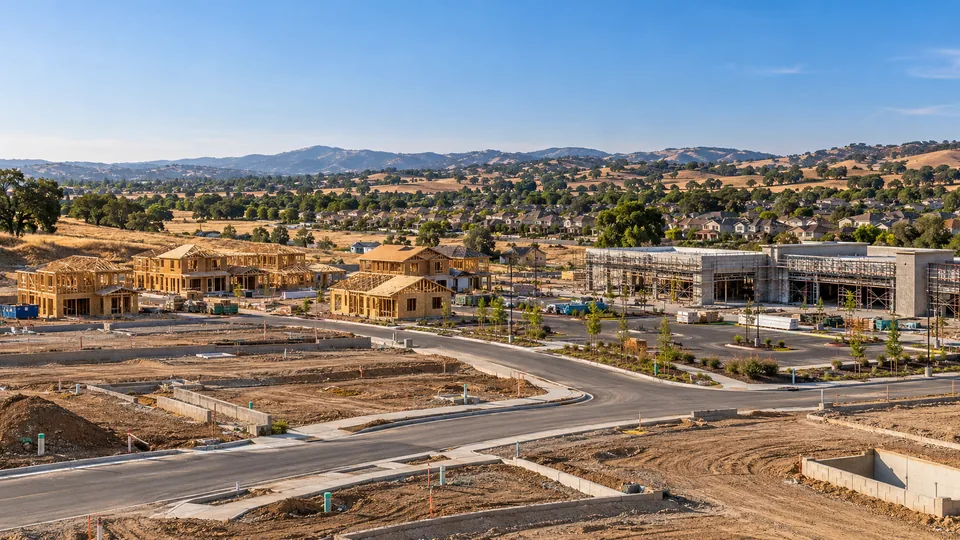
Those are former redevelopment project areas, and the page is a historical record, not a current development pipeline. They are useful for scale: a developer or general contractor working in Fontana is often building tilt-up distribution space or the streets, storm drain and utilities that serve it. That means large improvement estimates, two full-value improvement bonds under the City's agreement form and a long list of trucks, equipment and subcontractors in the public right-of-way.
Regional warehouse plans and how other cities compare are discussed on the Inland Empire construction insurance page.
Security Under Fontana's Subdivision Improvement Agreement
The City posts its Subdivision Improvement Agreement as a fillable form, with a footer showing a September 22, 2022, revision. It asks the subdivider for faithful performance security equal to 100 percent of the estimated cost of constructing the improvements. It then asks for labor and materials security "in the additional amount of 100%" of that estimate. Many California agencies set payment security at 50 percent, so a Fontana tract or parcel map can carry twice the payment bond a developer may have budgeted from another city.
The form also sets a completion period of 24 months. A surety underwriting the bonds looks at the full stack: performance, payment, warranty and monuments together, sometimes on several maps at once. Because sureties extend credit rather than insurance, every outstanding bond counts against the developer's program until it is released, and the surety expects the developer and any indemnitors to repay a loss.
This is the City's template. The Fontana Municipal Code subdivision chapter that sits behind it could not be read for this page, so confirm the current percentages with the City's Engineering Department before pricing bonds.
How these bonds work under the Subdivision Map Act is explained in California subdivision improvement bonds.
Warranty, Monuments and the Six-Month Payment Release
Warranty security under the Fontana form is 20 percent of the estimated cost of construction, held for one year following City Council acceptance. Monument security is 100 percent of the estimated cost of setting subdivision monuments, which must be set within one year after the final map is recorded. The form also calls for a landscape maintenance guarantee for one year after acceptance, though it names no percentage, so the amount should be confirmed with the City.
Release timing differs by bond. Performance security is released at acceptance, and partial release as work progresses is left to the City Council's "absolute discretion." Payment security is released 6 months after acceptance, less the total of all claims noticed against it. Separately, the subdivider's repair obligation under Section 17 runs up to one year after acceptance.
For cash flow, that means a developer may carry the payment bond for half a year after the streets are accepted and the warranty bond for a full year, while starting the next phase. Build those dates into the surety program so capacity for the next map is not tied up longer than planned.
Release and reduction patterns across California cities are summarized in the city subdivision improvement bond overview.
The Agreement's Insurance and Indemnity Clause
Section 14 of the agreement form sets insurance minimums in an older split-limit style: $250,000 per person for bodily injury, not less than $1,000,000 for bodily injury or death of more than one person in any occurrence, $250,000 property damage per occurrence and $500,000 property damage per policy period. The policy must cover the City, and it may not be canceled until the City has had at least 90 days' written notice.
Most current commercial general liability forms use a combined single limit, so a certificate typically shows limits well above these figures. The detail that tends to slow a closing is the notice term. Many policies give a certificate holder less than 90 days' notice by default, and meeting the City's wording can require a specific endorsement, subject to underwriting and the terms of the policy issued. The form also includes a broad indemnity running from the subdivider to the City, which should be read against the insured contract definition in the developer's liability policy.
Master developer exposures from entitlement through lot sales are covered under insurance and bonds for land developers.
Excavation and Traffic Control Permit Terms
Fontana's Department of Engineering requires an Excavation and Traffic Control Permit for all work in the public right-of-way. The application, revised in September 2019, requires a Fontana business license and a contractor's license in Class A or C only, with "no B license" accepted. It lists a minimum $1,000,000 general liability and a minimum $1,000,000 "Workers Compensation," requires the City to be named as additional insured and says the requirements apply to all contractors, including subcontractors, working within the City.
The workers' compensation line is the City's wording. California workers' compensation is statutory and is not written to a dollar limit, so the $1,000,000 figure most likely refers to employer's liability, the companion coverage on the same policy. Confirm with Engineering what the City expects to see on the certificate rather than assuming.
The application also requires the permittee to indemnify the City, states that damage to City facilities will be repaired by the City and charged to the contractor and bans lane closures during peak hours of 7:00 to 8:30 a.m. and 3:30 to 6:00 p.m. Fees listed include a $98 application fee, $100 for a utility traffic control plan and $400 for an engineered traffic control plan. The form names no bond or deposit amount; any separate encroachment security should be confirmed with the City.
How city and Caltrans right-of-way security compares is explained under California encroachment permit bonds.
Ordinance 1891 Rules for Warehouse Construction
Ordinance No. 1891, adopted by the City Council on April 12, 2022, revised the Industrial Commerce Centers Sustainability Standards in Article V of Chapter 9 of the Municipal Code, first created by Ordinance No. 1879. It states that it applies to all warehouse uses throughout the city, including warehouse uses in specific plans, and it supersedes specific plan rules. Whether it has been amended since April 2022 could not be confirmed from the current code text, so check with the City.
The operating standards include landscaped buffers of 10 feet for buildings over 50,000 square feet and 20 feet over 400,000 square feet, a 3-minute idling limit, zero-emission on-site operating equipment, solar-ready roofs, rooftop solar on buildings over 400,000 square feet before a business license issues and an electrical room sized 25 percent larger. The City's summary page says the buffer applies to any warehouse larger than 50,000 square feet built next to sensitive receptors.
During construction, the contractor must submit an equipment list confirming compliance with the highest CARB Tier before the permit issues. Hand tools, forklifts and pressure washers must be electric, the site needs an EV charging area for construction equipment and diesel generators are prohibited except in an emergency or to establish temporary power during construction.
Our view of the insurance effect, not a City statement: an equipment list that does not clear can delay permit issuance, newer or rented electric equipment changes the contractor's equipment schedule and charging stations and larger electrical rooms add values that a builders risk policy should include from the start.
Values, delay and electrical equipment on large distribution buildings are discussed under builders risk for industrial projects.
Putting a Fontana Program Together
Start with the agreement form and the engineer's estimate. Multiply it out for performance at 100 percent, labor and materials at an additional 100 percent, warranty at 20 percent and monuments at 100 percent of setting cost, then map each release date. Share that schedule with the surety early, because the payment bond is larger than many developers expect.
Next, line up the certificates. The developer's policy needs to answer the agreement's insurance clause and its 90-day notice term, and every contractor and subcontractor entering the right-of-way needs general liability, employer's liability and the City as additional insured. For warehouse work, add the Ordinance 1891 equipment list to the preconstruction schedule and make sure builders risk and contractor's equipment values reflect it. Requirements can vary by carrier guidelines and programs, so confirm the current requirement with the City before closing.
Bond and insurance planning for distribution buildings is described under industrial construction projects.
Before You Ask for a Quote
What to Gather
- The City's Subdivision Improvement Agreement form and the engineer's estimate for each map
- A schedule of performance, labor and materials, warranty and monument security with release dates
- The developer's liability policy with its cancellation notice wording
- Business and contractor's license classes for every firm entering the right-of-way
- Certificates showing general liability, employer's liability and the City as additional insured
- The Ordinance 1891 construction equipment list and any electric equipment rentals
- Builders risk values including rooftop solar, chargers and the enlarged electrical room
What to Ask the Insurer or Surety
- Can our surety program carry a labor and materials bond at an additional 100 percent of the estimate?
- How will the 6-month payment release and one-year warranty affect capacity for our next map?
- Can our policy give the City 90 days' notice of cancellation, and which endorsement does that take?
- Does the City read its $1,000,000 workers' compensation line as employer's liability?
- Is there a separate encroachment bond or deposit for this scope?
- Do our builders risk and equipment schedules reflect the Ordinance 1891 requirements?
Quick Answer
Fontana's improvement agreement form typically calls for 100 percent performance security, an additional 100 percent labor and materials security, a 20 percent one-year warranty and 100 percent monument security, with payment security released 6 months after acceptance. Right-of-way work needs the Excavation and Traffic Control Permit with $1,000,000 general liability and the City as additional insured.
Common Mistake
Budgeting the payment bond at 50 percent from another city's agreement, or sending a right-of-way certificate that leaves off employer's liability because the City's form calls it workers' compensation.
Broker Perspective
A broker reads the City's form section by section, adds up the full bond stack with release dates and checks that the cancellation notice, additional insured and subcontractor terms can be met before the agreement goes to Council.
Coverage Impact
Improvement bonds are surety credit that stays on the developer's program until release. Builders risk may not include solar, chargers or equipment added for Ordinance 1891 unless they are scheduled, subject to underwriting and the terms of the bonds and policies issued.
Other Inland Empire Cities
Questions Buyers Ask
Why is Fontana's labor and materials bond so large?
The City's Subdivision Improvement Agreement form asks for labor and materials security in an additional 100 percent of the estimated construction cost, on top of 100 percent performance security. Many agencies use 50 percent, so plan surety capacity for the larger figure and confirm the current amount with the City.
When does Fontana release improvement security?
Under the agreement form, performance security is released at City Council acceptance, payment security 6 months after acceptance less noticed claims, and warranty security after one year at 20 percent of the estimate. Partial performance release during construction is at the Council's absolute discretion.
What does "$1,000,000 Workers Compensation" mean on Fontana's right-of-way permit?
It is the City's wording on the Excavation and Traffic Control Permit application. California workers' compensation is statutory, so the dollar figure most likely refers to employer's liability. Ask the Engineering Department to confirm what the certificate should show.
Can a Class B general contractor pull a Fontana right-of-way permit?
The City's application lists a contractor's license in Class A or C only and says no B license. A general building contractor may need a Class A or C subcontractor to hold the permit, and that firm's certificate must name the City as additional insured.
Does Ordinance 1891 change anything before construction starts?
Yes. Before a permit issues, the construction contractor submits an equipment list confirming the highest CARB Tier. The ordinance also requires electric hand tools, forklifts and pressure washers, an EV charging area and limits diesel generators to emergencies or temporary construction power.
Official Sources
- City of Fontana Subdivision Improvement Agreement (form, revised 09/22/2022), City of Fontana. Faithful performance security at 100 percent; labor and materials security in an additional 100 percent; 20 percent warranty for one year after acceptance; monument security at 100 percent of setting cost; one-year landscape maintenance guarantee; performance release at acceptance and payment release 6 months after acceptance less claims; partial release at Council discretion; 24-month completion; Section 14 insurance minimums and 90 days' cancellation notice; indemnity; Section 17 repair obligation. Verified 2026-10-25.
- Excavation and Traffic Control Permit Application and Requirements (revised 9/12/19), City of Fontana Department of Engineering. Permit for all right-of-way work; Fontana business license; Class A or C license only; minimum $1,000,000 general liability and $1,000,000 workers' compensation as worded; City as additional insured; requirements apply to subcontractors; indemnity; damage repaired by the City and charged to the contractor; peak-hour lane-closure bans; $98, $100 and $400 fees. Verified 2026-10-25.
- Ordinance No. 1891, Industrial Commerce Centers Sustainability Standards, City of Fontana City Council. Adopted April 12, 2022, revising Article V created by Ordinance No. 1879; applies to all warehouse uses including specific plans; buffers, 3-minute idling limit, zero-emission operating equipment, solar-ready roofs and solar over 400,000 square feet, 25 percent larger electrical room; construction equipment list at the highest CARB Tier before permit, electric hand tools, forklifts and pressure washers, EV charging area and diesel generator limits. Verified 2026-10-25.
- Final Approved Industrial Commerce Centers Sustainability Standards, City of Fontana. City summary stating the buffer applies to any warehouse larger than 50,000 square feet constructed adjacent to sensitive receptors. Verified 2026-10-25.
- Project Areas, City of Fontana. Historical redevelopment project areas: Southwest Industrial Park about 3,427 acres primarily industrial and light manufacturing, Amendment No. 9 of June 23, 2010, adding about 1,101 acres; North Fontana about 8,900 acres including the 1,400-acre Village of Heritage. Verified 2026-10-25.
Reviewed by the Principal, Gleason Insurance Brokers, LLCUpdated

