
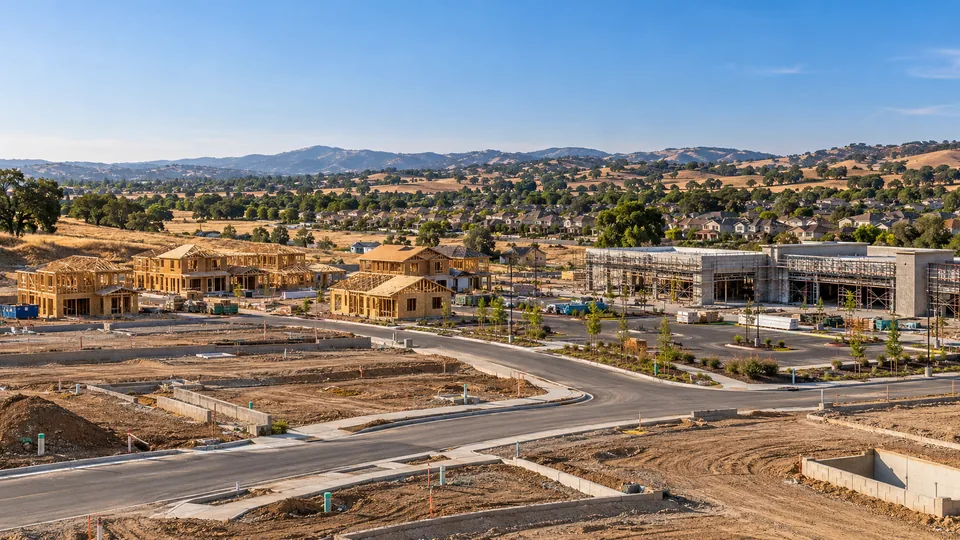
Unincorporated Riverside County and the Cities Inside It
The County's General Plan describes Riverside County as the fourth largest county in the state, covering approximately 7,400 square miles. Much of that land sits outside any city, and there the County's own ordinances decide what a developer must bond, deposit and pay. Inside an incorporated city, such as Menifee, the city's code and engineering department set those terms instead. The County's figures do not carry over to city projects.
The unincorporated pipeline is large on paper. The Land Use Element's buildout capacity summary for unincorporated Riverside County, dated Sept. 28, 2021, shows capacity for 1,909,054 people, 575,579 dwelling units and 573,820 jobs, with Western County holding 53 percent of the population capacity. That is theoretical buildout capacity, not a dated forecast, but it explains why master developers, industrial builders and civil contractors keep returning to County standards.
Before pricing bonds or insurance, confirm the parcel's jurisdiction. A site that looks like part of a nearby city may still be unincorporated, and the answer changes the security percentages, the permit desk and the indemnity wording in the permit.
Regional warehouse and specific plan exposures are covered on the Inland Empire construction insurance.
Ordinance No. 460 Improvement Security
Article XVII of Ordinance No. 460, the County's subdivision ordinance, requires an improvement agreement and security when improvements are not complete before the final or parcel map is approved. Accepted forms are a corporate surety bond, cash, an instrument of credit or an irrevocable letter of credit payable on demand of the Director of Transportation. Bonds are to be substantially in the form the Subdivision Map Act provides.
The posted ordinance sets three layers of security. Faithful performance is 100 percent of the total estimated cost of the improvement. Labor and materials is 50 percent, securing payment to the contractor, subcontractors and suppliers. A guarantee and warranty of the work for one year after completion and acceptance is 10 percent. Attorney's fees and costs are added on top of the face amounts.
The estimate itself has a local wrinkle. Bond estimates use the Transportation Department's annual unit costs, and when improvement plans are not approved and signed before the map is approved, the ordinance adds a 20 percent contingency to the security amount. A developer recording a map ahead of signed plans should expect a larger bond than the engineer's estimate alone suggests.
Who signs depends on the map. For Schedule A through E maps, the major subdivisions, agreements are executed for the County by the Chairman of the Board after the Director of Transportation checks them. For Schedule F through I maps, the Director of Transportation executes them on Board-approved forms.
The copy the County posts is labeled as amended through Ordinance No. 460.152, effective Aug. 14, 2014. Later amendments may have changed Article XVII, so confirm the current requirement with the Transportation Department before relying on these figures.
Statewide rules for sizing and releasing this security are explained in California subdivision improvement bonds.
Agreement Term, Partial Releases and Warranty Security
Under the posted ordinance, the original period of the agreement and security is 24 months. The Director of Transportation may extend it up to one year at a time and may require additional security with an extension, which matters to a surety that priced the original term.
Reductions follow progress. Once one third of the bonded work is complete, the developer may request a partial release, with a maximum of three partial releases before full release on completion and acceptance. Any partial release reflects only the percentage of construction work completed. The Director of Transportation is authorized to release or reduce the security.
Labor and materials security is released after the lien-recording period and acceptance, reduced to the total of recorded lien claims or released in full if there are none. Release of the performance security does not release the warranty security, which runs its own one-year period. Where another agency must approve the work, the County holds the security until that agency is satisfied, and that agency has two months to respond before approval is deemed given.
Surety liability under the posted ordinance extends to changes and alterations that do not exceed 10 percent of the original estimated cost. Larger redesigns can call for a bond rider or new security, so tell the surety early when the scope moves.
How warranty security differs from performance security is discussed under maintenance and warranty bonds.
Monuments, Small Items and Lien Agreements
Survey monuments must be set before recordation or secured. Section 9.10 of the posted ordinance lets the land divider execute a secured agreement or cash bond guaranteeing the setting of the monuments upon approval by the County Surveyor. There is no separate monument percentage, but the small-item rule applies: if the estimated cost of an item such as setting the monuments is less than $5,000, a cash bond is required rather than a surety bond.
A lien agreement can stand in for bonds only where the County finds it is not in the public interest to install improvements sooner than two years. It is not available once lots are sold, permits are issued or construction has begun, so most active projects should plan on surety bonds, cash or a letter of credit.
Map-stage obligations from entitlement through lot sales are covered under bonds and insurance for developers and subdividers.
Road Encroachments Under Ordinance No. 499
Work in County highways falls under Ordinance No. 499. Its security is discretionary, with no fixed amount: the Transportation Director may require a surety bond or deposit of money as necessary to secure performance, including restoration of pavement, ground surfaces and subsurfaces and any survey monuments or other improvements that may have been disturbed. For tree permits, the Director may require a bond, insurance or other security to protect person and property.
The Transportation Department's Riverside office application asks the applicant to comply with Ordinance No. 499, to give 48 hours' written notice before work starts and to indemnify, defend and save the County harmless. The staff-use block has a Security Deposit line with no amount printed. Neither the ordinance text nor the form states insurance limits or additional insured wording, so ask the Transportation Department for its current certificate requirements before bidding the work.
The posted copy of Ordinance No. 499 is labeled as amended through 499.13, effective in 2012. Board minutes from December 2023 reference a later amendment. Treat the posted text as possibly outdated and confirm the current version with the County.
How county, city and Caltrans permit security compares is explained in California encroachment permit bonds.
Flood Control District Permits and Deposits
The Riverside County Flood Control and Water Conservation District runs its own encroachment permit when work touches District facilities, such as a storm drain connection, a utility crossing or a channel. Its 2023 application packet lists a non-refundable $500 filing fee for most permits, an initial deposit of $2,000 for storm drain connections and utility crossings and an initial deposit of $3,000, including the filing fee, for major construction.
Add-ons can exceed the base deposit. The packet calls for an additional $10,000 deposit for each license agreement or easement, $5,000 if floodplain management review is required and an extra deposit if survey monuments are in the work area. If the balance drops under 25 percent of the original deposit, more is required. Unused funds are refunded within 60 days of acceptance.
Projects disturbing 1 acre or more must show Construction General Permit coverage, and the packet notes that initial comments typically take about 30 working days. The extracted packet states no insurance limits, so confirm any certificate the District requests at application.
Exposures for crews connecting to District facilities are covered under insurance and bonds for storm drain contractors.
Solar Project Security
Riverside County solar applications propose closure financial security as part of approval.
Those requirements are set out in Riverside County solar closure security.
MSHCP Mitigation Fees and Development Impact Fees
In western Riverside County, the Multiple Species Habitat Conservation Plan adds a per-acre or per-unit cost line. The Western Riverside County Regional Conservation Authority, the regional joint powers authority that administers the plan, publishes a fee schedule effective July 1, 2026, to June 30, 2027: $20,846 per acre for commercial and industrial development, $4,632 per unit for residential under 8 units per acre, $1,931 per unit at 8 to 14 units per acre and $854 per unit above 14. On a large warehouse pad the commercial rate is a significant early cost, and habitat conservation conditions can affect schedule and environmental exposure.
The County's Development Impact Fee ordinance, Ordinance No. 659, adds timing rules. Fees cannot be deferred beyond final inspection or issuance, and commercial and industrial fees are paid in their entirety for the project area rather than prorated. A developer who builds eligible facilities may receive a credit under a credit agreement approved by the Board of Supervisors. Whether that agreement calls for added performance security should be confirmed with the County. The posted copy is amended through 659.9 and its fee tables may be outdated, so this page does not quote DIF amounts.
Values and schedule exposure on large pads are discussed under builders risk for industrial projects.
Before You Ask for a Quote
What to Gather
- Confirmation that the parcel is in unincorporated Riverside County, not a city
- Conditions of approval and the map schedule (A through E or F through I)
- The Transportation Department's bond estimate and whether the 20 percent contingency applies
- Any Flood Control District encroachment permit application and deposit estimate
- The MSHCP fee calculation and any DIF credit agreement
- Encroachment permit applications for County highway work
What to Ask the Insurer or Surety
- Is the current Ordinance No. 460 security schedule the same as the posted 2014 copy?
- Will the surety write the performance, labor and materials and warranty bonds at the County's figures?
- What insurance certificate and additional insured wording does the Transportation Department require?
- Does the Flood Control District require a certificate of insurance for this permit?
- Does a DIF credit agreement require separate performance security?
- How will a 24-month agreement term and any extension affect our surety capacity?
Quick Answer
Unincorporated Riverside County's posted Ordinance No. 460 requires improvement security of 100 percent for performance, 50 percent for labor and materials and 10 percent for a one-year warranty, plus a 20 percent contingency when plans are unsigned. Flood Control District permits add separate deposits. Cities in the county set their own rules.
Common Mistake
Sizing the bond program from the engineer's estimate and then learning the County adds a 20 percent contingency because plans were not signed before the map, or applying County rules to a parcel that is inside a city.
Broker Perspective
A broker confirms jurisdiction first, then reads the conditions of approval for every bonded item, every District crossing and every permit indemnity, and checks the posted ordinance figures against what the County requires today.
Coverage Impact
Improvement and warranty bonds are credit that counts against surety capacity for as long as they are outstanding. Permit indemnities can reach beyond the policy's terms, so liability coverage for them is subject to underwriting and the terms of the policies issued.
Other Inland Empire Cities
Questions Buyers Ask
What improvement security does unincorporated Riverside County require for a tract or parcel map?
The posted Ordinance No. 460 requires security of 100 percent of the estimated cost for faithful performance, 50 percent for labor and materials and 10 percent for a one-year warranty, with attorney's fees and costs added. The posted copy is amended through 2014, so confirm the current figures with the Transportation Department.
Why is our Riverside County bond larger than the engineer's estimate?
Estimates use the Transportation Department's annual unit costs, and the ordinance adds a 20 percent contingency to the security amount when improvement plans are not approved and signed before the map is approved. Getting plans signed first can reduce the amount the surety must underwrite.
Can we reduce Riverside County improvement bonds as work progresses?
Generally yes. Once one third of the bonded work is complete, a partial release may be requested, up to three partial releases, and each reflects only the percentage of work completed. Labor and materials security is released after the lien period, and the warranty security runs its own year.
Does a storm drain connection in unincorporated Riverside County need a separate permit?
Work that touches Flood Control District facilities typically needs the District's own encroachment permit. Its 2023 packet lists a $500 filing fee, a $2,000 initial deposit for storm drain connections and utility crossings and $3,000 for major construction, with added deposits for easements and floodplain management review.
Do Riverside County's rules apply inside Menifee or other cities in the county?
No. These ordinances govern unincorporated areas. Incorporated cities adopt their own improvement security and permit rules, and Menifee's are covered on its own page. Confirm the parcel's jurisdiction before sizing bonds or answering a permit's insurance questions.
Official Sources
- County of Riverside Ordinance No. 460 (Subdivision Ordinance), as amended through 460.152, effective Aug. 14, 2014, County of Riverside, Clerk of the Board. Article XVII: improvement agreement and security forms; 100 percent performance, 50 percent labor and materials and 10 percent one-year warranty plus fees and costs; execution by Schedule; 24-month term and extensions; partial releases after one third, maximum three; labor and materials release; other-agency approval; 10 percent change limit; cash bond under $5,000; lien agreement limits. Section 9.10 monument security; Section 10.3.E-F 20 percent contingency and partial releases by percentage complete. Verified 2026-10-25.
- County of Riverside Ordinance No. 499 (Encroachments in County Highways), as amended through 499.13, County of Riverside, Clerk of the Board. Section 2.1: the Transportation Director may require a surety bond or deposit to secure performance, including restoration of pavement, surfaces and survey monuments; bond, insurance or other security for tree permits. Verified 2026-10-25.
- Encroachment Permit Application, Riverside office, County of Riverside Transportation Department. Indemnify, defend and save the County harmless; compliance with Ordinance No. 499; 48 hours' written notice before work; Security Deposit line in the staff-use block with no amount printed. Verified 2026-10-25.
- Application for Encroachment Permit (2023), Riverside County Flood Control and Water Conservation District. $500 filing fee; $2,000 initial deposit for storm drain connections and utility crossings; $3,000 initial deposit for major construction; $10,000 per license agreement or easement; $5,000 for floodplain management review; added monument deposit; top-up below 25 percent; refund within 60 days; Construction General Permit coverage for 1 acre or more; about 30 working days for initial comments. Verified 2026-10-25.
- County of Riverside General Plan, Chapter 3 Land Use Element (Sept. 28, 2021), Table LU-2, County of Riverside TLMA Planning. Unincorporated buildout capacity of 1,909,054 population, 575,579 dwelling units and 573,820 jobs, with Western County at 53 percent of population capacity; Riverside County is the fourth largest county in the state at approximately 7,400 square miles. Verified 2026-10-25.
- Western Riverside County MSHCP Local Development Mitigation Fee Schedule, FY2027, Western Riverside County Regional Conservation Authority. Effective July 1, 2026, to June 30, 2027: $20,846 per acre commercial and industrial; $4,632 per unit residential under 8 units per acre; $1,931 per unit at 8 to 14; $854 per unit above 14. Verified 2026-10-25.
- County of Riverside Ordinance No. 659 (Development Impact Fee), as amended through 659.9, County of Riverside, Clerk of the Board. No deferment of fees beyond final inspection or issuance; commercial and industrial fees paid in their entirety and not prorated; credits require a credit agreement approved by the Board of Supervisors. Verified 2026-10-25.
Reviewed by the Principal, Gleason Insurance Brokers, LLCUpdated

